AI Agents in the Enterprise: What Agentic AI Can Really Do in 2026 – and Where Humans Still Belong
AI agents and agentic AI in 2026: how autonomous systems work in support, sales and document processing, how they differ from chatbots and where oversight is needed.
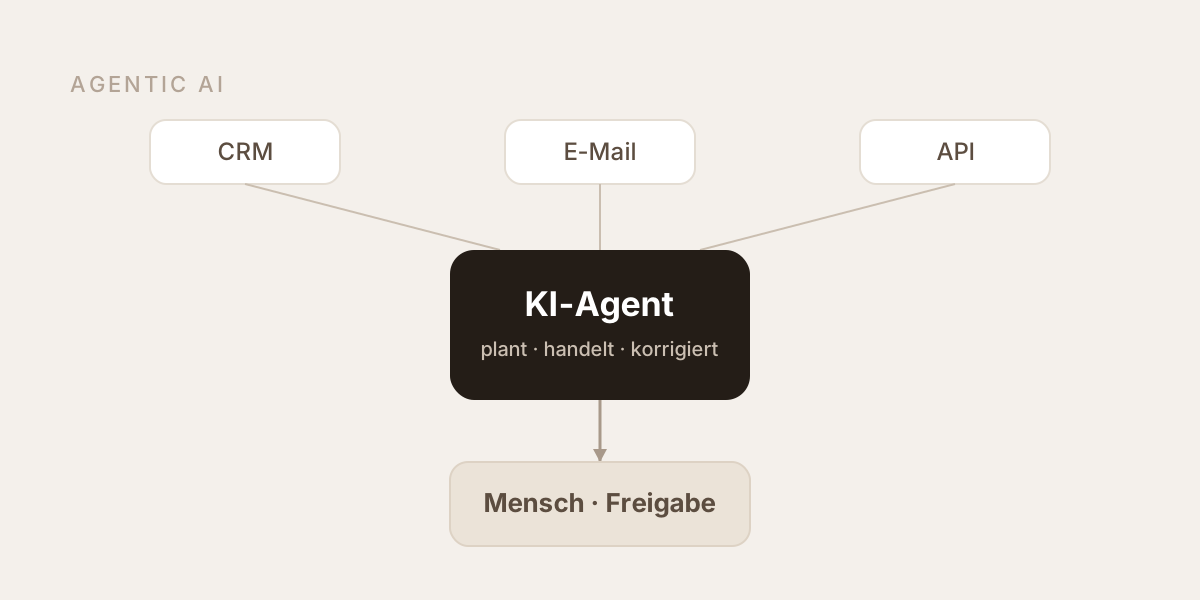
An AI agent is a software system that pursues a goal on its own: it plans steps, uses tools such as CRM or email and corrects itself – instead of merely reacting to individual prompts. Agentic AI describes precisely this capacity to act. 2026 is regarded as a breakthrough year, above all in support, sales and document processing.
The important part is often in the fine print: agents are strong where tasks are clearly defined – and risky where decisions become ambiguous or consequential. The value comes from the right division of labour with humans.
What is an AI agent? What is agentic AI?
A classic language model reacts to an input and returns an answer. An agent receives a goal and a toolkit. It breaks the goal down into steps, calls tools (query a database, send an email, book an appointment), evaluates the result and decides on the next step. Agentic AI is the combination of planning, tool use and self-correction.
How does an AI agent differ from a chatbot?
| Characteristic | Chatbot | AI Agent |
|---|---|---|
| Trigger | a single question | an overarching goal |
| Approach | a single answer | a multi-step plan |
| Tools | none or fixed answers | CRM, email, APIs, databases |
| Error behaviour | repeats itself | detects and corrects |
| Human | continues answering directly | takes on exceptions & approvals |
Which use cases exist in 2026?
- Customer support: sort, prioritise and independently resolve up to 80% of standard cases; hand off complex cases cleanly to a human.
- Sales: research, enrich and score leads by fit and prepare appointments – the foundation for automated lead generation.
- Documents: review contracts and invoices, extract relevant fields and trigger follow-up processes.
How do humans stay in the loop?
Good agents are built so that the normal case runs through and only exceptions are escalated. A simple pattern makes this visible:
// The agent acts autonomously – until a threshold brings a human in.
async function handleRequest(task: Task) {
  const plan = await agent.plan(task);
  const result = await agent.execute(plan);

  if (result.confidence < 0.8 || result.isHighStakes) {
    return escalateToHuman(result); // exceptions stay human
  }
  return result; // standard case runs automatically
}
What you should clarify before deployment
Before an agent goes into production, three things need to be settled: which data may it see (GDPR, hosting)? Which actions may it perform without approval? And how is its work logged? For sensitive applications, the EU AI Act applies from August 2026 with concrete obligations on oversight and documentation.
Are you considering where an AI agent would make sense in your business? Talk to us.
Frequently asked questions
- What is the difference between an AI agent and a chatbot?
- A chatbot answers individual requests. An AI agent pursues a goal: it plans several steps, uses tools such as CRM or email, checks intermediate results and corrects itself until the task is complete.
- What can agentic AI really do in 2026?
- Within clearly defined areas, agentic AI reliably handles standard tasks today – such as up to 80% of recurring support tickets, researching and scoring leads, or reviewing documents. For ambiguous or high-stakes decisions it remains unreliable and needs oversight.
- Are AI agents GDPR-compliant?
- It depends on how they are built. GDPR compliance comes from data minimisation, clear purposes, hosting choices and logging – not from the tool alone. For many DACH use cases, infrastructure with EU hosting and documented data flows is advisable.
- Do AI agents still need human oversight?
- Yes. Agents should handle the volume, while thresholds, exceptions and critical decisions go to a human. For sensitive applications, this oversight is also mandated by the EU AI Act from August 2026 onwards.
About the author
Tenzin Langdun
AI Expert & Marketing Lead at Hierarchy
Tenzin is an AI expert and marketing lead with an MSc in Artificial Intelligence from the University of Bath and over 10 years of marketing experience across strategy, paid acquisition, and SEO. He has held roles at leading organisations including KPMG, EY, Siemens, and Adnovum — with expertise in AI, cybersecurity, audit and consulting, and the insurance sector. Together with Martin Oswald, he co-authored an award-winning research paper on AI-based cancer detection, published in Nature and recognised with the National Siemens Excellence Award and the Lab Sciences Award.