AI Visibility for SaaS: Buy a Monitoring Tool or Hire an Agency?
Monitoring tool, agency or both? A decision guide for SaaS companies: what tools do, what an agency adds and when each path pays off.
An AI visibility monitoring tool measures; an agency changes things. For a SaaS company the right choice depends less on budget than on one simple question: does someone on the team have the time and experience to turn the measurements into concrete work every week? If yes, a tool is often enough. If not, the tool becomes a dashboard nobody looks at after three months.
The background is the same at many SaaS companies: prospects ask ChatGPT, Perplexity or Gemini for "the best software for X", get a short list of products and only then visit a website. If you are missing from that list, you often never make it into the evaluation. So marketing wants to know where it stands, and there are two obvious paths: subscribe to a monitoring tool or hire an agency.
This article shows what each path delivers, where the middle ground lies and which questions should be settled before deciding.
What a monitoring tool does
AI visibility monitoring tools regularly put a fixed list of questions, a so-called prompt set, to AI assistants and analyse the answers. Depending on the vendor, they cover ChatGPT, Perplexity, Gemini, Claude, Microsoft Copilot, Google AI Overviews and Google's AI Mode. Typical metrics are:
- Mentions: in how many answers does your brand appear?
- Position: is it named first or at the end of the list?
- Competitors: who is named instead of you or next to you?
- Sources: which pages do the assistants cite when they talk about your category?
- Sentiment: is your brand described positively, neutrally or with reservations?
Well-known vendors include Peec AI, Otterly.AI and Profound. The tools now go beyond pure measurement. On their websites, Peec AI lists strategy recommendations and analysis of key sources, Otterly.AI content audits, content briefs and GEO recommendations, and Profound, among other things, prompt volume data, analysis of how AI agents use a website and an AI assistant that drafts content and sends it for approval (as of October 2026).
What a tool does not take off your hands is the work itself. Recommendations like "more presence on source X" or "revise page Y" have to be checked, prioritised and implemented. That is exactly where many teams stall: the numbers arrive on time every month, but nobody has the time or the mandate to turn them into work. After a few months nobody opens the dashboard any more. How to set up measurement that actually leads to decisions is covered in Measuring AI visibility.
What an agency adds
An agency specialised in AI visibility provides three things a tool cannot:
- Interpretation: which of the cited sources really matter in your category? Which mention comes from the model's memory and which from a live web search? That decides whether the work should go into your own website, third-party sources or both.
- Priorities: picking the three measures that come first out of twenty possible ones, and explaining why.
- Implementation or enablement: rewriting pages, building comparison pages, adding structured data, maintaining profiles. Either the agency does it, or it gets your team to the point where the team does it.
The trade-off: an agency costs more than a tool subscription, and with pure "done for you" the know-how stays with the agency. When the engagement ends, the work often ends too.
Three paths compared
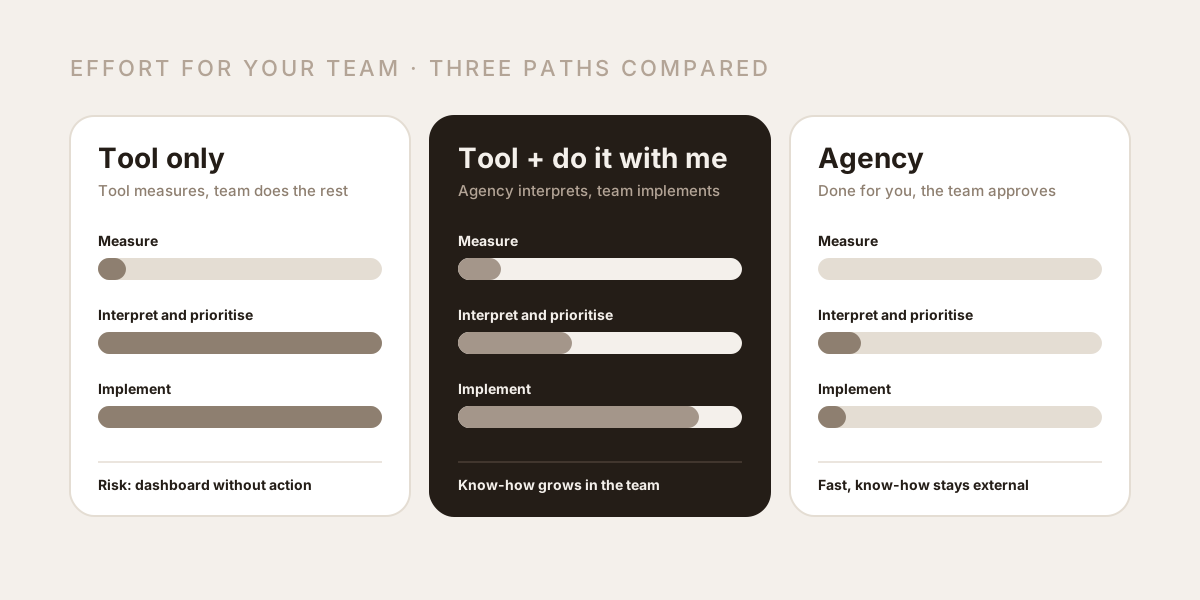
| Monitoring tool only | Tool + do it with me | Agency (done for you) | |
|---|---|---|---|
| Who measures? | tool | tool | agency (with a tool) |
| Who interprets and prioritises? | your team | agency with your team | agency |
| Who implements? | your team | your team, agency reviews | agency |
| Effort for your team | high | medium | low |
| In-house know-how | grows slowly, by trial and error | grows fast, through reviews | stays low |
| Typical risk | dashboard without action | team lacks time to implement | dependence on the agency |
Which path fits which team?
| Situation | Recommendation |
|---|---|
| One person with SEO or content experience has at least half a day per week | monitoring tool, possibly plus a workshop |
| Marketing team of two to five that already publishes its own content but is new to the topic | tool + do it with me: strategy and reviews from the agency, implementation by the team |
| A tool has been running for months, but the numbers trigger no action | do it with me or sparring, so the numbers turn into priorities |
| No marketing team or no spare capacity, competitive category | agency with implementation (done for you) |
| Unclear where the company stands at all | a one-off assessment first, then decide |
The table shows a pattern: the bottleneck is almost never measurement but the time and experience to turn measurement into work. Buying a tool without settling that question mostly buys you a dashboard.
What is different for SaaS
The basics apply to every industry. How AI assistants choose sources is covered in How do I get recommended by ChatGPT?. Software adds a few specifics:
- Comparisons and alternatives: many software questions to AI assistants read "X or Y?" or "alternatives to X". Your own comparison and alternatives pages, factual and with clear criteria, are therefore often the most effective pages of all.
- Review platforms: platforms such as G2, Capterra or OMR Reviews are to software what industry directories are to local businesses. A complete, current profile with categories and reviews is groundwork.
- Documentation and help centre: assistants like to answer "can tool X do Y?" from documentation. Publicly accessible, well-structured docs with clear headings help directly.
- Integration pages: "software for X that integrates with Y" is a typical question. A dedicated page per important integration makes that answer possible.
- English: software is compared internationally, and many review platforms and trade media are in English. Without English content, a product gives an assistant little to work with in English answers.
- Use case over brand: people rarely ask for your name; they ask about a problem. The prompt set should therefore mainly contain problem and category questions, not brand questions.
These points are why implementation is more work than measurement for SaaS: comparison pages, integration pages and docs do not come out of a dashboard.
Questions before you decide
For a monitoring tool vendor:
- Which assistants, languages and countries are measured, and how often?
- Can we define the prompt set ourselves, and how many prompts are included?
- Do we see the cited sources per answer, not just a summary?
- Can the data be exported or pulled into our reporting via an API?
For an agency:
- Who implements: you, us or both? Task by task?
- How do you justify priorities, and what data do you base them on?
- Do the prompt set, reporting and templates belong to us?
- How will we know after three months whether the work is paying off?
And for your own team: who is responsible, how much time per week is realistic, and who is allowed to change pages? Without those answers, neither a tool nor an agency will help.
How Hierarchy works
Hierarchy is a full-funnel marketing and AI agency in Zurich specialising in SEO, GEO and paid ads. We work in three ways: implementation by our team (done for you), done with you, the do-it-with-me model, where your team implements and we provide strategy, prompt set, reporting and reviews, and workshops for teams that want to get started.
The foundation is our own study of how AI assistants recommend companies: 1,515 collected AI answers, 14,135 traced mentions, 5,110 measured companies across 12 industries in the Zurich area. The AI visibility study shows whether mentions come from the company's own website, from third-party pages or from the models' memory. How the do-it-with-me model works in detail and which other providers work this way is covered in Running AI visibility in-house. Services and packages are on the SEO & AI visibility page.
Conclusion
A monitoring tool is a good investment if someone on the team has the time and experience to turn the numbers into work. If not, an agency makes more sense, either with implementation or as do it with me, where your team builds the know-how. For many SaaS teams the combination is the best path: the tool measures, the agency interprets and reviews, the team implements.
Where your company stands today is shown by the free AI visibility check: it checks whether ChatGPT, Gemini and Claude name your product and which competitors show up instead.
Frequently asked questions
- Is a monitoring tool enough for AI visibility?
- For measurement, yes. A monitoring tool shows how often ChatGPT, Gemini, Perplexity or Google AI Overviews mention your brand, in which position, next to which competitors and with which sources. Many tools now also give recommendations. You still have to do the work yourself: rewriting pages, building comparison pages, maintaining profiles on review platforms, improving documentation. A tool is enough if your team has the time and the experience for that. If either is missing, you end up with a dashboard.
- What does an agency do for AI visibility that a tool cannot?
- An agency turns measurements into priorities and either implements them or enables your team to. In practice it judges which sources really matter in your category, decides which page gets revised first, writes or reviews content, handles structured data and third-party sources, and interprets the results every month. The tool provides the numbers; the agency provides the decisions and the work behind them.
- When should a SaaS company hire an agency instead of buying a tool?
- When nobody on the team has regular time for the topic, when the measurements have not triggered any action for months, or when the category is competitive and comparison pages, review platforms and trade media all need work at once. A tool on its own pays off when one person with SEO or content experience can give it at least half a day per week.
- Can you combine a monitoring tool and an agency?
- Yes, and for many SaaS teams that is the most sensible path. The tool measures continuously, the agency provides strategy, priorities and reviews, and your own team implements. This model is called "do it with me". What matters is that the prompt set, reporting and templates belong to your team, so the work carries on without the agency.
- What is different about AI visibility for SaaS compared with local businesses?
- AI assistants often answer software questions with comparisons and alternatives. That is why comparison and alternatives pages, profiles on software review platforms, readable documentation, integration pages and English-language content matter more than, say, industry directories or a Google Business Profile. People also tend to ask about a use case ("tool for X that integrates with Y") rather than a brand name.
- Which questions should you ask a monitoring tool vendor or an agency?
- For the tool: which assistants and countries are measured, how often, with which prompts, and can the data be exported? For the agency: who implements, how are priorities justified, do the prompt set and reporting belong to us, and how will we know after three months whether it works?

About the author
Tenzin Langdun
AI Expert & Marketing Lead at Hierarchy
Tenzin is an AI expert and marketing lead with an MSc in Artificial Intelligence from the University of Bath and over 10 years of marketing experience across strategy, paid acquisition, and SEO. He has held roles at leading organisations including KPMG, EY, Siemens, and Adnovum — with expertise in AI, cybersecurity, audit and consulting, and the insurance sector. Together with Martin Oswald, he co-authored an award-winning research paper on AI-based cancer detection, published in Nature and recognised with the National Siemens Excellence Award and the Lab Sciences Award.