How Do I Get Recommended by ChatGPT? Turning a Lucky Referral Into a Repeatable Channel
The criteria ChatGPT uses to recommend companies, how to test whether a referral was luck, the levers that raise the probability, and how to evaluate a provider. With data from 1,515 AI answers.
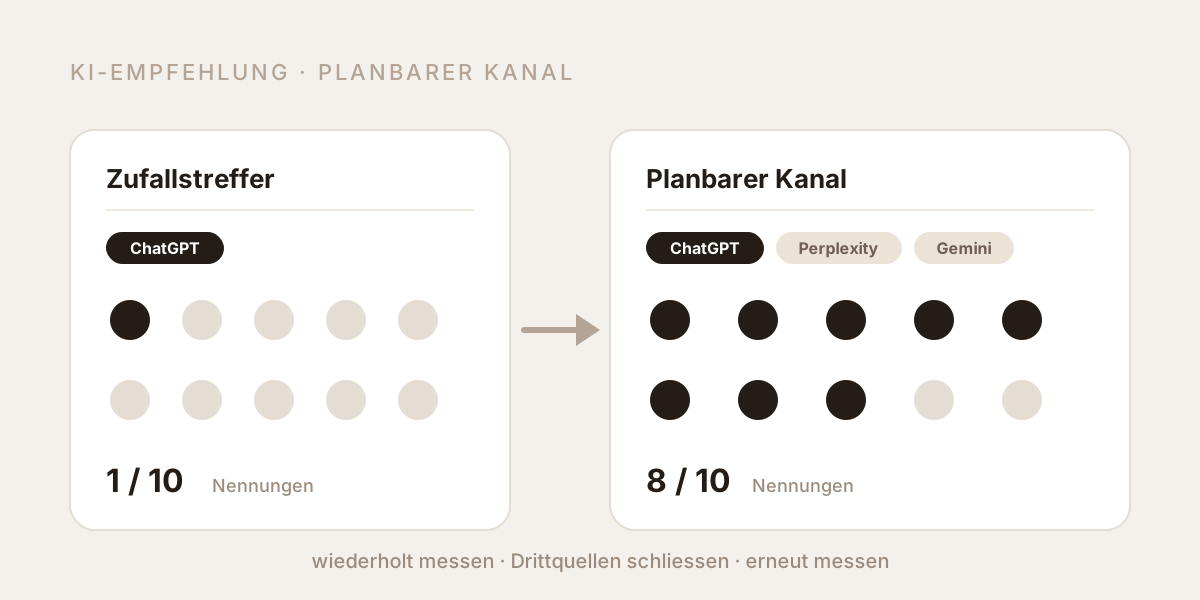
Whether ChatGPT recommends your company is decided in three places: on the pages the assistant reads while answering, on your own website, and in the model's memory. In our AI visibility study of 1,515 AI answers and 14,135 traced mentions of Zurich companies, 40 percent of mentions came from memory, 39 percent from the company's own website and 18 percent from third-party pages. The channel becomes plannable not through a single measure but through a control loop: measure a fixed prompt set, close the gaps, measure again. What you steer is the probability of a mention, not any individual answer.
The trigger for this article was a real enquiry: a company had won its best new customer of the month through a ChatGPT recommendation. That was luck. The question is how to turn it into a plannable channel. Since the first version we have measured the answer across 5,110 Zurich companies and tested it on ourselves. Both are below.
How do I get recommended by ChatGPT?
The short answer before the detail. Faced with a provider question ("Which accounting firms in Zurich can you recommend?"), ChatGPT with web search works in three steps: it searches for lists, directories and comparisons, opens the websites of the companies it finds there, and writes a shortlist with reasons from what it read. Without web search it answers from memory, meaning whatever the web said about you at training time.
Three things follow that you can influence:
- Be on the pages the assistant reads. This is the strongest single lever: a company that appears on a page the assistant demonstrably opened is 8.2 times as likely to be named as one that does not. Whether it is the stronger company on that page only adds a factor of 1.3.
- A website a recommendation can be copied from. The assistant lifts your wording, often verbatim. If the opening paragraphs say what you do, for whom and from what price, it has something to quote. Pages with an FAQ section are cited 1.6 times as often as pages without.
- Sit above the thresholds. Reviews and referring domains raise the chance of a mention steeply at first, then barely: across all twelve industries the share of named companies rises from 67 percent at 1 to 9 reviews to 91 percent at 30 to 99, and little happens after that. For links the threshold sits at around 99 referring domains.
Everything else in this article is the derivation of these three points, the test of whether your previous recommendation was luck, and the control loop that turns it into a channel.
Citation, mention, recommendation: what is the difference?
These three terms get mixed up regularly, even though they mean different things and require different work:
| Event | What happens | What it gets you |
|---|---|---|
| Citation | Your website is linked as a source | The AI uses your content, but may recommend a different provider |
| Mention | Your brand name appears in the answer | Visibility, but not necessarily a buying recommendation |
| Recommendation | You are on the shortlist the assistant names | The channel your new customer came from |
The case here is the third row: someone asked an assistant about providers, your name was in the answer, and that became a customer. Anyone who wants to repeat that effect has to understand that a recommendation is a different goal than a citation, and that you can be recommended without ever being cited: two in five mentions in our study had no source at all.
Was that one recommendation luck?
Most likely yes, at least in part. AI answers are non-deterministic: Profound analysed more than 240 million ChatGPT citations and found that 40 to 60 percent of cited domains change from month to month for identical queries. SE Ranking ran 10,000 queries through Google's AI Mode three times: only 9.2 percent of cited URLs were identical across all three runs. In our own study we therefore asked every question repeatedly and only counted what held up across the repetitions.
Before you build a strategy on it, run a simple test. Half an hour of work. If you would rather skip it: our AI visibility check runs exactly this test for free across ChatGPT, Google AI Overviews, Perplexity and Gemini.
- Reconstruct the prompt. Ask the new customer how they searched, or derive the wording from Search Console. Its report on generative AI features now shows long, conversational queries too. Use their phrasing, not a cleaned-up version of it.
- Query it ten times, each in a fresh chat. No history, no personalisation, and no brand name in the prompt.
- Test across several systems. ChatGPT, Perplexity, Gemini and Google AI Mode cite different sources. According to AirOps, 68 percent of brands appeared in only one AI platform. We see the same on ourselves: for the same 14 questions, ChatGPT with web search named us eleven times, Gemini six times, Claude twice.
- Count. Eight mentions out of ten means you hold a real position worth expanding. One or two means it was noise, and you are starting from zero.
Both outcomes are useful. The only difference is the time horizon: an existing position can be expanded in weeks, a new one takes months.
What criteria does ChatGPT use to decide which companies it recommends?
The common answer is: third-party sources. The AirOps analysis of 21,311 brand mentions across 500 commercial-intent queries in six verticals (tested on GPT-5, Claude Sonnet 4.5 and Perplexity Sonar; data collected October 2025) finds 85 percent of mentions in third-party sources and only 13.2 percent on the brand's own domain, and nearly 90 percent of those third-party sources are listicles, comparisons and reviews.
For local service businesses in Switzerland that is only half true. For the AI visibility study we traced every one of the 14,135 mentions of 5,110 Zurich companies across twelve industries: where did the assistant get the name?
| Source of the mention | Share across all twelve industries | Range between industries |
|---|---|---|
| Model memory (no page opened) | 40% | 11% (physiotherapy) to 57% (wealth management) |
| The company's own website | 39% | up to 69% (physiotherapy) |
| Third-party page (directory, list, media) | 18% | 9% (physiotherapy) to 32% (moving companies) |
Three findings from that, in order of effect:
Being on the page beats being the better company. Among companies on a page the assistant demonstrably read, the stronger half was picked 42 percent of the time, the weaker half 32 percent, a factor of 1.3. Being on that page at all is worth 8.2 times as much. And where you sit on the page counts too: companies in the top third of a list page are named 31 percent of the time, companies in the bottom third 21 percent. This matches AirOps, except that for Zurich service businesses the lists are more likely local.ch, association directories and booking platforms than trade media.
The company's own website carries more than the third-party rule suggests. Among companies with a traceable source, two thirds of mentions come from their own website. The assistant opens it while answering and copies its reasoning from it: specialisation, location, formats, prices. Cited pages look different from ignored ones: own pages with an FAQ section are cited about 1.6 times as often, pages that name Zurich explicitly about 1.35 times. What that looks like in practice is in the industry breakdowns for dental practices, physiotherapy, accounting firms and architecture firms.
Reviews and links work up to a threshold. Both raise the chance of being named steeply at first and then flatten: from 67 percent of companies named at 1 to 9 reviews to 83 percent at 10 to 29 and 91 percent at 30 to 99. Beyond around 30 reviews and around 99 referring domains, more of the same changes almost nothing. The star rating itself barely separates named from unnamed companies.
What does not show up is equally instructive. A study by OppAlerts covering 145 industries and more than 105,000 ChatGPT prompts, analysed by The Digital Bloom, finds only a weak correlation between backlinks and AI recommendations (Spearman rho +0.204, R² 4.2 percent). All 13 signals examined together explain well under 20 percent of the variance. Translated: classic SEO metrics do not buy you a recommendation, and anyone guaranteeing you a placement is selling something the evidence does not support. About three quarters of the companies the assistants recommended in our study are not in Google's top 10, even for the exact searches the assistants themselves ran.
What can be influenced comes down to six levers, ordered by effect on recommendation probability:
| Lever | Why it works | Where to start |
|---|---|---|
| Being on the pages the assistant reads | 8.2 times as likely to be named; top third of the list 1.5 times as often as bottom third | Read out the cited domains in your industry: directories, associations, booking platforms, "best providers" articles. Get listed, get moved up |
| A website that delivers a recommendation | 39% of all mentions; pages with an FAQ cited 1.6 times as often | Homepage with services, audience, location and price in the opening paragraphs; one page per service and location; FAQ with real customer questions |
| Reviews up to the threshold | 67% named at 1 to 9 reviews, 91% at 30 to 99 | A continuous flow of reviews up to around 30, responses to criticism; beyond that, invest in the website instead |
| Consistent entity data | The model has to identify you unambiguously, including from memory | Company name, address, founders and services identical everywhere; Organization schema, sameAs |
| Quotable content of your own | Demonstrates your competence to the model and feeds its memory for the mentions without a source | Clear answer sentences, figures, sources, named authorship |
| Technical access | Without crawl access you exist for the model only from memory | robots.txt for GPTBot, ClaudeBot, PerplexityBot, Google-Extended; no bot blocking at the firewall |
The last two levers are hygiene: they win you nothing, but their absence costs you everything. The firewall trap in particular is common, because bot protection at the CDN layer often blocks AI crawlers by default without anyone noticing. How the content side works is covered in From SEO to GEO.
How does this become a plannable channel?
Through a four-step control loop run every quarter. The channel is created by the repetition, not by any single measure.
- Build the prompt set (week 1). 50 to 150 realistic questions along genuine decision situations, structured by funnel stage: unbranded ("Who helps SMEs in Zurich with X?"), category ("Compare the best providers for X"), branded ("Is [your brand] reputable?"). The set stays stable across quarters, otherwise no comparable trends emerge.
- Measure the baseline (week 2). Query each prompt repeatedly across all relevant systems and record per answer: mentioned yes/no, at which position, in what tone, and which sources the AI drew on. That last point is the most valuable: the cited domains are your action list.
- Close the gaps (weeks 3 to 10). Work where the AI sources its answers: get into the cited directories and comparison articles and move up within them, build review profiles up to the threshold, unify entity data, and write the homepage and service pages so that the recommendation can be copied from them.
- Measure again and report (weeks 11 to 12). Same set, same method. Report the change in mention rate and share of voice against the baseline. How such reporting is structured in detail is covered in Measuring AI visibility.
A realistic expectation: movement in the mention rate is measurable within one quarter, a stable channel takes two to three. That is no worse than other channels; it is the same horizon as SEO, with the difference that competition here is still thin. According to McKinsey, only 16 percent of companies measure their AI search performance systematically (as of September 2026).
What this control loop looks like in practice is covered in our solar provider case study: a measurement set of 100 real customer questions, steered weekly from SERP, Search Console, ranking and AI mention data. After six months the brand was named in 63 out of 100 AI answers instead of 19, while the 30 focus keywords climbed from position 10 to 12 to position 2 to 4.
The traffic quality justifies the effort: visitors from AI search convert at 4.4 times the rate of classic organic visitors, according to Semrush. And the market is there: in Switzerland, 60 percent of the population already uses AI tools according to the IGEM Digimonitor 2025, rising to 79 percent among 15- to 34-year-olds.
How do you evaluate a suitable provider?
We deliberately do not name a list of providers in this article; if you want names and prices for Zurich, see our comparison of SEO, GEO and AEO agencies in Zurich. The market is young, the labels GEO, LLMO, AI SEO and AI visibility are used inconsistently, and any list would be outdated in six months. Criteria you can test yourself in a first conversation are more useful:
- An in-house measurement setup, not a resold tool. Ask how the prompt set is built and how the volatility of AI answers is handled. Anyone merely reselling a SaaS dashboard delivers data, not actions.
- Work on both the website and third-party sources, not just one of them. An offer that consists solely of on-page optimisation leaves the 8.2× lever of list pages on the table. One that only promises listings and mentions ignores the 39 percent of mentions that come from the company's own website. Ask specifically about both.
- Probability promises, not placement promises. "We'll get you to position 1 in ChatGPT" is not a credible promise for non-deterministic systems. Sound providers talk in mention rates and share of voice.
- Measurement across several systems. Looking only at ChatGPT misses the larger part of the market: 68 percent of brands appear in a single platform only.
- A connection to traffic and lead data. Visibility without a link to GA4 and CRM stays a vanity metric. Good reporting shows whether mentions turn into enquiries.
- Demonstrable AI visibility of their own. Ask an assistant the provider question for the provider's own category. Anyone raising other companies' recommendation probability should be findable in their own, and should be able to show you the measurement.
On the sixth point, here is our own measurement. This website has been live since June 2026. On 8 September 2026 we put 14 questions about AI workshops and training in Zurich once each to ChatGPT, Gemini and Claude, all three with web search and a user location in Zurich. ChatGPT named Hierarchy in 11 of 14 answers, Gemini in 6, Claude in 2. All three described us in the wording of our workshop page: role-specific programmes, work on the team's own tasks, a prompt library, a review after 30 days. Google Analytics tells the same story: from June to September 2026, 28 of 32 sessions from AI assistants came via chatgpt.com. That is the proof, with date, questions and systems, you should demand from any provider.
The same logic in broader form, for choosing an agency beyond AI visibility, is covered in Choosing an SEO agency in Switzerland: 7 criteria. What we offer ourselves is under SEO & AI visibility.
What you can do yourself in the next 30 days
Even without external support, the starting position can be improved considerably:
- Run the luck test described above, or request the AI visibility check, and write down the result. That is your baseline.
- Check crawl access: does your robots.txt allow GPTBot, ClaudeBot, PerplexityBot and Google-Extended? Does your CDN or firewall block AI bots?
- Read out the AI's sources: note which websites are cited in every test run. That list is your most important working document. For each source, check whether you are listed and where in the list you sit.
- Rewrite the homepage: the first 100 words say what you do, for whom, where, and from what price. Add an FAQ section with the five questions customers ask on the phone.
- Unify entity data: write company name, address, services and founders identically on your website, LinkedIn, Google Business Profile and in directories; add Organization schema with
sameAs. - Bring your review profile towards 30 reviews on the platforms cited in your category. Beyond that the effect flattens; if you are already there, the time is better spent on the website.
These six steps cost little and remove the most common disqualifiers. Everything beyond that, prompt set, continuous measurement, systematic work on the website and in third-party sources, is project work.
Conclusion
The answer to the original question: yes, a chance AI recommendation can be turned into a plannable channel, as a probability, not as a placement. The path runs through a stable prompt set, repeated measurement across several systems and work on the three sources the models build their recommendations from: the pages they read, your own website, and their memory. Which of those counts first in your industry can be measured; the range runs from 69 percent own website in physiotherapy to 57 percent memory in wealth management.
Hierarchy runs its own in-house AI visibility tracking for exactly this: continuous measurement of brands across ChatGPT, Google AI Overviews, AI Mode, Perplexity and Gemini, with custom-built prompt sets, repeated sampling against answer noise and competitive benchmarks. Measurement and execution come from one team, as part of our SEO & AI visibility offering.
Won a customer through an AI recommendation and want to know whether it can be repeated? Let's talk.
Sources
- Hierarchy – AI visibility study Zurich (2026) – 1,515 AI answers, 14,135 traced mentions, 5,110 measured companies across 12 Zurich industries: 40% memory, 39% own website, 18% third-party pages; being on the page read 8.2×; FAQ pages cited 1.6×; thresholds at around 30 reviews and around 99 referring domains; 77% of recommended companies outside Google's top 10.
- Hierarchy – own measurement of 8 September 2026: 14 questions about AI workshops in Zurich, once each to ChatGPT (gpt-5-mini), Gemini (3.7 Flash) and Claude (Sonnet 5) with web search; mentions 11, 6 and 2 of 14. Google Analytics 4, June to September 2026: 28 of 32 AI-assistant sessions via chatgpt.com.
- AirOps – The Influence of Offsite Signals in AI Search (October 2025) – 21,311 brand mentions across 500 commercial-intent queries: 85% from third-party sources, 13.2% from the brand's own domain, nearly 90% of third-party sources are listicles, comparisons and reviews; 68% of brands visible on one platform only.
- The Digital Bloom – LLM Ranking Factors 2026 – analysis of the OppAlerts study across 145 industries and 105,000 ChatGPT prompts: backlinks rho +0.204 (R² 4.2%), all 13 signals together explain under 20% of the variance.
- Profound – AI Search Volatility – 40 to 60% of cited domains change monthly.
- SE Ranking – AI Mode Research – only 9.2% identical URLs across three runs.
- Semrush – ChatGPT Search Insights – AI search visitors convert at 4.4×.
- McKinsey via MarketingTech – only 16% of companies measure AI search performance systematically.
- IGEM Digimonitor 2025 – 60% of the Swiss population use AI tools.
- Aggarwal et al. – GEO: Generative Engine Optimization (KDD 2024) – up to 40% visibility gain through quotable content optimisation.
Frequently asked questions
- How do I get recommended by ChatGPT?
- For a provider question, ChatGPT with web search first looks for lists and directories, then opens the websites of the companies it found and writes the recommendation from them. Three things decide: whether you are on the pages it reads (in our study that is worth 8.2 times as much as being the stronger company on the page), whether your website says clearly in its opening paragraphs what you do, for whom and from what price, and whether reviews, links and listings sit above the thresholds at which models treat a company as established. A mention cannot be guaranteed, but it can be measured and raised systematically.
- What criteria does ChatGPT use to decide which companies it recommends?
- From 1,515 analysed AI answers about Zurich companies: first, the source landscape. About 40 percent of mentions come from the model's memory, 39 percent from the company's own website, 18 percent from third-party pages; a company that appears on the page the assistant reads is 8.2 times as likely to be named. Second, how readable the website is: concrete services, prices, location, FAQ. Pages with an FAQ section are cited 1.6 times as often. Third, thresholds: the share of named companies rises up to around 30 Google reviews and around 99 referring domains, then flattens. The star rating itself barely separates named from unnamed companies.
- Can you deliberately influence recommendations in ChatGPT?
- You can influence them, but you cannot guarantee them. AI answers are non-deterministic, and no credible method produces a fixed placement. What is steerable is probability: how often your brand is named across a set of realistic user questions. That rate can be measured, raised systematically and reported quarterly as a trend. That is exactly what turns a lucky referral into a repeatable channel.
- How do I know whether an AI recommendation was luck?
- Ask the exact question your customer used ten times in fresh chats, across several systems: ChatGPT, Perplexity, Gemini, Google AI Mode. If you are named in eight out of ten answers, you hold a real position. One or two mentions means it was noise. Profound found that 40 to 60 percent of cited domains change from month to month for identical queries, which is why a single query is never a measurement.
- What is the difference between a citation, a mention and a recommendation?
- A citation links your website as a source; the AI uses your content but may still recommend someone else. A mention puts your brand name somewhere in the answer. A recommendation puts you on the shortlist the assistant returns when asked about providers. Only the last one brings customers. All three require different work and must be measured separately.
- Which signals raise a brand's recommendation probability the most?
- It depends on the industry. For Zurich physiotherapy practices, 69 percent of mentions rest on the practice's own website; for wealth managers, 57 percent come from the model's memory. Across all industries the strongest lever is being on the list and directory pages the assistant reads (8.2×), followed by a website with concrete services, prices and an FAQ (cited 1.6 times as often), reviews up to the threshold of around 30, and consistent company data. Technical access for AI crawlers is a prerequisite, not a lever.
- Which agencies specialise in raising recommendation probability in AI assistants?
- The market is young and the labels GEO, LLMO, AI SEO and AI visibility are used inconsistently, so any provider list dates quickly. A more durable approach is to test candidates against six criteria: an in-house measurement setup rather than a resold tool, work on both the website and third-party sources, probability rather than placement promises, measurement across multiple AI systems, a connection to traffic and lead data, and demonstrable AI visibility of their own. The last one takes a minute to check: ask ChatGPT the provider question for the provider's own category.

About the author
Tenzin Langdun
AI Expert & Marketing Lead at Hierarchy
Tenzin is an AI expert and marketing lead with an MSc in Artificial Intelligence from the University of Bath and over 10 years of marketing experience across strategy, paid acquisition, and SEO. He has held roles at leading organisations including KPMG, EY, Siemens, and Adnovum — with expertise in AI, cybersecurity, audit and consulting, and the insurance sector. Together with Martin Oswald, he co-authored an award-winning research paper on AI-based cancer detection, published in Nature and recognised with the National Siemens Excellence Award and the Lab Sciences Award.