Case Study: SEO, AEO and GEO for a Solar Provider – From Page 2 to Positions 2–4 in Six Months
How we steered a solar provider's 30 focus keywords and 100 customer questions week by week from SERP, Search Console, ranking and AI mention data — with landing pages and a solar cost and energy calculator as a lead magnet. Result in six months: position 10–12 to 2–4, AI mentions from 19 to 63 out of 100, 500% more organic traffic and a 12% lead conversion rate.
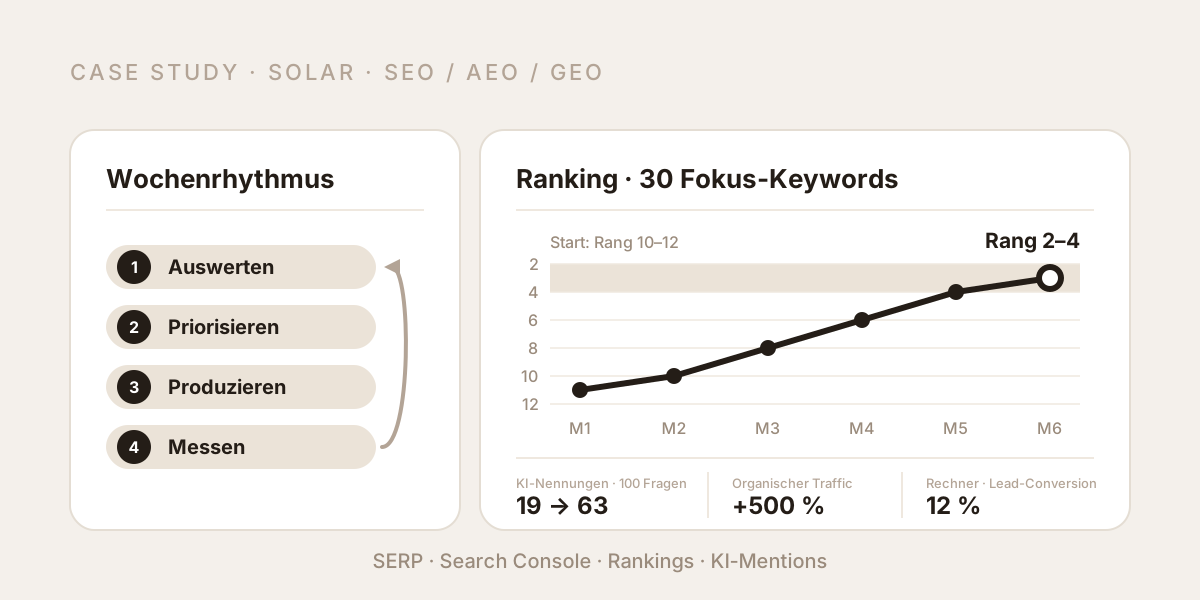
For a solar provider we set up SEO, AEO and GEO as a single weekly control loop: 30 focus keywords and a set of 100 real customer questions were steered week by week from SERP, Search Console, ranking and AI mention data rather than from a topic list. After six months the focus keywords ranked 2–4 instead of 10–12, and the brand was named in 63 out of 100 AI answers instead of 19. Organic traffic grew by 500% over the same period, and a solar cost and energy calculator built as a lead magnet converted at 12%.
The more interesting part of the story is not the ranking but the mechanism. What made the difference was not more content, but the weekly feedback loop between measurement and production — and the decision to treat questions, not keywords, as the unit of planning.
Starting point: page 2 is not half of page 1
At the start of the project the 30 focus keywords ranked between positions 10 and 12 — the bottom of page 1 and the top of page 2. That is the most thankless position in search: the content was good enough for Google to index and evaluate, but not visible enough to generate enquiries. Positions at the page 1 to page 2 boundary generate impressions but hardly any clicks.
In parallel, a baseline for AI visibility was taken at the start: across a set of 100 real customer questions, put repeatedly to several assistants, the brand was named in 19 out of 100 cases. That put a number on the second channel from day one — and made a growing share of demand observable in the first place.
Why solar is a demanding category
Solar is not an impulse purchase. Weeks or months pass between first interest and signature, during which prospects compare providers, research subsidies and self-consumption, check references and collect several quotes. That creates a large volume of information-driven questions before the actual provider search begins — about economics, payback periods, roof requirements, storage options, permits and funding.
This has two consequences for content strategy. First, competition for pure provider keywords is fierce, while competition for the questions that precede them is considerably weaker. Second, those advice-heavy questions are the first to migrate to AI assistants, because there they are answered in one response instead of across eight open tabs. Optimising only for provider keywords means losing the phase in which the shortlist is formed in the first place.
The setup: four data sources, one prioritisation
The foundation was not an editorial calendar but a data picture, re-evaluated every week. Four sources, each answering a different question:
| Data source | The question it answers | What follows from it |
|---|---|---|
| SERP analysis | Which format and search intent does Google reward for this term? | Whether a guide, a comparison page, a local landing page or a calculator is the right format |
| Google Search Console | Where do impressions already exist without clicks? | The fastest levers: pages just short of breaking through that only need sharpening |
| Rank tracking | How does each focus keyword move over time? | Whether a measure worked — or needs reworking |
| AI mention tracking | For which questions do assistants name the brand, and for which not? | The gaps classic rank tracking cannot see at all |
That fourth row is what separates this from a pure SEO project. What was tracked was not only mentions but the questions that triggered them. That reveals which topic areas the brand already exists in inside AI answers — and which it is absent from despite the website ranking for the topic.
The weekly rhythm
The real core of the project was the cadence. The same cycle ran every week:
- Analyse. Rankings, Search Console data and AI mentions from the past week against the week before. What moved, what did not, and why?
- Prioritise. The data picture produced a ranked order rather than a wish list: which piece of content has the largest expected effect this week? Pages with many impressions and a poor click-through rate almost always beat new topics started from zero.
- Produce. One brief per piece, derived from the SERP analysis — format, search intent, questions to cover, internal linking.
- Publish and measure. The content goes live, enters tracking, and becomes a data point again in the following week's analysis.
The difference from a classic editorial calendar is decisive: a calendar decides in January what will be published in May. This cycle decides afresh every week, based on what last week's data showed. That is where the compounding comes from — no piece is produced before the effect of the previous one is known.
What was built: landing pages and a lead magnet
The output of the weekly cycle was not only guide content but data-driven landing pages that had to do three jobs at once:
- Rank. Built along the search intent the SERP analysis actually showed for the term — not along a preferred structure.
- Answer. Address the questions from the set of 100 directly and self-containedly, so the same content also works as an answer inside assistants and AI Overviews.
- Convert. A clear offer logic, a visible next step, and the evidence that decides trust in an advice-intensive category.
The third point is the one most often overlooked in SEO projects. Position 2 on a page that leads nobody to an enquiry is an expensive metric. Because ranking, question and conversion requirements went into the same brief from the outset, each page became one asset rather than three separate jobs — and the requirements conflict less than people assume: a page that answers a question immediately and verifiably usually converts better than one that hints at the benefit after 800 words.
The decisive component, though, was the lead magnet: a solar cost and energy calculator. A good landing page only captures those already ready to enquire — and in a category with a months-long decision cycle, that is the minority. The far larger share of traffic is still researching: people who want to know whether the project is worth it for their roof and their consumption before they talk to any provider.
A calculator answers exactly that question — individually rather than in general. That makes it the logical continuation of the whole approach: if the question is the unit of planning, then the best lead magnet is the tool that answers the category's most-asked question personally. "What will a system cost me, and what will I save?" cannot be settled conclusively in any guide article — in a calculator it can.
For the prospect this is a fair exchange: they get a concrete number for their situation, the company gets a qualified contact with a known requirement — without forcing the jump to a sales conversation most visitors are not ready for. 12% of visitors became leads through it, well above what a conventional contact form achieves at that stage.
The calculator also worked twice over: it does not only capture, it attracts. Calculator queries are among the highest-demand searches in this category, and a genuinely useful tool gets linked and recommended far more often than a guide article — which in turn feeds rankings and, as described above, the probability of being named in AI answers. That dual role is what makes a calculator the single strongest asset in advice-intensive categories.
Competitor analysis: content gaps and backlink opportunities
A continuous competitor analysis ran alongside the weekly cycle, with two objectives.
Content gaps. For every focus topic we recorded which competitors ranked, which sub-questions they covered — and which they left out. The gaps are the way in: topics with demand but no good answer in the market. In an advice-intensive category like solar these are typically the uncomfortable questions providers prefer to avoid, because they involve effort or limitations. Precisely that content builds trust — and AI assistants draw on it disproportionately often, because it is concrete and verifiable.
Backlink opportunities. The competitors' backlink profiles produced a prioritised list of reachable sources: directories, trade portals, regional media and partner sites that already link to several competitors but not to the client. These gaps are the most pragmatic entry point into link building, because topical relevance is already demonstrated.
Both analyses work twice over: they improve classic rankings, and they simultaneously raise the probability of being named in AI answers, because assistants build their recommendations largely from third-party sources. Why that is and which signals matter is covered in detail in Getting recommended by AI assistants.
The AEO and GEO layer: questions instead of keywords
The shift in perspective that shaped the project: the unit of planning was the question, not the keyword.
A keyword like "photovoltaic quote" tells you what someone is searching for. A question like "Is a photovoltaic system worth it on an east-facing roof?" tells you why — and gives you the structure for content that both ranks in the results list and works as a quotable direct answer. Three principles followed from this for every piece:
- Answer first. The core question is answered in the opening sentences, not after 800 words of preamble.
- Self-contained sections. Every paragraph has to make sense without context — that is what makes it quotable when an assistant excerpts only that part.
- Verifiability. Concrete figures, conditions and limitations instead of marketing language. What cannot be checked is picked up less often by assistants.
This layer was measured through a fixed set of 100 realistic customer questions put repeatedly to several assistants — unbranded ("Which solar provider is suitable for …?"), topical ("How does funding work for …?") and branded. Because AI answers are non-deterministic, the single query never counts; only the mention rate across repeated runs does. How such a measurement setup is built in detail is covered in Measuring AI visibility.
The result
After six months both channels stood in a markedly different place:
| Metric | Start | After 6 months |
|---|---|---|
| Ranking of the 30 focus keywords | Position 10–12 | Position 2–4 |
| Mentions in AI answers (100 questions) | 19 / 100 | 63 / 100 |
| Organic traffic | Baseline | +500% |
| Lead conversion via the calculator | – | 12% |
The last two rows are the commercially relevant ones. Rankings and mentions are intermediate quantities; they only pay off once they turn into reach, and reach into contactable prospects. That chain — visibility, traffic, lead — is why landing pages and the lead magnet were part of the plan from the start rather than a later optimisation phase.
The move from page 2 into the top 5 is not linear: the first weeks bring barely visible movement, because the groundwork is being laid. The effect kicks in once enough topically connected content exists, is cleanly interlinked, and the first external references arrive.
The relationship between those two rows is worth noting. The AI mention rate more than tripled while the ranking improved by "only" eight positions — the AI channel responded more strongly to the same work. That matches the state of the market: in classic search results every provider has been competing for years, whereas in AI answers most are simply not yet prepared.
Three things were decisive:
- Consistency over volume. The weekly rhythm ran through — including weeks when little happened.
- Prioritisation from data. What already generated impressions in Search Console was worked on first. Sharpening beats starting over, as long as the substance is there.
- Questions as the unit. The same work served rankings, direct answers and AI mentions — instead of three separate workstreams.
What transfers to other industries
The approach is not solar-specific. It fits anywhere the buying decision is advice-intensive and many factual questions precede the choice of provider — construction and trades, healthcare, education, financial and insurance services, B2B industry. The three transferable elements:
- A weekly control loop instead of a quarterly editorial calendar.
- Four data sources instead of one — SERP, Search Console, rank tracking and AI mentions together produce a prioritisation none of them delivers alone.
- Questions as the unit of planning, because the same work then serves classic rankings and AI visibility at once.
- A tool as the lead magnet — a calculator, a configurator, a check — that answers the category's most-asked question individually, rather than letting the traffic you built flow away unused.
The first step
Before a strategy comes the starting point — and with AI visibility that is almost never known. Our free AI visibility check puts your customers' questions to ChatGPT, Gemini and Claude live and with web search, additionally checks whether AI crawlers can read your website at all, and sends you the result as a PDF report. Free, no account — that is the baseline everything else is measured against.
Want to build your visibility in search and AI assistants systematically? Let's talk — or read how we set up content as a process rather than a project.
Frequently asked questions
- How long does it take to move from page 2 to the top 5?
- Six months in this project: the 30 prioritised focus keywords moved from position 10–12 to positions 2–4. What mattered was not the volume of content but the consistency — a weekly cycle of analysis, prioritisation, production and measurement. First movements were visible within a few weeks; the jump into the top 5 came from the compounding effect.
- What is the difference between SEO, AEO and GEO?
- SEO optimises for the classic results list, AEO (answer engine optimisation) for direct answers to specific questions, and GEO (generative engine optimisation) for being named or cited by AI assistants such as ChatGPT, Gemini and Perplexity. In practice all three are served by the same content work — but they are measured differently: rankings, question coverage and mention rates.
- What data does weekly content planning require?
- Four sources: SERP analysis shows which format and search intent Google rewards in the category; Google Search Console shows where impressions already exist without clicks; rank tracking shows movement per keyword; and AI mention tracking shows which questions cause assistants to name the brand. Only together do they produce a prioritisation rather than a topic list.
- Why is solar a difficult SEO category?
- Because the buying decision is long and advice-intensive. Prospects compare providers, research subsidies and self-consumption, check references and collect several quotes. A large volume of information-driven questions arises before the actual provider search — and those are exactly the questions more and more people now put to an AI assistant instead of a search engine.
- How does SEO traffic actually turn into leads?
- Through a capture step that matches the research phase. In advice-intensive categories most visitors are not yet ready to enquire, so a contact form only picks up a fraction of them. In this project the lead magnet was a solar cost and energy calculator: it answers the category's most-asked question — what will a system cost and what will I save — individually rather than in general, and turns anonymous traffic into a qualified contact. The calculator converted at 12%, while organic traffic grew by 500% over the project period.
- How do you measure visibility in AI assistants?
- Through a fixed set of realistic customer questions put repeatedly to several assistants. For each answer you record whether the brand is named, in which position, and for which question. Because AI answers are non-deterministic, a single query is not a measurement — only the mention rate across repeated runs produces a reliable metric. In this project the set covered 100 questions; the mention rate rose from 19 to 63 out of 100.

About the author
Tenzin Langdun
AI Expert & Marketing Lead at Hierarchy
Tenzin is an AI expert and marketing lead with an MSc in Artificial Intelligence from the University of Bath and over 10 years of marketing experience across strategy, paid acquisition, and SEO. He has held roles at leading organisations including KPMG, EY, Siemens, and Adnovum — with expertise in AI, cybersecurity, audit and consulting, and the insurance sector. Together with Martin Oswald, he co-authored an award-winning research paper on AI-based cancer detection, published in Nature and recognised with the National Siemens Excellence Award and the Lab Sciences Award.