Contents
A good SEO agency builds the foundation AI visibility rests on. Whether ChatGPT recommends you, though, is largely decided outside that foundation: in our AI Visibility Study of 1,515 AI answers and 14,135 traced mentions, only 39 percent of mentions came from the company's own website. 40 percent came from the model's memory and 18 percent from third-party pages. So the question is not "SEO agency or GEO agency?" but: who works on all three places, and who measures whether it works?
The question reaches us in many versions. "Can a regular SEO agency get ChatGPT to recommend us, or do we need a specialist?" "Our web agency offers AI visibility as an add-on. Is that enough?" "Our rankings are good, but clicks keep falling. We want someone who treats SEO and AI visibility as one, instead of selling us two separate workstreams." Often with the rider: pure technical SEO is not an option.
This post sorts out the three agency types you'll come across and helps you decide. What GEO is in the first place is covered in Generative Engine Optimization (GEO). General criteria for choosing an SEO agency are in How to choose an SEO agency: 7 criteria, and concrete names in the comparison of SEO, GEO and AEO agencies in Zurich.
Can a regular SEO agency get ChatGPT to recommend you?
Partly, and that part matters. A recommendation from an AI assistant comes from three places:
- Your own website. ChatGPT with web search opens the websites of the companies it is considering and writes its reasoning from them: specialisation, location, prices, formats. That is classic SEO territory. An agency that builds clean service pages and aligns content with real questions improves this part directly.
- Third-party pages. Before opening websites, the assistant looks for lists, directories and comparisons. In our study, a company listed on a page the assistant demonstrably read was 8.2 times as likely to be named as one that wasn't there. This work is closer to digital PR and directory management than to classic link building.
- The model's memory. Two in five mentions had no source at all: the assistant already knew the company. That memory is fed by everything about you on the web at training time, and it responds to consistent company data and mentions over a long period.
Then there is a finding that is decisive for choosing an agency: around three quarters of the companies the assistants recommended were not in Google's top 10, even for exactly the searches the assistants ran themselves. A good ranking gets you in the door, but it doesn't make the selection. An SEO agency that only optimises for positions is therefore working on a prerequisite, not on the outcome.
Where SEO and GEO are the same, and where they are not
The overlap is large. That is exactly why it rarely makes sense to set them up as separate projects with separate agencies that don't coordinate.
| Area | Classic SEO | Additionally for AI visibility |
|---|---|---|
| Technical | crawlable, fast, indexable | allow AI crawlers such as GPTBot, ClaudeBot and PerplexityBot, check the firewall's bot protection |
| Content | search intent, keywords, structure | answer sentences, prices, location, FAQ: pages with an FAQ are cited 1.6 times as often, pages naming Zurich 1.35 times |
| Off-page | backlinks for authority | presence on the pages the assistant reads, and position on them: top third of a list 31 percent mentions, bottom third 21 percent |
| Company data | Google Business Profile, local listings | identical company data everywhere, Organization schema, sameAs, so the model recognises you unambiguously |
| Measurement | rankings, clicks, Search Console | mention rate across a fixed prompt set, repeated, in several assistants, with the cited sources |
| Unit | keyword and page | customer question and answer |
Two rows deserve a second look. Reviews and links have thresholds: across all twelve industries in our study, the share of named companies rises up to around 30 Google reviews and around 99 referring domains, after which more of the same changes very little. If you are already above those, more link building gains you little in AI answers. And for measurement, a single query is never enough: according to an analysis by Profound, 40 to 60 percent of cited domains change from month to month for identical queries. Only the mention rate across many repeated questions tells you anything.
What a good SEO agency already covers
If you have a solid SEO agency today, you are not starting from scratch. Much of what counts for AI visibility is everyday work there:
- a website that is technically reachable and indexable
- one page per service and location, clearly structured
- content that answers a search intent directly
- structured data and a well-kept Google Business Profile
- review management and local listings
- Search Console and analytics reporting
For local service businesses this is even a large part of the job. In our measurement of Google AI Mode in Switzerland, AI Mode relied on Google Maps data for 76 of 100 questions. An agency with strong local SEO is already working in the right place.
What is often missing
The gaps are usually not technical, but work that doesn't appear in a classic SEO mandate:
- Source analysis: which domains do ChatGPT, Gemini, Perplexity and Google AI Mode cite when they talk about your category? This list differs from industry to industry and is the actual to-do list.
- Placement work on third-party pages: getting into the directories, best-of lists, comparison articles and trade media read in your industry, and moving up on them. How to do that legitimately is covered in Digital PR for AI visibility.
- Measurement through customer questions: a fixed set of realistic questions that stays the same for months and is queried repeatedly in several assistants. How that looks is described in Measuring AI visibility.
- Differences between assistants: Google AI Mode leans heavily on Maps, but much less for B2B questions: for IT service providers only 3 of 10 answers relied on Google Maps. ChatGPT, Gemini and Claude name other companies from other sources. Measuring a single assistant shows only part of the picture.
- Editorial work for complex offerings: especially in B2B, what decides is whether your pages explain so clearly what you solve for whom that an assistant can repeat it in two sentences. That is writing, not technical work.
Good rankings, falling clicks: what's behind it
Many companies see this pattern in Search Console: positions and impressions stay stable while the click-through rate falls. According to Pew Research, Google users in the US clicked a traditional search result in 8 percent of searches with an AI summary and in 15 percent without one (data from March 2025). They clicked a link inside the summary in 1 percent of cases.
What to do in that situation:
- Narrow it down. Check in Search Console for which queries the click-through rate falls while position and impressions hold. Usually they are informational questions, less often queries with clear purchase intent.
- Check who is in the answer. For those queries, look at whether the AI summary cites your page or names your brand, and whom it names instead.
- Write the same pages for both. Clear answer sentences at the top, concrete figures and prices, an FAQ with real customer questions. That helps the ranking and the citability at the same time.
- Use the long queries. The Search Console report on generative AI features now also shows long, fully written-out questions. They show very precisely the situation in which customers look for you, and they belong in the prompt set.
This is exactly where it becomes clear why two separate workstreams rarely work: the SEO agency optimises a page for ranking, the GEO agency optimises the same page for citability, and neither knows about the other. One shared plan and one shared report solve that.
Three agency types compared
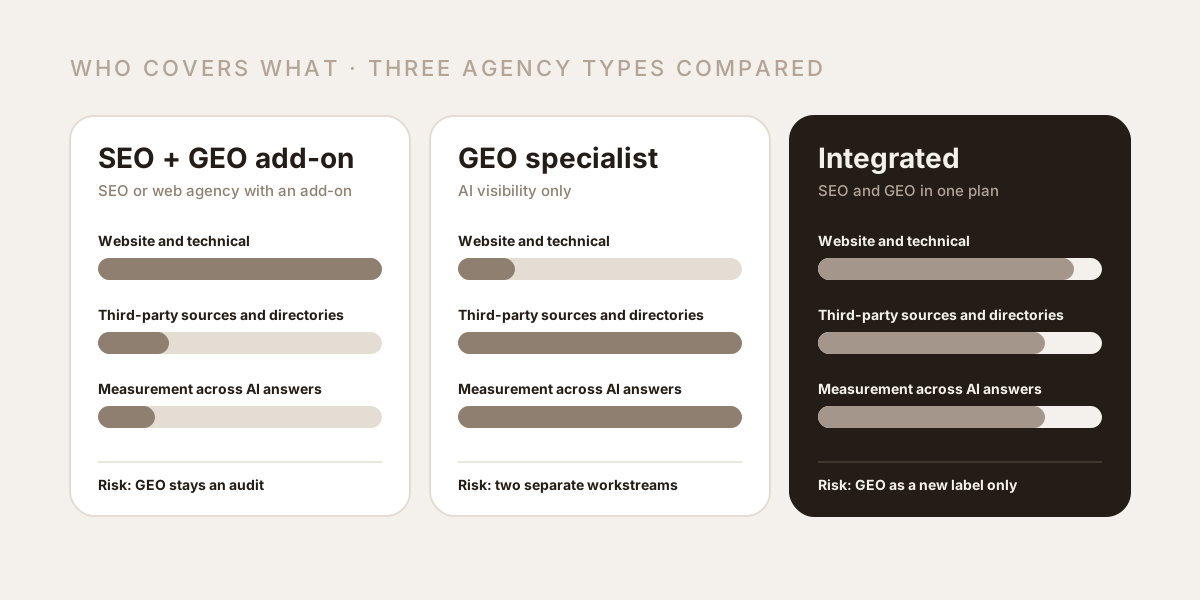
1. SEO or web agency with GEO as an add-on. The most common variant, often sold as an audit or an add-on package.
- Pros: knows your website and CMS, one point of contact, changes get implemented directly, the foundation is usually solid.
- Cons: the add-on is sometimes limited to technical tweaks and content recommendations. Source work on third-party pages and ongoing measurement through customer questions are then missing.
- Fits if: you're happy with your agency and it demonstrably delivers those last two points or brings in a partner for them.
2. Pure AI visibility specialist. Agencies and consultants doing nothing but GEO, LLMO or AI visibility. They exist in Switzerland and across the German-speaking region.
- Pros: depth in the topic, their own methods, quick to react to new assistants and features.
- Cons: implementation on your website often sits with someone else. Without clear coordination you end up with exactly the two workstreams many companies want to avoid.
- Fits if: your website and SEO are already well looked after and responsibilities can be split cleanly, or if your own team implements and wants strategy.
3. Integrated SEO and GEO agency. SEO and AI visibility as one mandate, with one plan for the same pages.
- Pros: one report for Google and AI answers, no coordination losses, measures prioritised by overall impact.
- Cons: more expensive than a one-off audit, and you need to check whether GEO is really separate work or just a new word for SEO.
- Fits if: rankings and clicks are drifting apart, nobody in-house can coordinate both, or website, content and third-party sources all need work at the same time.
Whether a large agency, a boutique or a freelancer fits, and the nine warning signs of a provider that does not, are covered in Which GEO agency is best for you?. None of the three types is better in principle. A specialist working closely with your existing SEO agency can beat an integrated agency that does GEO on the side. If you're looking for names: specialists and agencies offering knowledge transfer are listed in Running AI visibility in-house: 8 providers, agencies in Zurich in the comparison of SEO, GEO and AEO agencies.
Which type fits your situation?
| Situation | Recommendation |
|---|---|
| You have an SEO agency you're happy with, and AI visibility is new | First ask your existing agency whether it delivers prompt measurement and source work. If not: add a specialist, with a clear split of who owns which pages |
| Rankings good, clicks falling for months | Integrated approach: the same pages for ranking and citability, one shared report |
| Your web agency offers AI visibility as an add-on | Check whether the add-on includes measurement through customer questions and work on third-party pages. If it does, that is often the simplest route |
| Complex B2B offering, pure technical SEO is not enough | An agency with editorial skills and source work, integrated or specialised, with B2B case studies |
| Local service business with walk-in customers | Strong local SEO covers a lot: Google Business Profile, reviews up to the threshold, directories. Add AI measurement |
| Your marketing team should implement itself | A specialist or integrated agency on a do-it-with-me basis: strategy and reviews from outside, implementation in-house |
| You don't know where you stand | First a baseline across several assistants, then decide |
Questions for the first meeting
General questions for any SEO agency are in the comparison of Zurich agencies. For choosing between the three types, these are the ones that matter:
- "What do you do for AI visibility that you wouldn't do for pure SEO?" Good answer: concrete work on third-party sources, measurement through customer questions, differences between assistants. Weak answer: the same list as for SEO with new terms.
- "Who owns which pages, and who implements?" Especially important when several agencies are involved. Without a clear answer you get two workstreams.
- "What does a report look like with rankings, clicks and AI mentions side by side?" Ask to see an example.
- "Which third-party pages do the assistants cite in our industry, and how do we get there?" Good answer: a reasoned selection, not a generic directory list.
- "Who writes the content, and how do you get up to speed on complex offerings?" Decisive for B2B.
- "How will we know after three months whether it's working?" Good answer: change in mention rate across a fixed question set against a baseline, plus clicks and enquiries.
How Hierarchy works
Hierarchy is a full-funnel marketing and AI agency in Zurich, specialised in SEO, GEO and paid ads, so the third type. Marketing and engineering sit in one team of four people. The same people write the content, implement the technical side and measure the impact in one shared report for Google and AI answers. The basis is our own AI Visibility Study of 5,110 Zurich companies across 12 industries.
We work as implementation by our team (done for you), as done with you, where your team implements and we deliver strategy, measurement and reviews, or through workshops. Packages and prices from CHF 900 per month are on the SEO agency and GEO agency pages.
Conclusion
A regular SEO agency can do a lot for your AI visibility, but rarely everything: your own website is only one of three places where a recommendation comes from. Whether you get the missing parts from your existing agency, a specialist or an integrated agency matters less than two conditions: website, third-party sources and measurement are steered together, and success is measured by the mention rate across real customer questions, not by a single query.
The free AI visibility check shows where your company stands today: it checks whether ChatGPT, Gemini and Claude name you and which competitors show up instead.
About the author