Contents
Google AI Mode recommends local businesses almost entirely from Google Maps. In October 2026 we asked AI Mode 100 questions across 10 Zurich industries. 76 answers were built on Google Maps data, mostly as cards with stars, reviews and address. The suggested businesses had a median rating of 4.9 stars, but not necessarily many reviews: one in six had fewer than ten. And almost every question brought up different names: 249 different businesses on 271 cards.
Google launched AI Mode in Switzerland on 8 October 2025, in German, French and Italian. A year later, a growing share of people no longer just scan the results list but ask Google a question and get an answer with a handful of recommendations. "ai mode" is now searched more than 12,000 times a month in Switzerland, and the trend is rising.
For SMEs, the key question is: what criteria does AI Mode use to choose the businesses it names? So far there has mostly been speculation. So we measured it.
What is Google AI Mode?
Google AI Mode (German: "KI-Modus") is a separate part of Google Search. Instead of ten blue links you get a written answer with sources and can ask follow-up questions. Technically, Google splits the question into sub-questions and searches each in parallel, the so-called "query fan-out". AI Mode is available from the Google homepage, as a tab on the results page and in the Google app.
| AI Overviews | AI Mode | |
|---|---|---|
| Where? | Above the normal search results | Separate tab or area |
| When? | Automatically, when Google considers it useful | When you open it deliberately |
| Answer | Short summary | Detailed answer with follow-ups |
| Sources | A few links | More links, often with Google Maps cards |
| Can it be turned off? | No, only the Web filter shows plain links | You don't have to use it |
How AI Overviews change classic search is covered in our article From SEO to GEO. This one is about AI Mode.
Our measurement: 100 questions, 10 industries
On 13 October 2026 we asked AI Mode 100 questions the way customers in Zurich actually type them, with the location set to the canton of Zurich and the language to German. Ten questions per industry, for example:
- "Bester Zahnarzt in Zürich", "Zahnarzt Zürich Notfall am Wochenende", "Kinderzahnarzt Zürich"
- "Physiotherapie Zürich Kreis 4", "Physiotherapie nach Kreuzbandriss Zürich"
- "Treuhänder Zürich für KMU", "Anwalt Mietrecht Zürich Empfehlung"
- "Architekt für Umbau Altbau Zürich", "Badsanierung Zürich Firma", "Umzugsfirma Zürich gute Bewertungen"
- "Restaurant Zürich Altstadt Empfehlung", "Coiffeur Zürich Balayage", "Fitnessstudio Zürich ohne Vertrag"
- "Google Ads Agentur Zürich", "IT Support Zürich KMU", "KI Agentur Zürich"
The ten industries: dentists, physiotherapy, accounting firms, law firms, architecture, trades and home services, restaurants, hair, beauty and fitness, marketing agencies, and IT and software. We analysed whether each answer showed Google Maps data, what ratings and how many reviews the suggested businesses had, and which websites were linked. We asked each question once, on desktop, without being signed in. Repeating a question sometimes brings up different names, but the patterns across 100 answers are more stable than any single answer.
Finding 1: three in four answers come from Google Maps
For 76 of 100 questions, AI Mode relied on Google Maps data. Usually it shows the businesses as small cards with name, stars, review count, category and address, with "Call", "Directions" and "Website" buttons. Otherwise the answer explicitly points to the Maps results. In the 66 answers with business cards there were four cards on average, eleven at most.
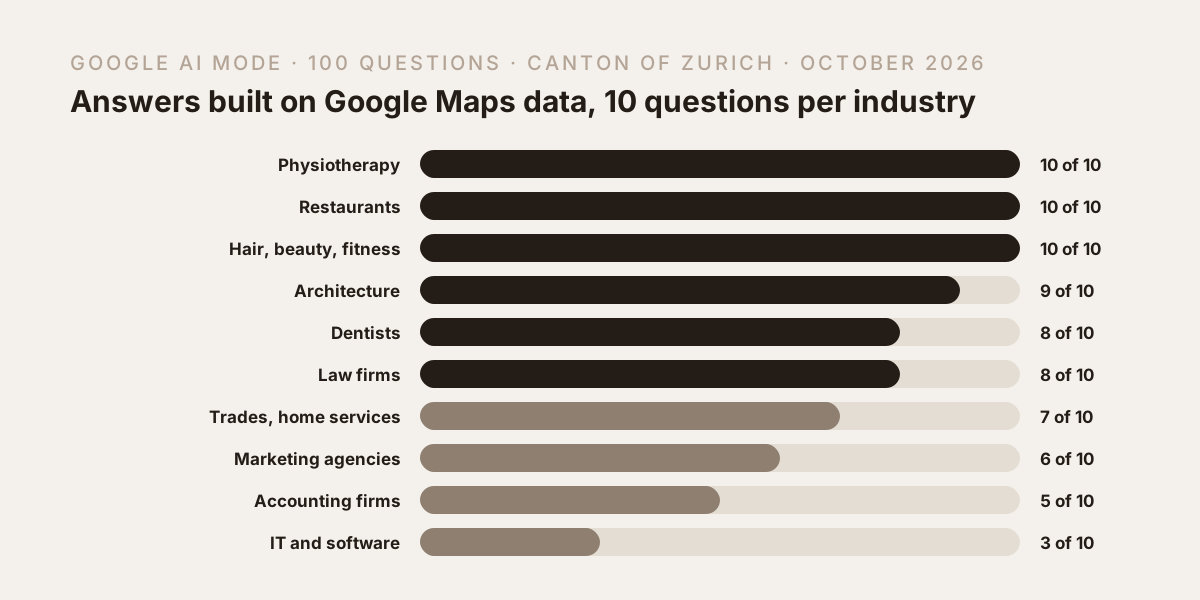
| Industry | Answers with Maps data | Business cards | Median stars | Median reviews |
|---|---|---|---|---|
| Physiotherapy | 10 of 10 | 25 | 4.9 | 33 |
| Restaurants | 10 of 10 | 27 | 4.6 | 449 |
| Hair, beauty, fitness | 10 of 10 | 60 | 4.9 | 169 |
| Architecture | 9 of 10 | 36 | 5.0 | 6 |
| Dentists | 8 of 10 | 32 | 4.9 | 114 |
| Law firms | 8 of 10 | 19 | 4.7 | 51 |
| Trades and home services | 7 of 10 | 23 | 4.9 | 17 |
| Marketing agencies | 6 of 10 | 23 | 5.0 | 21 |
| Accounting firms | 5 of 10 | 16 | 5.0 | 22 |
| IT and software | 3 of 10 | 10 | 5.0 | 16 |
For a physiotherapy practice, a restaurant or a hair salon this means the Google Business Profile is the shop window in AI Mode. If you are missing there, have the wrong category, or haven't updated photos and opening hours in years, you will rarely appear in these answers.
Finding 2: ratings matter more than the number of reviews
Across all industries, the 271 suggested businesses had a median rating of 4.9 stars. 74 percent were at 4.8 or higher, only 7 percent below 4.5, and the lowest rating was 3.7.
The number of reviews varies much more. The median was 52, but one in six businesses had fewer than ten reviews. 37 businesses appeared in the answers with 5.0 stars and fewer than ten reviews. How many reviews are "enough" depends heavily on the industry: for architecture firms the median was six, for restaurants 449.
One caveat: we only see the businesses AI Mode suggests, not the ones it leaves out. So we cannot prove that an average below 4.5 is why a business is missing. The pattern is still clear. For a small business it pays to actively ask satisfied customers for reviews and to answer every review. In most industries you don't need hundreds.
Finding 3: every phrasing brings up different names
The 271 business cards showed 249 different businesses. Only 20 appeared for more than one question. For dentists it was 26 different practices on 32 cards; for hair, beauty and fitness 59 on 60.
So AI Mode doesn't answer "the" question about the best dentist, it answers every phrasing afresh: weekend emergency, anxious patients, implants, children, Oerlikon. For a business that is good news. You don't have to be the biggest practice in the city to be named. You have to fit a specific question, and Google has to be able to see that: from the category and services in your Business Profile, from review texts, and from a website that explains each service and location on its own page.
Finding 4: where the links come from
Besides the Maps cards, AI Mode links websites as sources. Across the 100 answers we counted 483 such links:
| Type of source | Share | Examples |
|---|---|---|
| The businesses' own websites | 59% | Practice, law firm and agency websites |
| Portals, booking and comparison platforms | 25% | onedoc.ch, tbooking.ch, ofri.ch, sortlist.ch, gryps.ch, search.ch |
| Associations and public authorities | 10% | Zurich Bar Association, SIA Zurich, City and Canton of Zurich |
| Media and city guides | 4% | Gault&Millau, Guide Michelin, ron orp |
| Job boards | 2% | for IT questions |
What stands out is how industry-specific the portals are. onedoc.ch appeared for dentists and physiotherapy, tbooking.ch for physiotherapy, ofri.ch for trades, the Zurich Bar Association and jurata.ch for lawyers, and the Zurich section of SIA for architects. A listing in a general business directory, by contrast, barely mattered: local.ch had two links.
32 of the 100 answers linked no website at all, only Google's own data. For these questions, the Business Profile alone decides.
Finding 5: B2B service providers are chosen differently
For IT questions only 3 of 10 answers relied on Google Maps, for marketing agencies 6 of 10 and for accounting firms 5 of 10. Here AI Mode more often answers with lists and descriptions from websites, comparison portals and "best agencies" articles. For B2B companies the Business Profile is therefore only half the job. The other half is clear service pages, case studies, and listings on the portals that are actually cited in your industry.
How ChatGPT, Gemini and Claude answer the same industries is shown in our AI Visibility Study Zurich 2026. There, far more mentions come from websites and from the models' memory. Google AI Mode is the assistant where Google Maps counts most.
How do I get into Google AI Mode? The checklist
According to Google there are no additional requirements for AI Mode: a page must be indexed and eligible to appear in Search with a snippet, and then the usual SEO fundamentals apply. Our data shows where the work pays off most:
- A complete Google Business Profile: the right primary category, fitting secondary categories, services, opening hours including holidays, photos, a description without keyword stuffing.
- The same name, address and phone number everywhere: in the profile, on the website, in portals and associations. After a move, update every listing.
- Collect and answer reviews actively: ask satisfied customers right after the job. Specific review texts ("emergency appointment on a Saturday", "renovating an old building") help you match specific questions.
- One page per service and location: if you explain "implants", "paediatric dentistry" and "emergencies" on separate pages, you match more phrasings.
- The right portals: not every directory, but the ones cited in your industry, such as booking portals in healthcare, quote portals in the trades, and associations for lawyers and architects.
- Structured data: LocalBusiness or the matching industry schema with address, opening hours and geo-coordinates, consistent with the visible text.
- For B2B, additionally: case studies, clear service pages, and presence on the comparison portals and specialist lists in your industry.
- Measure: ask AI Mode the same five to ten questions every month and note who is named.
Turning Google AI Mode on and off
Many people searching for "ai mode" actually want to know how to find it or get rid of it. In short:
- Turn on: on google.ch, choose the AI Mode tab after a search, or open AI Mode directly from the homepage or in the Google app.
- Turn off: there is no switch. But AI Mode only opens when you click it. According to Google, AI Overviews in normal search cannot be disabled. If you only want classic links, choose the Web filter after searching.
What Search Console shows and what it doesn't
Google counts clicks and impressions from AI Mode in the Search Console Performance report, under the Web search type. AI Mode cannot be broken out separately there. Whether your business appears in the answers, next to whom and with which sources, you only see by asking the questions yourself. How to set up such a measurement is explained in Measuring AI visibility. And if you would rather advertise than be named organically: how advertising in ChatGPT works and who may advertise in Switzerland is explained in ChatGPT Ads in Switzerland.
How Hierarchy helps
Hierarchy is a full-funnel marketing and AI agency in Zurich, specialised in SEO, GEO and paid ads. We measure whether Google AI Mode, ChatGPT, Gemini and Claude name your business, find out which sources count in your industry, and implement the measures: Business Profile, service pages, structured data, portals. Either our team does it (done for you), or we guide your team through it (done with you). More on the SEO & AI visibility page.
Conclusion
A year after its Swiss launch, it is clear what AI Mode looks at for local questions: Google Maps. Three in four answers rely on it, and the suggested businesses almost always have top ratings, but not necessarily many reviews. And because every phrasing brings up different names, it is not the biggest business that wins but the one that fits a specific question. For B2B service providers, the website and the portals of their own industry count as well.
Whether your business is named today is shown by the free AI visibility check.
About the author