Law Firm Marketing Zurich: How AI Recommends Lawyers
Business law firms in Zurich: Gemini names almost only from memory, ChatGPT reads websites. The question that makes smaller firms visible.
Business law is the most concentrated industry in our study. Ten firms take 68 percent of all AI mentions for Zurich; in no other industry is it more than 57. Every second mention comes from the model's memory, and the reasons given are transactions, international reach and litigation. Still, there is one question where the field opens up: on an SME's situational question the assistants named a firm 18 times and used 17 different names. This article shows who gets named, why Gemini and ChatGPT work in almost opposite ways, and where a mid-sized firm realistically gets into the answer.
Someone in Zurich with a contract dispute with a supplier no longer necessarily calls a peer from the bar association. They type: «I run an SME with 20 employees in Zurich and need a business law firm, specifically for a contract dispute with a supplier. Do you have a recommendation?» The answer is a list with reasons, and two of the names get an email. Google publishes no reliable search volumes for phrasing like this. What can be measured is who appears in the answers, and why.
For our AI visibility study Zurich 2026 we analysed answers from Claude, ChatGPT and Gemini across twelve Zurich industries. For this article we went back through the business law rows one by one, merged duplicate mentions under different firm names and removed rankings, directories and associations: 15 answers to five questions, 132 mentions, 33 firms, plus ten search queries in Google AI Mode. The data covers business law firms, not firms serving private clients. The questions:
- «Which business law firms in Zurich can you recommend?»
- «I run an SME with 20 employees in Zurich and need a business law firm, specifically for a contract dispute with a supplier. Do you have a recommendation?»
- «best business law firm zurich»
- «Name me 5 good business law firms in Zurich and what speaks for them.»
- «Which business law firms in Zurich would you recommend?»
The first four questions were asked in German, the last one in English.
The tightest industry in the study
Most often named were Homburger, Lenz & Staehelin and Bär & Karrer with twelve mentions each, then Schellenberg Wittmer and Niederer Kraft Frey with ten each, MLL Legal and Walder Wyss with nine each, followed by Baker McKenzie, Kellerhals Carrard, Wenger Vieli and Pestalozzi. The three leaders together take 27 percent of all mentions, the ten most-named 68 percent.
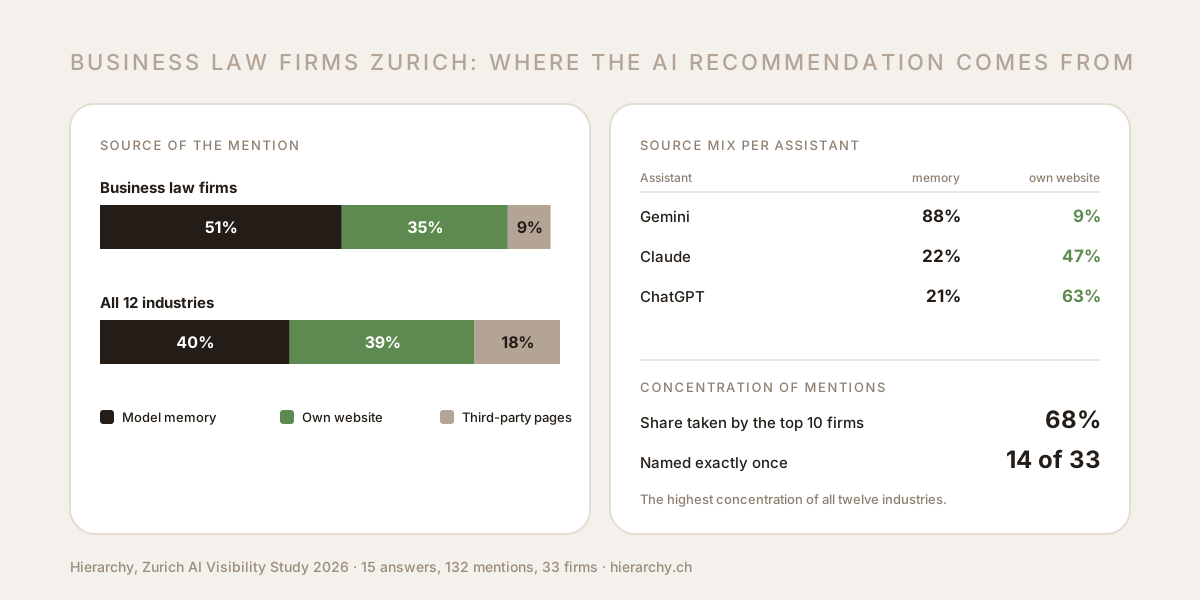
That is the highest concentration of all twelve industries. The next industry reaches 57 percent for its top ten, and eight of the other eleven sit below 50 percent. Nine firms were named by all three assistants.
The counter-figure sits in the same analysis: 14 of the 33 named firms came up exactly once. The field has not shrunk to ten names, it simply has a very heavy top. Getting to the top takes years of publicity. Getting into the other answers takes something else, and that is what the rest of this article is about.
Where the mentions come from
An assistant names a firm from the model's memory, from the firm's website that it reads during the answer, or from a third-party page. Across all twelve industries that splits 40, 39 and 18 percent. In business law it looks like this:
| Source of the mention | Business law firms | All twelve industries |
|---|---|---|
| Model memory | 51% | 40% |
| Firm's own website | 35% | 39% |
| Third-party pages (directories, rankings, articles) | 9% | 18% |
The remaining 5 percent are pages that were fetched but not cited.
On Gemini your website barely counts, on ChatGPT it counts a lot
The average hides three very different assistants:
| Assistant | from memory | from the firm's website | from third-party pages |
|---|---|---|---|
| Gemini | 88% | 9% | 3% |
| Claude | 22% | 47% | 28% |
| ChatGPT | 21% | 63% | 0% |
ChatGPT and Claude searched the web on all five questions. Gemini searched on only one, the terse input «best business law firm zurich». On every other question, all of Gemini's mentions came from memory.
In practice: if your clients use Gemini, what decides is what the training data says about your firm, and that only changes with the next model. If they use ChatGPT, what decides is mostly what is on your pages today. Claude, besides the firm's website, reads directories and rankings notably often. A report that shows «AI visibility» as a single number adds these three worlds together.
The question decides whether anything gets looked up
| Question | from memory | from the firm's website | Mentions | Firms |
|---|---|---|---|---|
| «best business law firm zurich» | 20% | 57% | 30 | 19 |
| Situational question SME / contract dispute | 50% | 39% | 18 | 17 |
| «Which business law firms in Zurich would you recommend?» | 45% | 27% | 33 | 16 |
| «Name me 5 good business law firms …» | 67% | 33% | 18 | 8 |
| «Which business law firms in Zurich can you recommend?» | 76% | 21% | 33 | 19 |
The terse, keyword-style input is answered most heavily from websites, because that is the only place Gemini searches. The politely phrased request for recommendations is answered from memory most often. And «Name me 5 good» produces the narrowest answer: 18 mentions spread across just eight firms, because the model retrieves a ready-made list.
The English question produced as many mentions as the German recommendation question, but hardly any different names: 14 of the 16 firms in the English answers also came up in German. Unlike IT support, for example, the English-speaking market in business law is not a separate one but the same circle of large firms.
So when you test your visibility, test at least these five phrasings. A single question measures a single mechanism.
The situational question is the open door
On the situational question with a client profile, company size and a concrete legal problem, the three assistants named a firm 18 times in total, and there were 17 different names. Only BommerMathys was named twice, both times in the same answer.
No name came up with two assistants. Gemini explicitly recommended a mid-sized firm or boutique with a pragmatic approach and a fee cap to the SME, naming among others Thouvenin, MME, Probst Partner, Bratschi, Kellerhals Carrard and Wenger Vieli. ChatGPT named versaLex, Quadra, BommerMathys and Walder Wyss. Claude named Advoro, Bruppacher Hug and Teichmann and also pointed to the directory of the Zurich Bar Association. Nine of the 17 firms came up on no other question.
The reason is plausible: once the question contains a client profile, the model can no longer retrieve a ready-made ranking, because none exists for «SME with 20 employees, contract dispute with supplier». It has to map the requirements onto descriptions. Accordingly, 39 percent of mentions on this question rest on the firm's website, against 21 percent on the open recommendation question.
That leads to the most concrete measure in this article: describe client profiles, not just practice areas. «Business law» sits on the pages of a hundred firms. «Contract disputes for manufacturers with 10 to 50 employees in the Zurich area, including conciliation before litigation» sits almost nowhere.
What the assistants give as reasons
We counted which attributes appear in the text right after a firm's name. Across 132 mentions:
| Reason | Mentions |
|---|---|
| M&A and transactions | 35 |
| International reach, other offices | 30 |
| Litigation, arbitration | 24 |
| Ranking or award | 12 |
| Size, full service | 10 |
| Suitability for SMEs | 9 |
| Contract and commercial law | 5 |
| Employment law | 4 |
Fees and founding year came up twice at most, location and languages not at all. In the models' perception, business law is an industry of transactions and proceedings, and a good part of both signals is created outside the firm's own website: in deal announcements, rankings and the trade press.
For a firm that is not in M&A this is bad news and good news at once. The bad: the dominant reason does not fit you. The good: only nine of the 132 mentions were justified with SME suitability. That field is barely occupied, and it is exactly what the situational question looks for.
What named firms do differently
We compared 36 named Zurich business law firms with 12 comparable firms that appeared in none of the 15 answers. The median:
| Metric (median) | named | not named |
|---|---|---|
| Referring domains | 454 | 38.5 |
| Web mentions in total | 101.5 | 21 |
| External domains mentioning the firm | 25 | 14.5 |
| Keywords in Google's top ten | 25 | 2 |
| Indexed pages | 10 | 6 |
| Words on the homepage | 346 | 231 |
| Google reviews | 12.5 | 3.5 |
| Star rating | 4.5 | 5.0 |
| Structured data present | 67% | 50% |
The largest gaps are in referring domains and keywords, that is in overall presence on the web. Named firms also have more Google reviews, with a slightly lower average. On the homepage the difference is smaller. As always with comparisons like this: these are correlations from a small sample, not proof.
One figure applies to the whole industry: not one of the 56 firms we measured has FAQ schema on its website, and the median homepage has 297 words. That is the second-lowest value in the study. Law firm websites in Zurich are often business cards, and an assistant reading a business card finds little to justify a recommendation with.
Which external pages the assistants read
The most-cited page in the law firm answers is not a firm's website but chambers.com, with 76 citations. It is followed by individual firms' websites, then iflr1000.com, bilanz.ch and legal500.com.
Among the listing pages an assistant opened during the answer, legalcommunity.ch supplies by far the most listing slots, followed by Wikipedia, chambers.com, iflr1000.com and legal500.de. In total, firms stood on a listing page that was read 738 times, and 194 of those slots led to a mention in the same answer, which is 26 percent. That is just above the all-industry average of 25 percent: three out of four listing slots have no effect.
A directory entry is therefore necessary but not sufficient, and the longer the list, the less the slot is worth. What counts is a complete profile on the few directories the assistants actually read.
Google AI Mode: the same top, a different field
We queried Google AI Mode separately with ten search queries. The answers named 40 different firms. At the front stand the same names as in the chat answers: Niederer Kraft Frey, Bär & Karrer, Schellenberg Wittmer, Lenz & Staehelin, Walder Wyss and Homburger.
Further down, the field changes. About half of the 40 firms appeared only in AI Mode, among them LENZ & CADUFF, Goldblum and Partners, Michlig Knutti Partner, Legal Partners Zurich, Suter Howald and Streiff von Kaenel. As sources, Google mainly uses chambers.com, legal500.com and the firms' websites, plus the map panel with Google Business Profiles.
For measurement that means: at the top, all channels show the same picture. But a firm in the wider field can be visible in AI Mode and not in ChatGPT, or the other way round. What a report that captures both looks like is described in Measuring AI visibility.
What the assistants tell clients
The assistants do not just supply names. Asked for the «best» firm, all three wrote that there is no single best firm and that the choice depends on the mandate. In five of the 15 answers they advised holding two or three initial consultations, and Claude pointed to the Zurich Bar Association's directory.
For your website that means: prospects arrive at the first meeting with a shortlist and with questions. What a mandate involves, how an initial consultation works and which clients you work for should be on your pages beforehand.
What a Zurich firm can actually do
Write out client profiles, not just practice areas. One page per typical situation: contract dispute with suppliers, employment dispute, succession in a family business, company formation, debt collection. With industry, company size and process. That is the text the situational question needs.
Turn the homepage from a business card into a description. A median of 297 words means the assistant reads three sentences about you and moves on. Practice areas, client base, team with responsibilities, languages, how a mandate runs.
Add FAQ sections. None of the 56 firms we measured has FAQ schema. Answer the questions clients ask in the first meeting: how a mandate runs, how long a contract dispute takes, when conciliation is worth it instead of litigation, how billing works.
Build publicity outside your own domain. Referring domains and web mentions separate named from unnamed firms most clearly. Expert articles, association pages, commentary on court decisions, talks with a programme page. It works slowly, and it is the only thing that moves the memory share.
Be listed completely in the legal directories. Chambers, IFLR1000, Legal 500 and legalcommunity.ch are this industry's third-party sources, and chambers.com is the most-cited page of all. An incomplete profile there is a wasted citation.
Maintain the English version. One of the five questions was in English and produced as many mentions as the German recommendation question. When ChatGPT or Claude searches for it, it reads your English pages.
Checklist: 12 points for your firm's website
And a 13th point that does not sit on the website: measure it. Ask ChatGPT, Gemini, Claude and Google AI Mode the same five questions every month and record who gets named. Only then do you see whether the work is paying off.
What we do for law firms
Hierarchy is a full-funnel marketing and AI agency for SMEs in Zurich, specialising in SEO, GEO and paid ads, with marketing and engineering in one team of four people. We base our recommendations on our own data study of AI recommendations, and we implement the changes ourselves: copy, client-profile pages, schema, English version, directory profiles. Where your firm stands today is shown by the free AI visibility check. Service details: SEO & AI visibility.
Conclusion
Business law is the tightest industry in the study: ten firms take 68 percent of mentions, and every second mention comes from model memory, where transactions, proceedings and rankings live. You do not reach the top via your website. But you can very much get into the answer once the question contains a client profile: there the assistants named 17 different firms in 18 mentions, and mid-sized firms stood next to the large ones. The measure is unspectacular and almost unoccupied in this industry: describe situations instead of listing practice areas, and expand the homepage from 297 words into a real description. The figures for all twelve industries are in the AI visibility study Zurich 2026. How other advisory professions in the same study fare: Accounting firm marketing Zurich and Wealth manager marketing Zurich.
Frequently asked questions
- Do ChatGPT and Gemini recommend specific law firms in Zurich?
- Yes. Across five questions, ChatGPT, Gemini and Claude named a specific business law firm 132 times in 15 answers, spread across 33 firms. They are not entirely uncritical: asked for the «best» firm, all three wrote that there is no single best one, and in five answers they advised holding two or three initial consultations. They named firms anyway.
- Where do the assistants get their recommendation for a business law firm?
- 51 percent of mentions come from the model's memory, that is from training, without any page being read during the answer. 35 percent rest on the firm's own website, 9 percent on third-party pages, 5 percent on pages that were fetched but not cited. Across all twelve industries in our study the memory share is 40 percent. Only wealth managers and architecture firms come close.
- Why does ChatGPT always name the same large firms?
- Partly because every second mention comes out of training memory: there, 73 percent of mentions go to the ten most-named firms. But even when the assistants search, it is 63 percent, because rankings and directories list the same names. The concentration is the highest of all twelve industries: the three most-named firms take 27 percent of all mentions, the ten most-named 68 percent. In no other industry do the top ten reach more than 57 percent. 14 of the 33 named firms came up exactly once.
- Does it depend on the assistant whether my firm's website counts at all?
- Yes, strongly. On Gemini, 88 percent of mentions come from memory and only 9 percent from the firm's website. On ChatGPT it is the reverse: 21 percent memory, 63 percent own website. Claude relies on the firm's website for 47 percent and on third-party pages for 28 percent. So the question «does my website do anything for AI recommendations» has three answers in this industry.
- Which question gets smaller firms into the answer?
- The situational one. Asked «I run an SME with 20 employees and need a firm for a contract dispute with a supplier», the three assistants named a firm 18 times and used 17 different names. No name came up with two assistants, and nine of the 17 firms were named on no other question, among them mid-sized firms and boutiques. On the open question «Which business law firms in Zurich can you recommend?», by contrast, 76 percent of mentions come from memory.
- What do the assistants give as reasons?
- In the text right after the firm's name, 35 mentions were about M&A and transactions, 30 about international reach, 24 about litigation or arbitration, 12 about a ranking and 9 about suitability for SMEs. Fees and founding year came up twice at most, location and languages never. Anyone who wants to be found for SME work has to write it on their pages.
- What separates named from unnamed firms?
- Mainly publicity outside the firm's own website. At the median, named firms have 454 rather than 38.5 referring domains, around 100 rather than 21 web mentions, and rank for 25 rather than 2 keywords in Google's top ten. They also have more Google reviews, 12.5 against 3.5, with a slightly lower average rating. On the homepage the gap is smaller: 346 against 231 words. We compared 36 named firms with 12 comparable firms that appeared in no answer.
- Do Chambers, Legal 500 and IFLR1000 help with AI visibility?
- They are this industry's third-party layer. chambers.com was the most-cited page of all with 76 citations, more than any firm's website. It is followed by iflr1000.com, bilanz.ch and legal500.com. Of the firms that appeared on a listing page an assistant read, 26 percent were named in the same answer, just above the all-industry average of 25 percent.
- Does Google AI Mode name the same firms as ChatGPT?
- At the top yes, further down no. Google AI Mode named 40 firms across ten search queries. The most-named ones are the same as in the chat answers, such as Niederer Kraft Frey, Bär & Karrer, Schellenberg Wittmer and Lenz & Staehelin. But about half of the 40 firms appeared only in AI Mode, among them LENZ & CADUFF, Goldblum and Partners and Michlig Knutti Partner.
- How do I check whether an AI recommends my firm?
- Ask ChatGPT, Gemini, Claude and Google AI Mode the same five questions every month, including a situational question with a client profile and a specific area of law, and record who gets named and with what justification. Hierarchy's free AI visibility check does this once for you.

About the author
Tenzin Langdun
AI Expert & Marketing Lead at Hierarchy
Tenzin is an AI expert and marketing lead with an MSc in Artificial Intelligence from the University of Bath and over 10 years of marketing experience across strategy, paid acquisition, and SEO. He has held roles at leading organisations including KPMG, EY, Siemens, and Adnovum — with expertise in AI, cybersecurity, audit and consulting, and the insurance sector. Together with Martin Oswald, he co-authored an award-winning research paper on AI-based cancer detection, published in Nature and recognised with the National Siemens Excellence Award and the Lab Sciences Award.