Accounting Firm Marketing Zurich 2026: Why ChatGPT, Gemini and Google AI Mode Recommend Your Firm, or Not
Data study for accounting and fiduciary firms in Zurich: 45 percent of AI mentions come from model memory and go to the big names. For local firms, every second mention is grounded in their own website. Which pages ChatGPT and Gemini read, why guides are the most-cited pages, plus a 12-point checklist.
When someone asks ChatGPT or Gemini for an accounting firm in Zurich, 40 percent of the mentions go to twelve big names: the Big Four, BDO, OBT, Mazars, Grant Thornton. Two thirds of those mentions come from model memory. A different rule applies to the 43 local firms named alongside them: every second mention is grounded in the firm's own website, which the assistant reads while answering. Named firms have three times as many referring domains, ten times as many ranking keywords and a homepage of around 500 words instead of 160. The most-cited pages are not directories but an award page and two guides that accounting firms wrote themselves. This article shows what ChatGPT, Gemini and Google AI Mode say about Zurich accounting firms, which pages they read for it, and what you should change on your website.
"Treuhand Zürich" is searched around 320 times a month on Google, "Steuerberater Zürich" another 320 times. That is not much, but it is expensive: a click on an ad for "Treuhand Zürich" costs around CHF 18, for "tax advisor zurich" CHF 24. An accounting mandate runs for years, which is why many firms compete for few enquiries. On top of that comes demand no statistic shows: founders, newcomers and SME owners who ask ChatGPT or Gemini "Which accounting firm in Zurich would you recommend?" and follow the answer without searching further. Whoever appears there gets enquiries from people who have already decided.
For our Zurich AI Visibility Study 2026 we analysed 1,515 answers from Claude, ChatGPT and Gemini across twelve Zurich industries. For this article we went back through the accounting rows in detail: 15 answers to five question variants, 112 mentions, 55 named firms, 65 measured firms, plus 158 source references from ten Google AI Mode answers. The questions were phrased the way people actually ask them:
- "Which accounting and tax firms in Zurich would you recommend?"
- "I run an SME with 20 employees in Zurich and need an accountant for bookkeeping and year-end accounts. Do you have a recommendation?"
- "best accountant zurich"
- "Name 5 good accounting firms in Zurich and what speaks for each."
- "Welche Treuhänder in Zürich kannst du empfehlen?"
Where the AI gets its accounting recommendation
An AI assistant can name a firm from three sources: from the model's memory (the firm was in the training data), from the firm's website (the assistant read it live while answering), or from a third-party page (a directory, a list, an article). Which source dominates decides the right strategy. For accounting firms the picture is split in two:
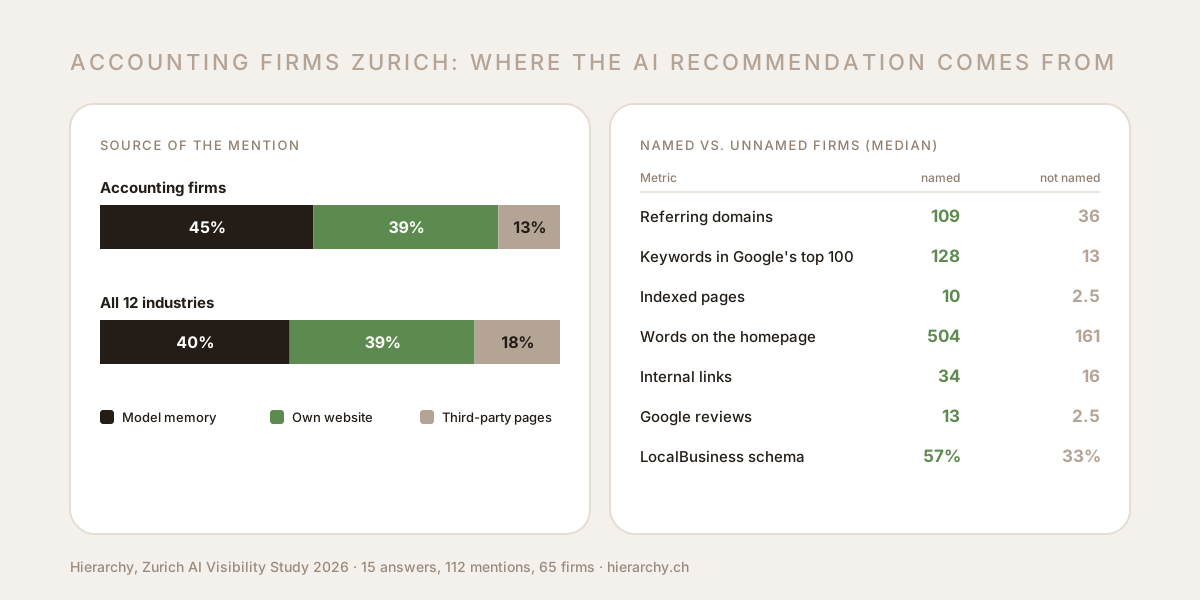
Across all 112 mentions, 45 percent come from model memory, 39 percent from the firm's own website and 13 percent from third-party pages. That looks like an industry where little can be influenced, like wealth managers with a 57 percent memory share. The impression is misleading, because two different markets sit inside one number:
| Mentions | Firms | Memory | Own website | Third-party | |
|---|---|---|---|---|---|
| Big names and networks (Big Four, BDO, OBT, Mazars, Grant Thornton, RSM, Baker Tilly, PKF) | 45 | 12 | 67% | 22% | 9% |
| Local accounting firms | 67 | 43 | 30% | 51% | 16% |
The assistant names the big players without searching. It learned them over years across thousands of pages, and it sorts them accordingly: "the Big Four for corporations, cross-border structures and audits, BDO and OBT for the mid-market". A local firm does not get in this way, and it does not need to. For the 43 local firms, every second mention is grounded in their own website. The assistant searches, opens the pages it finds and phrases the recommendation from them. That is the good news: for an accounting firm with 5 to 30 staff, the most important lever is entirely in its own hands.
What ChatGPT, Gemini and Claude say about accounting firms
An answer names eight firms on average, usually in groups: first the big ones, then "local, independent firms", each with one sentence of reasoning. We counted which attributes appear in the 112 mentions:
| Attribute in the reasoning | Occurrences |
|---|---|
| Tax, tax advisory, tax planning | 46 |
| International, cross-border, expats, English-speaking | 38 |
| SME focus, mid-market | 30 |
| Location: neighbourhood, street, "central", Prime Tower | 26 |
| Audit, statutory audit | 23 |
| Digital, cloud, bexio, Abacus, paperless | 16 |
| Payroll, HR | 15 |
| Succession, inheritance, retirement | 12 |
| Size: "leading", "established", "long-standing" | 12 |
| Price, "cheaper than the Big Four", cost range | 10 |
| Association or network membership | 8 |
| Start-ups, company formation | 6 |
| Ranking, award (BILANZ) | 5 |
| Google reviews, stars | 3 |
Three things stand out. First: the reasons are paraphrases of the websites. The assistant writes "modern, centrally located firm with a focus on digital workflows, payroll and SME support", "well connected in the Swiss start-up ecosystem, ideal for company formation and digital bookkeeping" or "regularly recognised as a top fiduciary and tax expert". That is what the respective homepage says. What is not on your website, the assistant cannot say about you.
Second: reviews play almost no role in the reasoning. For dentists, stars appear in 17 of 131 mentions; for accounting firms, in 3 of 112. For an accountant, the assistant argues with specialisation, target group and way of working, not with stars. That does not mean reviews are irrelevant (more on that below), but it does mean that a website whose only argument is "5.0 stars on Google" gives the assistant nothing to quote.
Third: the assistants behave differently. Claude declined to recommend on the open question ("that would not be responsible") and named no firm on the SME question either, explaining instead how to find an accountant: through the TREUHAND|SUISSE and EXPERTsuisse directories and comparison portals. Whoever is missing there loses part of Claude's answers, even when Claude names nobody. ChatGPT answered "best accountant zurich" with a clarifying question (individual or company? tax, bookkeeping or audit?) and named firms only afterwards. Gemini named firms in all five answers, 54 mentions, and backed 15 of them directly with a page from the named firm. Gemini is therefore the assistant on which your own website acts most directly.
What named firms do differently
We measured 65 Zurich accounting firms on the same 13 metrics: the 53 that were named at least once, and 12 comparable firms from the same Google Maps environment that never appeared. The comparison group is small, but the direction is the same in every metric. The median comparison:
| Metric (median) | Named firms | Unnamed firms | Factor |
|---|---|---|---|
| Domains linking to the website | 109 | 36 | 3.0× |
| Keywords in Google's top 100 | 128 | 13 | 10× |
| Keywords in Google's top 10 | 13 | 0.5 | |
| Estimated organic traffic per month | 489 | 13 | 37× |
| Indexed pages (sample) | 10 | 2.5 | 4× |
| Words on the homepage | 504 | 161 | 3.1× |
| Internal links | 34 | 16 | 2.1× |
| Domains that mention the firm by name | 13 | 0.5 | |
| Google reviews | 13 | 2.5 | 5× |
| Google star rating | 4.7 | 5.0 | |
| LocalBusiness schema present | 57% | 33% | |
| Any structured data present | 66% | 42% | |
| Google Business Profile present | 89% | 92% |
Three readings:
A 160-word homepage is empty to the assistant. The unnamed firms have a median homepage of 161 words and 2 to 3 indexed pages: home, contact, imprint. The named ones have 504 words and 10 pages. An assistant searching "accountant Zurich SME payroll" finds the second group because it has a page for every topic, and not the first.
Breadth of findability is the strongest signal. Named firms rank for ten times as many keywords and are mentioned by name on 13 instead of 0.5 external domains. That is not a number a firm catches up in a month. But it shows what the assistants reward: websites that are found for many terms around accounting, tax and bookkeeping in Zurich.
A Google Business Profile alone is not enough. 92 percent of the unnamed firms have one. What is missing is reviews and substance on the website. Of the 494 Zurich accounting firms in our study's Google Maps environment, one of 142 with no reviews was named, eleven of 248 with 1 to 9 reviews, eight of 28 with 30 to 99 reviews. Reviews are not the assistant's argument here, but they help decide which firms it finds in the first place.
This is a comparison, not a causal chain. But the direction is clear: it is not the firm with the most stars that gets recommended, but the one with the most complete website.
Which pages the assistants actually read
The assistants cited a source 122 times in their accounting answers, spread over 31 pages. We opened and measured each of these pages. The patterns:
The most-cited page has 200 words and is about an award. The page "Top 3 fiduciaries and tax advisors" by Budliger Treuhand describes the firm's placing in the BILANZ/Statista ranking of Switzerland's best tax advisors and fiduciaries. It was cited 14 times, by Claude and Gemini, and both adopted the reasoning almost verbatim: "regularly among the leaders in the BILANZ rankings". An award that exists only in the magazine cannot be found by the assistant. A page of your own about it can be cited.
Guides are the second and third most common source. The blog post "Accounting for SMEs in Switzerland" by Alpinum Accounting (3,087 words, eleven subheadings) was cited 12 times, the guide "Accounting in Zurich for SMEs" by Findea (1,263 words, 29 subheadings) 11 times. ChatGPT even took the cost range for SME bookkeeping from the Findea guide and repeated it in its answer. Both firms answer the question the user puts to the assistant, and are named as a source and recommended as a firm for it. This is the cheapest measure in this article.
Homepages with substance get cited, short ones do not. The cited homepages of STT Schoch Treuhand Team (839 words, 7 citations) and STM Steuerberatung & Treuhand Mettler (1,091 words, 5 citations) describe services, target groups, team and way of working on one page. The cited homepages have a median of only 199 words because the office pages of the large networks are among them, which the assistant opens only for the address.
Not a single cited page has an FAQ section or prices. 0 of 31. Across all industries, pages with an FAQ are cited 1.6 times as often as pages without, and ChatGPT actively searched for cost ranges in the accounting answers. The first Zurich firm to publish a page "What does an accountant in Zurich cost?" with FAQ and price range fills a gap the assistants currently fill with a competitor's guide.
| Type of cited page | Share of 122 citations | Typical features |
|---|---|---|
| Homepage or about page of a firm | 39% | Award page, homepages with 800 to 1,100 words, office pages of the networks |
| Service page of a firm | 16% | "Treuhand Zürich", "Services: accounting", 800 to 2,600 words |
| Guide article by a firm | 11% | "Accounting for SMEs", "Accounting in Zurich for SMEs: the guide" |
| Directories (treuhandscout.ch, gryps.ch, infinity.swiss) | 10% | Lists of 8 to 30 firms |
| Comparison listicles (treuhandvergleich.ch, ITR World Tax) | 8% | Rankings, some without readable text |
| Third-party pages with service descriptions | 7% | Rankings and office pages of law firms |
| Case studies, other | 8% | Association reports, PDF annual reports |
Three out of four citations point to a page owned by an accounting firm. Directories and listicles together account for a quarter. 102 of the 122 citations point to German-language pages, 10 to English ones.
Directories and comparison portals: what they do for accounting firms
In many industries, the decisive question is which third-party page a firm is on. For moving companies, 32 percent of mentions come from third-party pages, for marketing agencies 28 percent. For accounting firms it is 13 percent. The assistants read comparison pages listing a total of 142 Zurich accounting firms and named 25 of them, one in six:
| List or directory | Firms on the page | Of which named by the AI |
|---|---|---|
| treuhand-vergleich-schweiz.ch, canton of Zurich | 28 | 2 |
| treuhand-vergleich-schweiz.ch, Kilchberg | 29 | 1 |
| treuhandscout.ch, Zurich | 12 | 2 |
| valindex.ch, accounting and audit | 10 | 3 |
| treuhandscout.ch, tax advisory (English) | 8 | 4 |
| search.ch, accounting firms Zurich | 4 | 0 |
| clutch.co, accounting Zurich | 4 | 0 |
| amazingzurich.com, "Best accountant in Zurich" | 4 | 0 |
Across all industries, one in four firms on a page the assistant read is also named. For accounting lists it is one in six. The reason lies in length and form: a list of 28 firms with one line each gives the assistant no reason to choose a particular one, so it opens the websites and decides there. The English treuhandscout page with eight firms and a paragraph each has the best rate at 4 of 8. Short, reasoned lists work; long ones do not. A listing does no harm, but it does not replace a website.
The association is the exception. In two of five answers, Claude recommended no firm but the TREUHAND|SUISSE and EXPERTsuisse directories as the way to search. And for Google AI Mode, the association is the most important web source of all.
Google AI Mode: association, directories and Google Maps
Google AI Mode, Google's own AI assistant, answers accounting questions differently from dentist questions. For dentists, three quarters of the source references point to Google Business Profiles. For accounting firms it is 71 of 158, just under half. The other 87 sources are websites, and 30 of them point to directories and associations: the Zurich section of TREUHAND|SUISSE (8), gryps.ch (8), treuhandvergleich.ch (7), search.ch and Glassdoor. The remaining 57 point directly to accounting firms' websites, above all to the guides and service pages that ChatGPT and Gemini cite as well.
Google AI Mode names almost only local firms: of 107 firm mentions in the answer text, 11 go to the big networks. 70 different Zurich firms appear. So whoever disappears behind the Big Four on ChatGPT has the bigger chance on Google AI Mode.
For you this means: the Google Business Profile must be complete (categories such as "tax consultant" and "bookkeeping service", services, opening hours, photos), and the entry in the Zurich section of TREUHAND|SUISSE plus a profile on gryps.ch or treuhandvergleich.ch are part of AI visibility. Also important is what Google AI Mode does not do: it does not copy the top 10 of Google Search. Across all industries, 76.7 percent of the firms recommended by Google AI Mode were missing from Google's own top 10 for the same search. Position 1 for "Treuhand Zürich" guarantees no recommendation, and position 15 does not rule one out.
How do I get ChatGPT and Google to recommend my accounting firm?
We get this question regularly, often from firms that rank well on Google and are still missing from the AI answers. The short answer: you cannot "set" it, but you can earn it. The longer answer in five questions, as owners put them to us.
How do accounting firms get recommended by AI at all?
An assistant keeps no list you can register on. Every answer is created afresh, and the firms in it get in through three routes. First, memory: the model learned a firm during training because it appeared on many pages over years, and names it without searching. For accounting firms this is the route of the Big Four, BDO and OBT (45 percent of all mentions, 67 percent for the big networks). Second, live search: for an accounting question, ChatGPT and Gemini search the web (ChatGPT via the Bing index, Gemini via Google), open the websites they find and summarise what is there. For local Zurich firms, every second mention comes through this route. Third, third-party pages: a guide, a directory, a ranking (13 percent). Google AI Mode is the special case and relies half on Google Maps, half on association and firm websites.
The consequence: a local firm that is not named today gets in fastest through the second route. The website must be found and read, and contain the arguments the assistant is looking for.
Can I tell ChatGPT directly to recommend my firm?
No. There is no registration, no form and no paid slot in the answer. Offers that sell a "listing with ChatGPT" sell something that does not exist. What the assistants recommend follows from what they can find and read. That is also the good news: the route is open to every firm, and it costs mainly work on your own website, not media budget.
Does my accounting firm still need SEO if clients ask ChatGPT?
Yes, more than before, but a different SEO. The assistants do not only search "Treuhand Zürich". They search the way the user asked: "accountant Zurich SME payroll", "accounting start-up formation Zurich bexio", "english speaking accountant Zurich expat tax". A firm found for many such terms gets read often, and whoever gets read often gets named. Named Zurich firms rank for 128 keywords, unnamed ones for 13.
What counts for little, by contrast, is the single top position: across all twelve industries in our study, 77.5 percent of the firms named by AI are missing from Google's top 10 for the question asked. Whether a firm is there is the weakest of all the signals we tested. Breadth of findability is the strongest. The foundations remain the same as in classic SEO: indexable, fast pages, one page per topic, clean internal linking, schema. What shifts is the goal: not position 1 for one keyword, but being found for a hundred.
What is the difference between SEO and AI visibility?
SEO puts your page in a list the client clicks on. AI visibility puts your firm in an answer the client reads, usually without clicking. The answer names eight firms and gives a reason for each: specialisation, target group, software, location, award. The assistant does not write these reasons itself; it takes them from your website. If it says "We look after 120 SMEs in trades and hospitality with bexio and Abacus, payroll included" as a sentence, it can quote it. If it only says "Your partner for accounting", it cannot.
That is why AI visibility is SEO plus content: the same technical foundation, but pages that contain the arguments for a recommendation in full sentences. We have described this approach as a service: SEO & AI Visibility.
How fast does it work, and how do I check it?
The website route works as soon as Google and Bing have indexed the new pages, usually within weeks. The memory route takes years because the model only learns at the next training run, and for accounting firms it is occupied by the big networks anyway. You can check both yourself: ask ChatGPT, Gemini and Google AI Mode the five questions from this article every month and note who is named and with what reasoning. If you want to see it from the outside once: the AI visibility check does exactly that, free of charge.
Checklist: 12 points for your accounting firm's website
And a 13th point that is not on the website: measure it. Ask ChatGPT, Gemini and Google AI Mode the same five questions every month and note who is named. Only then can you see whether the work is paying off. How to do it is in Measuring AI visibility.
What we do for accounting firms
Hierarchy is a marketing and AI agency in Zurich with four people. We are the only agency in Switzerland that bases its recommendations on its own data study of AI recommendations, and we implement the changes ourselves: copy, service pages, guides, schema, English version, Google Business Profile, instead of sending a list to your webmaster. An audit of your website costs CHF 800 to 5,000 depending on size; ongoing work with monthly reporting of AI mentions starts at CHF 600 per month. Where your firm stands today is shown by the free AI visibility check. Details on services and prices: SEO & AI Visibility.
Conclusion
Accounting is an industry with two markets in one AI answer. The big networks come from model memory, and no website helps against that. The local firms next to them come half from their own website, and there it is not the star count that decides but whether the pages contain the arguments the assistant reasons with: specialisation, target group, software, location, award, price range. The most-cited pages are an award page and two guides that accounting firms wrote themselves. No cited page has an FAQ or prices; that is the open gap. The numbers for all twelve industries, the thresholds for reviews and links and the full 14-step guide are in the Zurich AI Visibility Study 2026. How dentists and physiotherapists fare in the same study: Dental marketing Zurich and Physiotherapy marketing Zurich.
Frequently asked questions
- Does ChatGPT recommend accounting firms in Zurich at all?
- Yes, and plenty of them: an answer names eight firms on average. In our study, ChatGPT, Gemini and Claude named a specific accounting or fiduciary firm 112 times across 15 questions, 55 different firms. Claude declined to recommend once and pointed to the TREUHAND|SUISSE directory instead; ChatGPT answered the question for the 'best' firm with a clarifying question rather than names.
- Why does the AI mostly name the Big Four and BDO?
- Because it knows those names from training. 40 percent of all mentions go to twelve large names and networks such as PwC, KPMG, BDO or OBT, and two thirds of those mentions come from model memory, without any website being read. For the 43 local firms named alongside them it is the reverse: every second mention is grounded in the firm's own website.
- Does my firm need to be listed on treuhandvergleich.ch, gryps.ch or with TREUHAND|SUISSE?
- For ChatGPT and Gemini a listing does little: of 142 firms on the comparison pages the assistants read, 25 were named. Google AI Mode is different. There, 30 of 87 web sources point to directories and associations, above all the Zurich section of TREUHAND|SUISSE, gryps.ch and treuhandvergleich.ch. An association entry belongs on the list, but it does not replace a website.
- How many Google reviews does an accounting firm need for AI visibility?
- Of 142 Zurich firms with no reviews, one was named; of 248 with 1 to 9 reviews, eleven; of 28 with 30 to 99 reviews, eight. Reviews raise the chance of being named, but the assistants almost never justify a recommendation with them: stars or reviews appear in only 3 of 112 mentions. The reasons given are tax, SME focus, location, audit and digital workflows.
- Which pages do the assistants read for accounting questions?
- Three out of four citations point to a page owned by an accounting firm. The three most-cited pages are a 200-word page about a BILANZ award, a 3,000-word guide on accounting for SMEs and a guide titled 'Accounting in Zurich for SMEs'. Directories and comparison lists together account for a quarter.
- What does AI visibility cost for an accounting firm?
- An SEO and AI visibility audit costs CHF 800 to 5,000 depending on the size of the website. Ongoing work with implementation and monthly reporting of AI mentions starts at CHF 600 per month at Hierarchy. For comparison: a click on a Google ad for 'Treuhand Zürich' costs around CHF 18.
- How can I get ChatGPT or Google to recommend my accounting firm?
- You cannot register or buy a recommendation. For an accounting question, the assistants read the websites they find and name the firms whose pages contain the arguments: one page per service, SME or start-up focus, software such as bexio or Abacus, district and neighbourhood, price range, awards and association membership. A guide that answers the user's question was the second and third most-cited source in our data.
- Does an accounting firm still need SEO if clients ask ChatGPT?
- Yes, but SEO of breadth. Named Zurich firms rank for 128 keywords in Google's top 100, unnamed ones for 13, and they have 10 indexed pages instead of 3. The single top position matters little: across all industries, 77.5 percent of firms named by AI are missing from Google's top 10 for the question asked.
- How do I check whether ChatGPT recommends my firm?
- Ask ChatGPT, Gemini and Google AI Mode the same five questions every month, such as 'Which accounting firm in Zurich would you recommend for an SME?' and 'Welchen Treuhänder in Zürich kannst du empfehlen?', and note who is named and why. Hierarchy's free AI visibility check does this for you once.
About the author
Tenzin Langdun
AI Expert & Marketing Lead at Hierarchy
Tenzin is an AI expert and marketing lead with an MSc in Artificial Intelligence from the University of Bath and over 10 years of marketing experience across strategy, paid acquisition, and SEO. He has held roles at leading organisations including KPMG, EY, Siemens, and Adnovum — with expertise in AI, cybersecurity, audit and consulting, and the insurance sector. Together with Martin Oswald, he co-authored an award-winning research paper on AI-based cancer detection, published in Nature and recognised with the National Siemens Excellence Award and the Lab Sciences Award.