Contents
Physiotherapy is the industry where the practice's own website counts most. 69 percent of AI mentions for Zurich physiotherapy practices are grounded in the practice website, 11 percent in the model's memory, 9 percent in third-party pages. Named practices have a median of 10 indexed pages instead of 2 and rank for 110 keywords instead of 11, yet their homepage is no longer than that of unnamed practices. The assistants reward depth, not word count: one page per location, one page per service. This article shows what ChatGPT, Gemini and Google AI Mode say about physiotherapy practices, which pages they read to say it, and what to change.
Someone in Zurich with back pain often no longer asks Google but an AI assistant: "I have had back pain for weeks and am looking for a physiotherapy practice in Zurich. Any recommendation?" The answer is a list of three to eight practices with reasons, and the person calls one of them. Google publishes no search volumes for most health terms, so this demand cannot be put into numbers. What can be measured is who appears in the answers and why.
For our AI Visibility Study Zurich 2026 we analysed 1,515 answers from Claude, ChatGPT and Gemini across twelve Zurich industries. For this article we went back through the physiotherapy rows in detail: 21 answers to five question variants, 194 mentions, 88 practices compared, plus 134 source references from nine Google AI Mode answers. The questions:
- "Welche Physiotherapie-Praxen in Zürich kannst du empfehlen?" (Which physiotherapy practices in Zurich can you recommend?)
- "Ich habe seit Wochen Rückenschmerzen und suche in Zürich eine Physiotherapie-Praxis. Hast du eine Empfehlung?" (I have had back pain for weeks and am looking for a practice in Zurich. Any recommendation?)
- "beste physiotherapie zürich" (best physiotherapy zurich)
- "Nenne mir 5 gute Physiotherapie-Praxen in Zürich und was für sie spricht." (Name 5 good physiotherapy practices in Zurich and what speaks for them.)
- "Which physiotherapy practices in Zurich would you recommend?"
Physiotherapy: the industry where the website decides almost everything
An assistant names a practice from the model's memory, from the practice website it reads live while answering, or from a third-party page. In our study the range runs from wealth managers (57 percent memory) to physiotherapy at 11 percent. At the other end of the same table stand 69 percent of mentions grounded in the practice website. No other value in the study is that high.
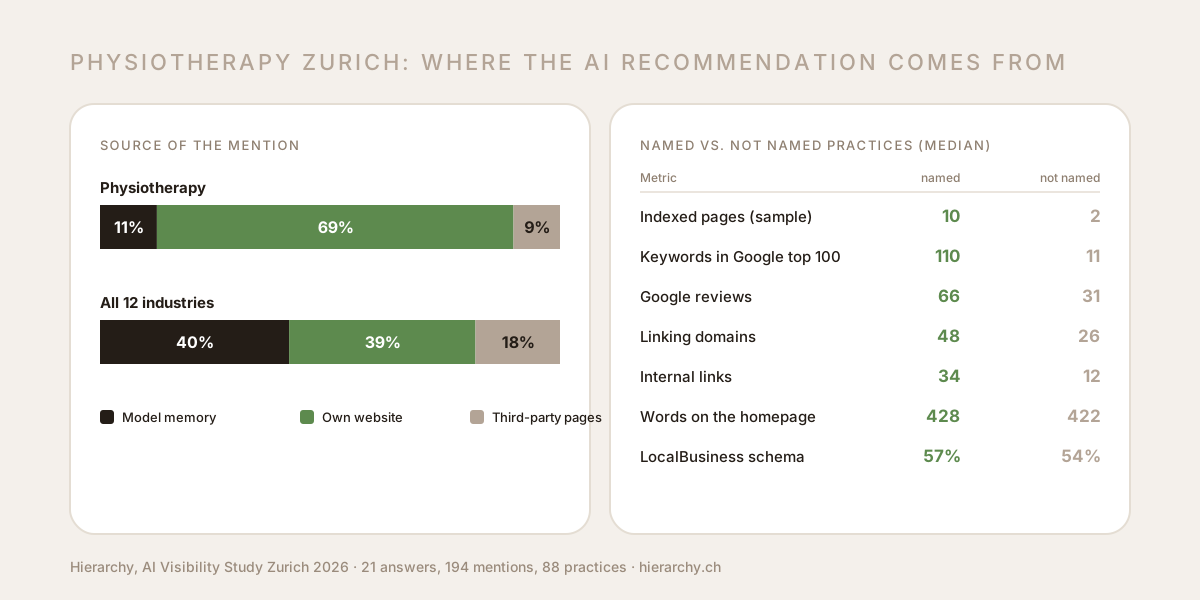
In practical terms: the classic website work that hits limits in other industries works directly here. There is no detour via media or rankings. The assistants search "Physiotherapie Zürich", open practice websites, read them and summarise what they find. Whoever has the right pages gets named.
The assistants themselves also behave distinctively in this industry: not one of the 21 answers was evasive, and 60 of the 88 compared practices appeared at least once. For dentists it was 35 of 73, for wealth managers far fewer. The assistants name physiotherapy practices readily, so there are many places to be won.
What the assistants say about physiotherapy practices
The reasons given in the 194 mentions, counted by attribute:
| Attribute in the reasoning | Occurrences |
|---|---|
| Sport, sports physiotherapy, athletes | 100 |
| Rehab, rehabilitation after surgery | 61 |
| Specialisation | 36 |
| MTT, medical training therapy, training area | 29 |
| Location: main station, central, district | 47 |
| "Modern", modern infrastructure, equipment | 25 |
| Google reviews, star rating | 19 |
| Team, interdisciplinary, experienced | 19 |
| Appointments, short notice, online booking | 18 |
| Manual therapy | 18 |
| Back, pelvic floor, lymphatic drainage, dry needling | 24 |
| English-speaking | 5 |
Sport is by far the most frequent argument, although the questions never mentioned sport. The assistants adopt the positioning that is stated most clearly on the practice websites. They write "specialised in sports medicine physiotherapy", "indoor track, Alter-G treadmill and speed court", "Qualitop-certified training", "locations in Oerlikon, Seebach and Kalkbreite" or "5.0 out of 5 with 124 reviews". Several answers say explicitly "according to its own website" or "by its own account". The assistant reads what you write about yourself and passes it on.
That has a flip side: practices whose website merely lists "physiotherapy, manual therapy, massage" give the assistant no reason to name them for back pain, after knee surgery or for pelvic floor training. A practice that spells out its specialisations gets recommended for exactly those needs.
The three assistants differ. Gemini and Claude back half of their mentions directly with a page of the named practice. Claude additionally read 16 practice websites without naming the practice in the end: the page was opened and discarded. ChatGPT lists sources collectively at the end of the answer and grounds 37 of its 65 mentions in them. Claude also regularly recommends the Physioswiss practice search and local.ch as the way to search.
What named practices do differently
88 Zurich practices, measured on the same 13 metrics: 60 named and 28 comparable, never named. The median comparison:
| Metric (median) | Named practices | Unnamed practices | Factor |
|---|---|---|---|
| Indexed pages (sample up to 10) | 10 | 2 | 5.0× |
| Keywords in Google's top 100 | 110 | 11 | 10.0× |
| Estimated organic traffic per month | 429 | 20 | 21× |
| Google reviews | 66 | 31 | 2.1× |
| Domains linking to the website | 48 | 26 | 1.8× |
| Internal links | 34 | 12 | 2.8× |
| Words on the homepage | 428 | 422 | 1.0× |
| Google star rating | 5.0 | 5.0 | 1.0× |
| LocalBusiness schema present | 57% | 54% | |
| FAQ schema present | 7% | 7% |
The table contradicts two common pieces of advice.
Longer copy achieves nothing. The homepages of both groups have around 420 words. For dentists, homepage length separates named from unnamed practices; for physiotherapy it does not. What separates them is the number of pages: named practices have ten indexed pages in our sample, unnamed ones two. Ten times as many ranking keywords follow from that. A practice with one page per location, one page per service and a team page can be found for a hundred different questions. A practice with a homepage and a contact page, for ten.
Structured data makes no difference here. 57 versus 54 percent for LocalBusiness schema, 7 versus 7 percent for FAQ schema. Schema is so rare and so evenly spread among physiotherapy practices that it explains nothing. That is no argument against it (across all industries, pages with an FAQ are cited 1.6 times as often), but it is not the lever to start with.
Reviews work, and the gap is real. 66 versus 31 reviews. The assistants often quote the number in the same sentence as the practice. Anyone below 30 should tackle that first; across all industries the share of named firms rises from 83 percent at 10 to 29 reviews to 91 percent at 30 to 99.
As always with such comparisons: these are correlations from a sample, not proof. But the direction is the same across every metric.
Which pages the assistants read
The assistants cited a source 244 times in their physiotherapy answers. Nine out of ten citations lead to a page a practice owns:
| Type of cited page | Share of 244 citations | Typical features |
|---|---|---|
| Practice subpage (location, service) | 41% | "Physiotherapie Zürich HB", "Sports physiotherapy Zurich", branch page with FAQ |
| Practice homepage | 32% | 360 to 1,500 words, services, locations, team |
| Directories (local.ch, onedoc.ch, Physiofinder) | 11% | Lists of 10 to 40 practices |
| English practice page | 9% | "Physiotherapy Zurich", English homepage |
| Practice's own guide article | 7% | "Finding the best physiotherapist in Zurich" |
Three observations from the individual pages:
Location pages are the most-cited pages of all. A practice group with one page per location ("Zürich HB", "Zürich Enge", "Zürich Altstetten") was cited 34 times, spread across those location pages. Each has 470 to 590 words, five subheadings, address, opening hours and public transport. The assistants sort practices by neighbourhood, and a location page gives them exactly that.
Service pages with substance get cited repeatedly. A branch page with 3,141 words, 21 subheadings, FAQ and review schema was cited 9 times, the same practice's "Sportphysiotherapie Zürich" page 3 times. Short can work too: a homepage with 360 words and LocalBusiness schema was cited 14 times because it states services, location and review count precisely.
Your own guide brings citations that otherwise go to directories. A practice's article titled "Finding the best physiotherapist in Zurich" was cited 13 times, its English version another 3. That is more than local.ch (5), onedoc.ch (5) and Physiofinder combined.
Directories: list yourself, but do not rely on them
Only 9 percent of mentions rely on third-party pages, the lowest value of all twelve industries. The lists the assistants read rarely turn entries into mentions:
| List or directory | Practices on the page | Named by the AI |
|---|---|---|
| amazingzurich.com, "Best physiotherapy Zurich" | 12 | 2 |
| Physiofinder, physiotherapy centres Zurich | 11 | 0 |
| Physiofinder, physiotherapy centres Zurich (second list) | 11 | 2 |
| yoys.ch, physiotherapy centre Zurich | 6 | 3 |
| Review sites (Trustindex, ProvenExpert) | 3 | 1 |
Across all industries, one in four firms on a page that was read gets named; physiotherapy lists have similar rates, but the lists are simply rarely read. The assistant goes straight to the practice.
Two directories remain mandatory nonetheless. Claude recommends the Physioswiss practice search as the official way to search, and Google AI Mode answers physiotherapy questions half from Google Business Profiles: 69 of its 134 source references point to Google Maps, and the web sources are led by two large clinics, followed by tbooking.ch, onedoc.ch and local.ch. A complete Google Business Profile and a profile on a booking platform therefore belong in the plan, even though they do little in ChatGPT and Gemini.
How do I get ChatGPT and Google to recommend my physiotherapy practice?
The question behind every enquiry we receive. The short answer: you cannot switch it on, but in physiotherapy the route is more direct than in any other industry. The longer answer in five questions.
How do AI assistants recommend physiotherapy practices in the first place?
An assistant has no list you can register on. Every answer is composed fresh, and practices get into it by three routes. First, live search: ChatGPT and Gemini search the web (ChatGPT through the Bing index, Gemini through Google), open the practice websites and summarise what is on them. For Zurich physiotherapy practices, 69 percent of mentions come from this route, more than in any other of the twelve industries. Second, the model's memory (11 percent), third, third-party pages such as local.ch or onedoc.ch (9 percent). Google AI Mode answers mostly from Google Maps and booking platforms.
For you that means: seven out of ten mentions happen because the assistant reads your website. If the right pages exist, the practice gets named. If they do not, it is invisible, however good it is.
Can I tell ChatGPT directly to recommend my practice?
No. There is no registration, no form and no paid placement inside the answer. Anyone selling you a "listing in ChatGPT" is selling something that does not exist. The assistants choose from what they can find and read. The route is open to every practice and costs work on the website rather than media budget.
Does my physiotherapy practice still need SEO if patients ask ChatGPT?
Yes, and precisely the SEO the table above shows. The assistants search in the user's words: "physiotherapy Zurich Enge sports injury", "physio Zurich HB short-notice appointment", "pelvic floor therapy Zurich". A practice found for many such phrases gets read often and therefore named. Named Zurich practices rank for 110 keywords, unnamed ones for 11, and the reason is page count: ten indexed pages against two.
What counts for little is position 1 for "physiotherapy Zurich". Across all industries, 77.5 percent of the firms named by AI are absent from Google's top 10 for the question asked; whether a practice is there is the weakest signal in our study, breadth of findability the strongest. The fundamentals remain classic SEO: indexable, fast pages, one page per location and per service, internal links, schema. The goal shifts: not winning one keyword, but being found for a hundred.
What is the difference between SEO and AI visibility?
SEO puts your page into a list the patient clicks on. AI visibility puts your practice into an answer that names three to eight practices and gives a reason for each: sports physiotherapy, rehabilitation after surgery, location by the main station, "5.0 from 124 reviews", short-notice appointments. The assistant takes those reasons from your website. If "appointments within 48 hours, evenings too" is there as a sentence on the location page, it can quote it; if it only lives in a booking widget, it cannot.
That is why AI visibility is SEO plus content: the same technical base, but pages that carry the arguments for a recommendation in full sentences. How we implement it is described under SEO & AI visibility.
How fast does it work, and how do I check?
Because the assistants read the website live, new location and service pages work as soon as they are indexed, usually within weeks. The memory route hardly matters in physiotherapy at 11 percent, so there is nothing to wait for. Check it yourself: ask ChatGPT, Gemini and Google AI Mode the five questions from this article every month and note who gets named and with what reason. From the outside, the free AI visibility check does the same.
Checklist: 12 points for your physiotherapy practice website
And a 13th point: measure it. The same five questions every month to ChatGPT, Gemini and Google AI Mode, count the mentions. How to do it is in Measuring AI visibility.
What we do for physiotherapy practices
Hierarchy is a full-funnel marketing and AI agency for SMEs in Zurich, specialising in SEO, GEO and paid ads, with marketing and engineering in one team of four people. We base our recommendations on our own data study of AI recommendations, and we implement the changes ourselves: location and service pages, copy, structure, English version, Google Business Profiles, instead of sending a list to your webmaster. Ongoing work includes a monthly report of AI mentions. Where your practice stands today is shown by the free AI visibility check. Details on services and prices: SEO & AI visibility.
Conclusion
Physiotherapy practices have the most direct access to AI recommendations of all the industries we measured. Seven out of ten mentions exist because the assistant read the practice website. It rewards not the longest homepage but the practice with one page per location, one page per service, a clear specialisation and at least 30 reviews. Directories are mandatory for Google AI Mode but not the lever. The numbers for all twelve industries, the thresholds for reviews and links and the full 14-step guide are in the AI Visibility Study Zurich 2026.

About the author