Contents
Every second AI recommendation for a dentist in Zurich comes straight from the practice's own website. 50 percent of mentions are grounded in the practice site, 29 percent in the model's memory, 15 percent in third-party pages. Directories and "best dentists" lists barely register: of 18 practices on the local.ch list, none was named. Named practices have four times as many linking domains, six times as many ranking keywords and a homepage of around 930 words instead of 630. This article shows what ChatGPT, Gemini and Google AI Mode say about Zurich dentists, which pages they read to say it, and what to change on your website.
"Zahnarzt Zürich" is searched about 1,900 times a month on Google, "Notfall Zahnarzt Zürich" 390 times, "dentist zurich" 590 times. A click on an ad for the main term costs around CHF 23. On top of that sits a demand no statistic shows: people who ask ChatGPT or Gemini "Which dentists in Zurich would you recommend?" and follow the answer without searching further. Whoever appears there gets patients who have already decided.
For our AI Visibility Study Zurich 2026 we analysed 1,515 answers from Claude, ChatGPT and Gemini across twelve Zurich industries. For this article we went back through the dentist rows in detail: 21 answers to five question variants, 131 mentions, 73 practices compared, plus 241 source references from ten Google AI Mode answers. The questions were phrased the way people actually ask them:
- "Welche Zahnärzte in Zürich kannst du empfehlen?" (Which dentists in Zurich can you recommend?)
- "Ich bin neu in Zürich und suche eine Zahnarztpraxis für eine Kontrolle und die Dentalhygiene. Hast du eine Empfehlung?" (I am new in Zurich and looking for a practice for a check-up and dental hygiene. Any recommendation?)
- "bester zahnarzt zürich" (best dentist zurich)
- "Nenne mir 5 gute Zahnärzte in Zürich und was für sie spricht." (Name 5 good dentists in Zurich and what speaks for them.)
- "Which dentists in Zurich would you recommend?"
Where the AI gets its dentist recommendation
An AI assistant can name a practice from three sources: the model's memory (the practice was in the training data), the practice's website (the assistant read it live while answering) or a third-party page (a directory, a list, an article). Which source dominates decides the right strategy. For dentists the picture is unambiguous:
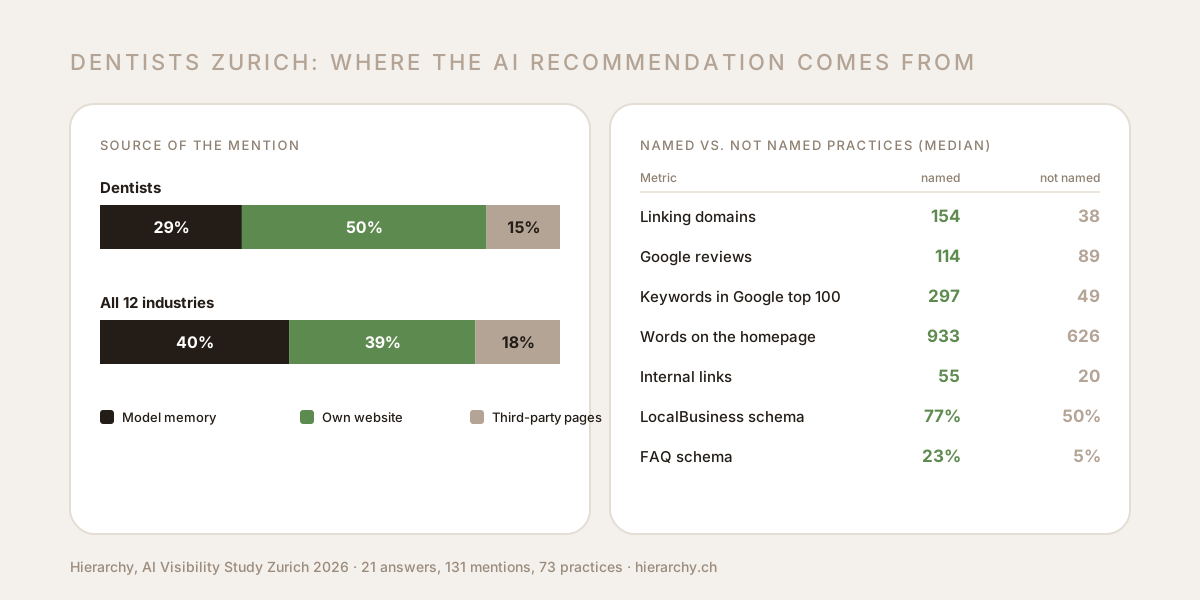
For comparison: among wealth managers, 57 percent of mentions come from the model's memory, among business law firms 52 percent. A better website helps little there; it takes years of presence in rankings and media. Dentists are the opposite. The assistant searches, opens practice websites and decides on what it finds there. That is the good news: the most important lever is entirely in your hands.
What ChatGPT, Gemini and Claude say about dentists
The assistants name 1.3 practices per sentence on average, and almost always with a reason. We counted which attributes appear in the 131 mentions:
| Attribute in the reasoning | Occurrences |
|---|---|
| Location: main station, Bahnhofstrasse, district, "central" | 67 |
| "Modern", modern equipment, laser, CEREC | 24 |
| Aesthetic dentistry, bleaching, veneers | 19 |
| Google reviews, star rating | 17 |
| Implants | 17 |
| Specialisation (orthodontics, surgery, children) | 15 |
| Emergency, weekend, evening, 365 days | 15 |
| Appointments, opening hours, online booking | 13 |
| Anxious patients, pain-free treatment | 8 |
| English-speaking | 6 |
Two things stand out. First: the reasons are paraphrases of the practice websites. The assistant writes "open 365 days a year, practical for emergencies", "laser and CEREC", "over 25,000 patients trust the team" or "4.9 stars with over 150 Google reviews". That is what the respective homepage says. What is not on your website, the assistant cannot say about you. Second: location is the most frequent argument. The assistant sorts practices by district, neighbourhood and public transport. A practice whose website never mentions its district and nearest tram stop is invisible to that sorting.
Claude behaves differently from ChatGPT and Gemini. In 2 of 7 answers, Claude named no practice at all and instead explained how to find one: via the dentist search of the SSO (Swiss Dental Association), the Zurich dental society, Google Maps or Doctolib. Practices missing from those directories therefore lose part of the recommendations even when Claude names nobody. Gemini reads the practice website most consistently: 23 of its 58 mentions are backed directly by a page of the named practice. ChatGPT leans more on sources it lists at the end of the answer, and on its memory.
What named practices do differently
We measured 73 Zurich practices on the same 13 metrics: the 35 that were named at least once, and 38 comparable practices that never appeared. The median comparison:
| Metric (median) | Named practices | Unnamed practices | Factor |
|---|---|---|---|
| Domains linking to the website | 154 | 38 | 4.1× |
| Keywords in Google's top 100 | 297 | 49 | 6.1× |
| Estimated organic traffic per month | 1,460 | 162 | 9.0× |
| Words on the homepage | 933 | 626 | 1.5× |
| Internal links | 55 | 20 | 2.8× |
| Google reviews | 114 | 89 | 1.3× |
| Google star rating | 5.0 | 5.0 | 1.0× |
| LocalBusiness or Dentist schema present | 77% | 50% | |
| FAQ schema present | 23% | 5% | |
| Review schema present | 26% | 11% | |
| Google Business Profile present | 91% | 100% |
Three readings:
Reviews are the ticket in, not the differentiator. Both groups have 5.0 stars and well over 30 reviews. Across all twelve industries, the share of named firms rises from 67 percent at 1 to 9 reviews to 91 percent at 30 to 99, and little happens after that. Zurich dentists have usually passed that threshold long ago. Collecting another 50 reviews does little for AI recommendations. And a Google Business Profile alone is not enough: every unnamed practice has one.
The difference is in the substance of the website. Named practices have four times as many linking domains, six times as many ranking keywords and nine times the organic traffic. Those are not numbers a practice catches up on in a month. But they show what the assistants reward: websites found for many terms around dentistry in Zurich, because they have a page for every topic.
Structured data helps. 77 percent of named practices have a LocalBusiness or Dentist schema on their site, against 50 percent of unnamed ones. The gap is widest for FAQ schema: 23 versus 5 percent. Across all industries, pages with an FAQ section are cited 1.6 times as often as pages without.
This is a comparison, not a causal chain. But the direction is clear: it is not the practice with the most stars that gets recommended, but the one with the most complete website.
Which pages the assistants actually read
The assistants cited a source 176 times in their dentist answers. We opened and measured every one of those pages. The patterns:
The practice homepage is the most important page. The most-cited pages are practice homepages with 1,000 to 2,000 words and 7 to 16 subheadings: services, team, opening hours, emergencies, location, technology, languages, all on one page. The most-cited practice homepage in our data has 1,086 words, nine H2 sections, an FAQ part and a Dentist schema with address, coordinates and opening hours. It was cited 16 times.
A practice's own guide article attracts citations. The second most frequent source is not a directory but a practice's blog post titled "Zahnarzt in Zürich finden" (finding a dentist in Zurich), 13 citations. The practice answers the question the user is asking the assistant, and gets cited as the source for it. That is the cheapest measure in this article.
English pages are read separately. The English version of a practice website and pages like "English-speaking dentist Zurich" were cited several times, as was the English local.ch list for Zurich. Zurich has a high share of newcomers who ask in English. A practice without an English page does not exist for those questions.
Location pages and review pages count. One page per location ("Zahnarztzentrum Zürich HB") and a dedicated reviews page on the practice website were cited too. The assistants prefer reading reviews on your site rather than on Google, because there they sit in the context of the services.
| Type of cited page | Share of 176 citations | Typical features |
|---|---|---|
| Practice homepage | 35% | 1,000 to 2,000 words, services, team, emergencies, schema |
| Practice subpage (service, location) | 18% | "Zahnarztzentrum Zürich HB", "Aesthetic dentistry" |
| Directories (zuri.net, search.ch, local.ch) | 18% | Lists of 10 to 40 practices |
| English practice page | 14% | "English-speaking dentist", English homepage |
| Practice's own guide article | 7% | "Finding a dentist in Zurich", 670 words |
| Comparison listicles | 5% | "The best dentists in Zurich" |
| Practice's review page | 3% | Reviews with FAQ and schema |
Three out of four citations lead to a page the practice itself owns. Directories and listicles together account for a quarter.
Directories and "best dentists" lists: why they hardly work for dentists
In many industries the decisive question is which third-party page a firm is listed on. For moving companies, 32 percent of mentions come from third-party pages, for marketing agencies 28 percent. For dentists it is 15 percent, and the lists that exist rarely turn entries into mentions:
| List or directory | Practices on the page | Named by the AI |
|---|---|---|
| diebestenderstadt.de, "Best dentists in Zurich" | 60 | 3 |
| zahnarzt-vergleich-schweiz.ch, canton of Zurich | 25 | 1 |
| local.ch, dentist Zurich | 18 | 0 |
| stilpunkte.de, "Best dentists Zurich" | 18 | 0 |
| bestezahnaerzte.ch, Zurich | 14 | 0 |
| local.ch, English-speaking dentists | 12 | 1 |
| zurich10.com, Dentist | 10 | 3 |
Across all industries, one in four firms listed on a page the assistant read also gets named. On dentist lists it is one in twenty. The reason is length: a list of 60 practices gives the assistant no reason to pick a particular one, so it opens the practice websites and decides there. An entry does no harm, but it does not replace a website.
Two exceptions: the directories of the SSO and the Zurich dental society are recommended by Claude as the way to search. And zurich10.com, a curated list of ten practices, has the best rate at 3 of 10. Short, reasoned lists work; long ones do not.
Google AI Mode: a different game
Google AI Mode, Google's own AI assistant, answers dentist questions almost entirely from Google Maps. Of 241 source references in ten answers, 180 point to Google Business Profiles. Among web sources, onedoc.ch leads, followed by individual practice websites and one review page.
For you this means: the Google Business Profile must be complete (categories, services, opening hours, photos, attributes such as "emergency service" and "English"), and a profile on onedoc.ch or a comparable booking platform is part of AI visibility. Also important is what Google AI Mode does not do: it does not copy the top 10 of Google Search. Across all industries, 76.7 percent of the firms Google AI Mode recommended were missing from Google's own top 10 for the same search. Rank 1 for "Zahnarzt Zürich" guarantees no recommendation, and rank 15 does not rule one out.
How do I get ChatGPT and Google to recommend my dental practice?
We get this question in exactly this form almost every day. The short answer: you cannot switch it on, but you can earn it. The longer answer in five questions, the way practice owners ask them.
How do AI assistants recommend dental practices in the first place?
An assistant keeps no list you can register on. Every answer is composed fresh, and practices get into it by three routes. First, live search: for a dentist question, ChatGPT and Gemini search the web (ChatGPT through the Bing index, Gemini through Google), open the websites they find and summarise what is on them. For Zurich dentists, every second mention comes from this route. Second, memory: the model learned a practice during training because it appeared on many pages over the years, and names it without searching (29 percent). Third, third-party pages: a list, a directory, a review site (15 percent). Google AI Mode is the special case and answers almost entirely from Google Maps.
The consequence: a practice that is not named today gets in fastest through the first route. The website has to be found and read, and it has to contain the arguments the assistant is looking for.
Can I tell ChatGPT directly to recommend my practice?
No. There is no registration, no form and no paid placement inside the answer. Offers that sell you a "listing in ChatGPT" sell something that does not exist. What the assistants recommend follows from what they can find and read. That is also the good news: the route is open to every practice, and it costs work on your own website rather than media budget.
Does my dental practice still need SEO if patients ask ChatGPT?
Yes, more than before, but a different kind of SEO. The assistants do not only search "dentist Zurich". They search the way the user asked: "emergency dentist Zurich Kreis 6 Sunday", "dentist Zurich anxious patients English", "implant cost Zurich". A practice that is found for many such phrases gets read often, and a practice that gets read often gets named. Named Zurich practices rank for 297 keywords, unnamed ones for 49.
What counts for little is the single top position: across all twelve industries in our study, 77.5 percent of the firms named by AI are absent from Google's top 10 for the question asked. Whether a firm is in that top 10 is the weakest of all signals we tested. Breadth of findability is the strongest. The fundamentals stay the same as in classic SEO: indexable, fast pages, one page per topic, clean internal linking, schema. What shifts is the goal: not position 1 for one keyword, but being found for a hundred.
What is the difference between SEO and AI visibility?
SEO puts your page into a list the patient clicks on. AI visibility puts your practice into an answer the patient reads, usually without clicking. The answer names three to eight practices and gives a reason for each: location, emergency hours, specialisation, review count, languages. The assistant does not write those reasons itself, it takes them from your website. If "emergencies daily until 8 pm, including weekends" is there as a sentence, it can quote it. If it is only an icon or inside an image, it cannot.
That is why AI visibility is SEO plus content: the same technical base, but pages that carry the arguments for a recommendation in full sentences. We describe the approach as a service here: SEO & AI visibility.
How fast does it work, and how do I check?
The website route works as soon as Google and Bing have indexed the new pages, usually within weeks. The memory route takes months to years, because the model only relearns at its next training run. You can check both yourself: ask ChatGPT, Gemini and Google AI Mode the five questions from this article every month and note who gets named and with what reason. If you want to see it from the outside once, the AI visibility check does exactly that, free of charge.
Checklist: 12 points for your dental practice website
And a 13th point that is not on the website: measure it. Ask ChatGPT, Gemini and Google AI Mode the same five questions every month and note who gets named. Only then do you see whether the work is working. How to do it is in Measuring AI visibility.
What we do for dental practices
Hierarchy is a full-funnel marketing and AI agency for SMEs in Zurich, specialising in SEO, GEO and paid ads, with marketing and engineering in one team of four people. We base our recommendations on our own data study of AI recommendations, and we implement the changes ourselves: copy, structure, schema, English version, Google Business Profile, instead of sending a list to your webmaster. Ongoing work includes a monthly report of AI mentions. Where your practice stands today is shown by the free AI visibility check. Details on services and prices for practices: SEO, AEO & GEO for dentists.
Conclusion
Dentists are the industry where AI visibility is most directly influenceable. The assistants read your website and phrase the recommendation from it. They reward practices with a complete homepage, one page per service, clear emergency hours, an English version and structured data, not the practice with the most stars. Directories and long best-of lists are side dishes. The numbers for all twelve industries, the thresholds for reviews and links and the full 14-step guide are in the AI Visibility Study Zurich 2026.
About the author