Architecture Firm Marketing Zurich 2026: 52 Percent of AI Recommendations Come From the Model's Memory
Data study for architecture firms in Zurich: only 27 percent of mentions in ChatGPT, Gemini and Claude are grounded in the firm's own website, the lowest figure of all twelve industries. Named firms are mentioned on 38 external domains instead of 4. What the assistants give as reasons, and what that means for your firm.
Architecture is the industry where the firm's own website counts least. 52 percent of AI mentions for Zurich architecture firms come from the model's memory, 27 percent from the firm's website, 17 percent from third-party pages. Those 27 percent are the lowest figure of all twelve industries in our study. What separates named firms is not on their own site: they are mentioned by name on 38 external domains instead of 4. This article shows what ChatGPT, Gemini and Google AI Mode say about architecture firms, what they base their recommendations on, and which lever actually works given that starting point.
Someone in Zurich planning to convert a commercial building today often no longer asks their own network but an assistant: "We are planning the conversion of our commercial building in Zurich and are looking for an architecture firm. Any recommendation?" The answer is a list of five to ten firms with reasons, and the client writes to two of them. Google publishes no reliable search volumes for most of these terms. What can be measured is who appears in the answers and why.
For our AI Visibility Study Zurich 2026 we analysed 1,515 answers from Claude, ChatGPT and Gemini across twelve Zurich industries. For this article we went back through the architecture rows in detail: 15 analysed answers to five question variants, 170 mentions, 76 different firms named, 105 firms measured on the same metrics, plus the source references from six Google AI Mode queries. Not a single evasive answer. The questions:
- "Welche Architekturbüros in Zürich kannst du empfehlen?" (Which architecture firms in Zurich can you recommend?)
- "Wir planen den Umbau unseres Geschäftsgebäudes in Zürich und suchen ein Architekturbüro. Hast du eine Empfehlung?" (We are planning the conversion of our commercial building in Zurich and are looking for an architecture firm. Any recommendation?)
- "bestes architekturbüro zürich" (best architecture firm zurich)
- "Nenne mir 5 gute Architekturbüros in Zürich und was für sie spricht." (Name 5 good architecture firms in Zurich and what speaks for them.)
- "Which architecture firms in Zurich would you recommend?"
Architecture: the industry where the website decides least
An assistant names a firm from the model's memory, from the firm's website which it reads live while answering, or from a third-party page. Across all twelve industries that splits 40, 39 and 18 percent. For architecture firms it is 52, 27 and 17 percent, with the remaining 4 percent on pages that were read but not cited.
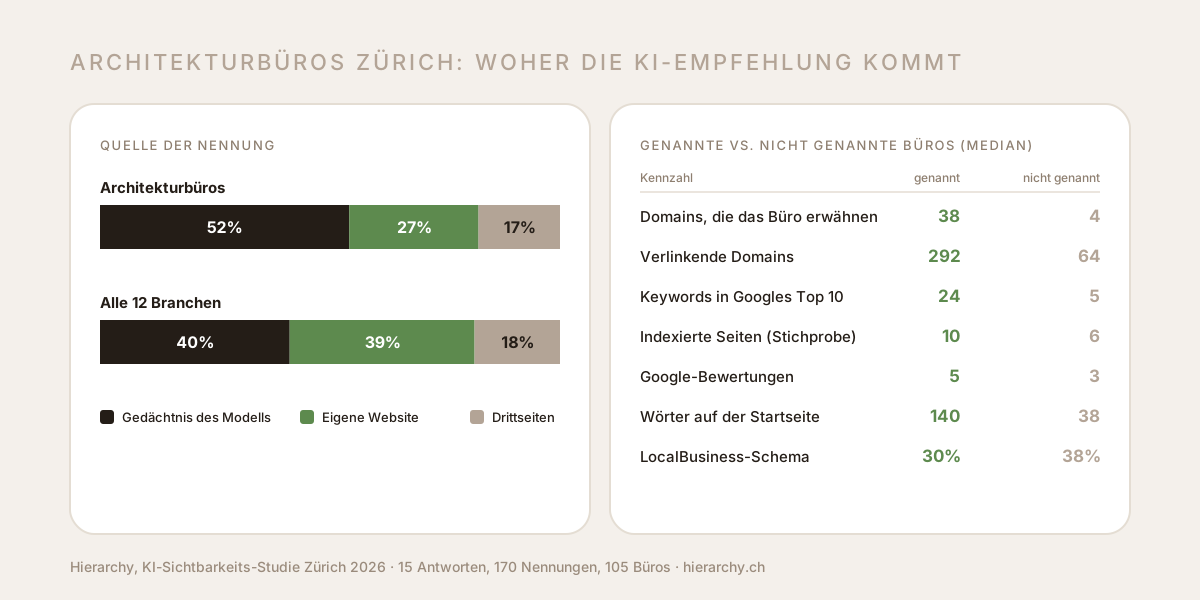
That puts architecture at the end of a table whose other end we described two weeks ago. For physiotherapy practices, 69 percent of mentions are grounded in the practice's own website; for architecture firms, 27. No value in the study is lower. Only wealth managers (57 percent memory) and business law firms (52 percent) sit above architecture, two industries where reputation and publicity likewise govern access.
That is the uncomfortable news for an architecture firm: the website work that brings a physiotherapy practice mentions within weeks shifts at most a quarter of the answer here. We deliberately looked for a segment where things look different, and found none. Even among the firms with the least publicity, mentioned on fewer than 20 external domains, 41 percent of mentions come from memory and only 24 percent from their own website. There is no niche in this industry where the firm's own page carries the answer.
The good news is in the same table. Concentration is lower than the memory share suggests: the three most-named firms take 16 percent of mentions, the top 10 reach 42 percent, and 46 of the 76 named firms appeared exactly once. The assistants are not working from a short list of star architects; they reach far into the field. Just not through the website.
What the assistants say about architecture firms
The justifications across the 170 mentions, counted by feature:
| Feature in the justification | Occurrences |
|---|---|
| Specific reference project named | 26 |
| Conversion, renovation, existing fabric, heritage | 24 |
| Award or prize | 19 |
| Founding year or founding partners | 19 |
| Additional locations, international work | 17 |
| Commercial, office or retail buildings | 15 |
| Culture, museums, schools, public buildings | 11 |
| Interior architecture | 10 |
| Competition wins | 7 |
| Ranking, rating or list | 6 |
| Firm size, headcount | 6 |
| Housing, cooperatives | 5 |
| Google reviews or stars | 4 |
| ETH connection or teaching | 3 |
| Sustainability, Minergie, timber construction | 3 |
| Location, district, address | 1 |
| Fees, costs, budget | 0 |
This table is the actual finding. The assistants justify architecture recommendations with built projects, prizes, founding history and international presence. They write "known for realising the Toni-Areal", "received the Prix Meret Oppenheim in 2014", "founded in 1997 by two architects, offices in Zurich and Berlin", "projects in the permanent collections of respected institutions".
The three assistants behave differently here. Claude named at least one selection aid unprompted in all five answers: the BauNetz ranking in three answers, plus the Archinaut Rating 2025, architektvergleich.ch, Houzz and swiss-architects.com. ChatGPT pointed to Wikipedia twice. Gemini named no external source in any answer, yet delivered the most mentions with 77 of 170.
Almost none of this normally appears on an architecture firm's website in a form a model can pick up. A project portfolio shows images with a caption. The sentence "the Toni-Areal in Zurich, completed 2014, 40,000 square metres, conversion of a dairy plant into a university" is usually nowhere on the page. So the assistant takes it from Wikipedia, from the trade press, or from its own memory.
Two features are almost entirely absent, and both are central in other industries. Location appeared once. Where assistants sort physiotherapy practices by district, the address within Zurich plays no role for architecture firms. Fees appeared not once, even though one of the five questions describes a concrete project with budget implications. Anyone planning to build visibility on price transparency is addressing a criterion that does not appear in our data.
The most frequent substantive feature after the reference project is conversion, renovation and building in the existing fabric, with 24 mentions. That is the one specialisation the assistants reliably pick up, and they do so especially when the question describes a conversion project. A firm that gives work on existing buildings its own heading, rather than listing it as one of twelve services, gives the assistant a reason to name it for exactly those enquiries.
What named firms do differently
105 Zurich architecture firms, measured on the same metrics: 73 named and 32 comparable, never-named ones. The median comparison:
| Metric (median) | Named firms | Unnamed firms | Factor |
|---|---|---|---|
| Domains mentioning the firm by name | 38 | 4 | 11× |
| Web mentions in total | 177 | 9 | 21× |
| Estimated organic traffic per month | 1,200 | 90 | 13× |
| Backlinks | 1,221 | 135 | 9× |
| Keywords in Google's top 10 | 24 | 4.5 | 5× |
| Keywords in Google's top 100 | 84 | 17 | 5× |
| Domains linking to the website | 292 | 64 | 4.6× |
| Words on the homepage | 140 | 38 | 3.7× |
| Internal links | 36 | 18 | 2.1× |
| Indexed pages (sample up to 10) | 10 | 6 | 1.7× |
| Google reviews | 5 | 3 | 1.7× |
| Google star rating | 4.6 | 5.0 | |
| LocalBusiness schema present | 30% | 38% | |
| FAQ schema present | 1% | 8% | |
| Google Business Profile present | 100% | 100% |
The table is unusually clear-cut, and it points in a different direction than in any other industry in the study.
The largest gap lies outside the firm's own website. 38 versus 4 domains mentioning the firm by name, and 177 versus 9 mentions in total. That is eleven and twenty-one times respectively, the largest difference in the entire dataset. Whoever writes about a firm feeds exactly the channel that 52 percent of mentions come from.
The website metrics barely separate. 10 versus 6 indexed pages is the weakest page-count gap of all industries; for physiotherapy practices it is 10 versus 2. Both groups have an almost text-free homepage: 140 versus 38 words in the median, and even 140 words is little for an assistant. Architecture websites are image portfolios, and that holds for named and unnamed firms alike.
Structured data explains nothing here. 30 versus 38 percent for LocalBusiness schema, 1 versus 8 percent for FAQ schema: the unnamed firms even have slightly more of it. That is not an argument against schema (across all industries, pages with FAQ are cited 1.6 times as often), but in this industry it is neither cause nor symptom. The absolute number is worth noting: of 71 measured named firms, exactly one has FAQ markup. A field that is practically empty.
Google reviews are not a lever. 5 versus 3 reviews, and the named firms even have the lower star rating at 4.6 against 5.0. Anyone arriving from the dentist or physiotherapy playbook, where reviews run between 30 and 66 and the assistants quote them directly, should strike this point here.
As always with comparisons like these: these are correlations from a sample, not proof. Publicity and quality of commissions are connected, and a firm does not become better because people write about it. For the question of what an assistant finds and passes on, the direction is nonetheless the same across every metric.
Which pages the assistants read
The assistants cited a source 125 times in their architecture answers. 64 percent of those citations lead to a firm's website, the rest to third-party pages. That sounds like a contradiction of the 27 percent above, but it is the same finding from the other side: when an assistant cites at all, it usually cites a firm. It just rarely cites, because it already knows the names.
The most-cited individual sources in the industry are not firm websites:
| Source | Citations | Type |
|---|---|---|
| archello.com, "25 best architecture firms in Switzerland" | 20 | Editorial best-of list, German and English |
| archinaut.ch, "Archinaut Rating 2025" | 12 | Industry rating of the top 100 Swiss firms |
| baunetz.de, regional ranking Switzerland | 7 | Trade press points system |
| listenchampion.de, "Top 5 architects from Zurich" | 6 | Editorial list |
| wikipedia.org | 6 | Firm and person articles |
| studioforma.ch, "Architekturbüros in Zürich" | 6 | Overview article by a firm |
| swiss-architects.com | 3 | Profile and team pages |
| architektvergleich.ch | 2 | Quote comparison platform |
| dieschweizerarchitekturpreise.ch | 2 | Award archive |
Three observations from the individual pages:
A single best-of list carries every sixth citation in the industry. The Archello article was cited 20 times across both language versions and supported 15 mentions. The Archinaut rating supported 13. Firms on those two pages get carried into the answer; firms that are not have to hope to come from memory.
Short profile pages are enough for a citation, not for a justification. Several firm homepages of 20 to 250 words were cited two to six times without producing a grounded mention: the assistant read the page, found nothing quotable, and then justified the name from memory. A profile page of 3,383 words, by contrast, directly supported two mentions.
A firm's own overview article about its industry works. One Zurich firm runs a page titled "Architekturbüros in Zürich" with 1,781 words that lists other firms. It was cited six times, more often than almost any individual firm website. We saw the same pattern with accounting firms and physiotherapy: your own guide picks up citations that would otherwise go to directories.
Competition archives instead of business directories
Of the firms that appeared on a list the assistant read, 29 percent were also named in the same answer; across all twelve industries it is 25 percent. A listing therefore works above average in this industry, provided the list gets read. Which lists those are is the surprise:
| List read | Firms on it | Of those, named |
|---|---|---|
| Hochparterre competition archive, project search | 47 | 5 |
| listenchampion.de, top 5 architects Zurich | 8 | 5 |
| valindex.ch, architecture and planning firms | 6 | 4 |
| wettbewerbe-aktuell.de, results page for a Zurich procedure | 7 | 3 |
| swiss-architects.com and world-architects.com, team pages | 8 | 3 |
| A firm's cooperation page | 13 | 3 |
The classic business directory does not appear in this list. What the assistants open are competition archives, results pages, industry platforms and press articles. For a firm that means: the entry that pays off is the complete, correctly spelled name in the competition result and a maintained profile on an industry platform, not a listing on local.ch.
Google AI Mode behaves differently again. Across six queries, 62 source references went to the Google Business Profile panel and 28 to web sources, and the web half is led by Archello, Divisare, swiss-architects.com, espazium.ch, hochparterre.ch, archdaily.com and baunetz.de. Google AI Mode named 38 firms, only 6 of which the three assistants also named. Serving both surfaces means a complete Google Business Profile and a presence in the trade press: two jobs, not one.
How do I get ChatGPT and Google to recommend my architecture firm?
The question behind every enquiry we get. The short answer: you cannot configure it, and for architecture firms the route is longer than in any other industry we measured. The longer answer, in five questions.
How do architecture firms get recommended by AI in the first place?
An assistant has no list you can sign up for. Every answer is generated fresh, and firms get into it three ways. First, the model's memory: the name appeared often enough in the training data, meaning in the trade press, Wikipedia, competition results, rankings, university pages. For Zurich architecture firms, 52 percent of mentions come this way. Second, live search, where the assistant opens the firm's website and summarises what it says: 27 percent. Third, third-party pages such as Archello, Archinaut or BauNetz: 17 percent.
For you that means: roughly half of your chance is decided in texts other people write about you. A quarter is decided on your own page, and that quarter is the part you can change this week.
Can I tell ChatGPT directly to recommend my firm?
No. There is no registration, no form and no paid slot in the answer. Anyone selling you a "ChatGPT listing" is selling something that does not exist. The assistants choose from what they have learned and what they can find.
What helps most when the website is only a quarter of it?
In this order. First: get onto the lists that get cited. Archello, the Archinaut rating, BauNetz, swiss-architects.com and the award archives together carry more citations than all firm websites combined. These are editorial inclusions and profiles, not ad slots, and they are reachable.
Second: treat competition results and project publications as visibility work. A procedure you took part in produces a results page with your name on it. Check that it is written there in full and consistently, the same spelling as on your website and in every profile. Inconsistent firm naming is the most common reason a name fails to add up.
Third: translate reference projects into text. 26 of the 170 justifications name a specific project. If your project pages consist of images and a one-line caption, an assistant cannot quote anything from them. Use, year, floor area, client, task, particularity, in full sentences: that is the form in which assistants pass projects on.
Fourth: spell out work on existing buildings if you do it. Conversion and renovation are the most-named substantive feature with 24 mentions, and the specialisation clients actually search for in the questions.
Does my architecture firm still need SEO?
Yes, but with a different goal. Named firms rank for 24 keywords in Google's top 10, unnamed ones for 4.5. The connection is real but runs largely through publicity: whoever gets linked ranks and gets read. What counts for little is position 1 for "Architekturbüro Zürich". Of the 76 firms named by AI, 3 appeared in Google's organic top 10 for the same question. Across all industries, 77.5 percent of AI-named firms are missing from Google's top 10; for architecture firms it is 96 percent. The two surfaces barely overlap here.
On top of that comes a language question that exists in this severity only in this industry: German answers named 62 firms, English answers 34, and only 20 appeared in both. 14 firms appeared exclusively in English answers. Anyone wanting international clients needs an English version that is more than a translated homepage.
How fast does it work, and how do I check it?
Slower than elsewhere, and at two speeds. The 27 percent grounded in your website respond within weeks, as soon as new pages are indexed. The 52 percent from memory only shift with the next model training, and the route there runs through mentions on other people's pages, which take months. Plan for a year, not a quarter.
Check it yourself: ask ChatGPT, Gemini and Google AI Mode the five questions from this article every month and note who is named and on what grounds. From the outside, the free AI visibility check does it for you.
Checklist: 12 points for your architecture firm's visibility
And a 13th point: measure it. The same five questions monthly to ChatGPT, Gemini and Google AI Mode, counting mentions. How to do that is in measuring AI visibility.
What we do for architecture firms
Hierarchy is a marketing and AI agency in Zurich with four people. We are the only agency in Switzerland that bases its recommendations on its own data study of AI recommendations, and we implement the changes ourselves: project pages with quotable text, pages for existing-building work and services, an English version, consistent firm naming across every profile, inclusion in the lists and platforms that actually get cited, Google Business Profile. An audit of your website costs CHF 800 to 5,000 depending on size; ongoing support with monthly reporting of AI mentions starts at CHF 600 per month. Where your firm stands today is shown by the free AI visibility check. Details on services and prices: SEO & AI visibility.
If you want to use AI inside the office rather than be recommended by it: ChatGPT or Claude for architects compares the two models for competition texts, standards, visualisation and BIM.
Conclusion
Architecture firms have the longest route into an AI recommendation of all twelve industries we measured. Every second mention comes from training memory, only every fourth from the firm's own website. What separates named firms is 38 versus 4 external domains mentioning them, not more pages, more schema or better reviews. The lever is therefore publicity: get onto the cited best-of lists and ratings, treat competition results and project publications as visibility work, write the firm name the same way everywhere. And on your own site, make up the one thing genuinely missing there: reference projects in full sentences. The figures for all twelve industries are in the AI Visibility Study Zurich 2026.
Frequently asked questions
- Do ChatGPT and Gemini recommend specific architecture firms in Zurich?
- Yes, without hesitating. Across five questions, ChatGPT, Gemini and Claude named a specific firm 170 times in 15 answers, without a single evasive answer. 76 different firms appeared. The assistants supply names, founding years, reference projects and awards along with them.
- Where do ChatGPT and Gemini get their architecture firm recommendations from?
- 52 percent of mentions come from the model's memory, meaning from training, without any page being read during the answer. 27 percent are grounded in the firm's own website, 17 percent in third-party pages such as Archello, Archinaut or BauNetz. Those 27 percent are the lowest own-website share of all twelve industries in our study.
- What separates named architecture firms from unnamed ones?
- Not the website. Named firms are mentioned by name on 38 external domains, unnamed ones on 4. They have 292 linking domains instead of 64 and rank for 24 keywords in Google's top 10 instead of 4.5. On their own website characteristics the gap is small: 10 indexed pages instead of 6, 140 words on the homepage instead of 38. Structured data and Google reviews do not separate the two groups at all.
- How many Google reviews does an architecture firm need?
- For the AI recommendation, almost none. Named Zurich architecture firms have a median of 5 Google reviews, unnamed ones 3, and the named ones even have the lower star rating at 4.6. Reviews appeared in four of 170 justifications. For dentists and physiotherapy practices the review count is a main driver; for architecture firms it is not.
- Is a listing on Archello, Archinaut or architektvergleich.ch worth anything?
- More than in most industries. 17 percent of mentions are grounded in third-party pages, and the most-cited sources in this industry are Archello, the Archinaut rating, the BauNetz ranking and swiss-architects.com. Of the firms that appeared on a list the assistant read, 29 percent were named in the same answer, against 25 percent across all industries.
- Why does ChatGPT always recommend the same large architecture firms?
- Because every second mention comes from training memory, and well-known names sit there. The concentration is nonetheless lower than expected: the three most-named firms take 16 percent of all mentions, the top 10 reach 42 percent, and 46 of the 76 named firms appeared exactly once. There is room, but it is allocated through publicity, not through the website.
- Does an architecture firm still need SEO if clients ask ChatGPT?
- Yes, but it is not enough. Named firms rank for 24 keywords in Google's top 10, unnamed ones for 4.5. At the same time, of 76 firms named by AI only 3 appeared in Google's organic top 10 for the same question. For architecture firms, Google rankings and AI answers are two almost separate worlds.
- How long does it take for an architecture firm to appear in AI answers?
- Longer than in other industries. Where the assistant reads the website live, a new page takes effect within weeks. For architecture firms only 27 percent of mentions come that way. The 52 percent memory share only shifts with the next model training, and the route there runs through mentions on other people's pages, not your own.
- What reasons do the assistants give for an architecture firm?
- Across 170 justifications: 26 times a specific reference project, 24 times conversion, renovation or building in the existing fabric, 19 times an award, 19 times the founding year or founding partners, 17 times additional locations or international work. Location appeared once, fees not once.
- How do I check whether ChatGPT recommends my architecture firm?
- Ask ChatGPT, Gemini and Google AI Mode the same five questions every month, for example "Welche Architekturbüros in Zürich kannst du empfehlen?" and "We are planning the conversion of our commercial building in Zurich and are looking for an architecture firm", and note who gets named and on what grounds. Hierarchy's free AI visibility check does this once for you.

About the author
Tenzin Langdun
AI Expert & Marketing Lead at Hierarchy
Tenzin is an AI expert and marketing lead with an MSc in Artificial Intelligence from the University of Bath and over 10 years of marketing experience across strategy, paid acquisition, and SEO. He has held roles at leading organisations including KPMG, EY, Siemens, and Adnovum — with expertise in AI, cybersecurity, audit and consulting, and the insurance sector. Together with Martin Oswald, he co-authored an award-winning research paper on AI-based cancer detection, published in Nature and recognised with the National Siemens Excellence Award and the Lab Sciences Award.