Contents
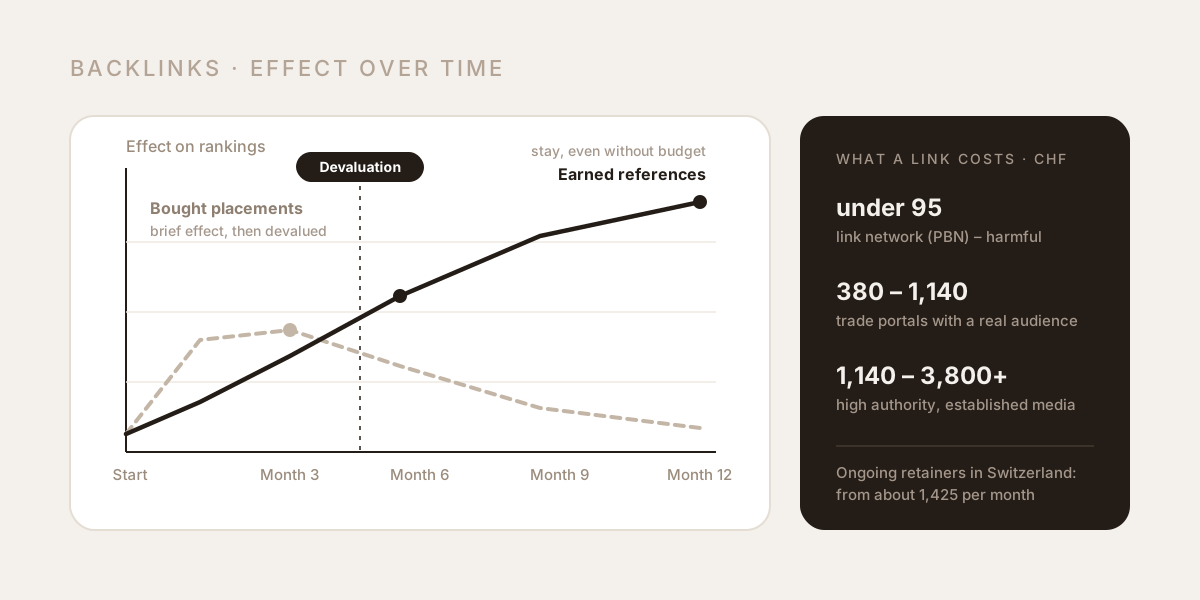
Buying backlinks isn't illegal, but it violates Google's spam policies — and the likeliest outcome isn't a penalty, it's quiet devaluation: you keep paying, the link stops counting. Usable Swiss placements cost CHF 380 to 1,140, genuinely strong sources several times that. Earned references are slower, but they last.
Almost every SME that has done SEO for more than two years has had this experience: at some point an offer arrived. Ten links, high domain authority, fixed price. Rankings moved for a few weeks, then nothing happened — and when the next offer landed, the real question was whether any of it could be trusted.
This article answers that with what Google itself writes, with prices from offers Swiss clients have shown us, and with a distinction that rarely comes up in sales conversations: backlinks do work — directly on Google rankings, and indirectly on AI answers through those same rankings. Just not when you buy them. At the end you'll find a check that lets you evaluate a specific offer in ten minutes.
What backlinks cost in Switzerland
Prices are remarkably consistent. The bands below come from offers clients have shown us over the past few years — not from published price lists, but from what was actually charged:
| Price per placement | What you typically get |
|---|---|
| under CHF 95 | Link networks (PBNs). More likely to damage the profile than help it. |
| CHF 380 – 1,140 | Usable quality: trade portals and industry media with a real audience. |
| CHF 1,140 – 3,800+ | High authority: established trade magazines, institutional sources. |
For ongoing work, Swiss link building retainers start at around CHF 1,425 per month. First ranking movement usually becomes visible after four to twelve weeks, with full effect over six to twelve months.
Run the numbers once: ten usable placements at CHF 760 is CHF 7,600 — for references you don't own, that can be devalued, and that vanish if the portal stops the practice. The same budget invested in an asset of your own belongs to you permanently.
What "buying backlinks" actually means in Switzerland
Four quite different transactions hide behind the term, and they often look identical in an offer:
- Link insertion into existing posts. Your link is retrofitted into an older article. Cheap, fast, and the easiest pattern for Google to recognise.
- Paid guest post. You supply the text, the portal publishes it with your link. It works for the seller because the same slot can be sold indefinitely.
- Sponsored article on a large publication. Expensive and tempting, because the brand name is familiar. Google now addresses exactly this setup with a dedicated policy — more on that below.
- Rental rather than purchase. The link stays as long as you pay monthly. Stop paying and it disappears, and so does the effect.
What's missing in all four cases is the reason anyone linked. That isn't a moral argument but a practical one: Google evaluates references by whether they plausibly arose editorially. A link with no occasion is precisely the signal being looked for.
What Google says about bought backlinks
This is worth reading in the primary source rather than in agency prose. Google's Spam policies for Google web search define link spam as "the practice of creating links to or from a site primarily for the purpose of manipulating search rankings." Among the examples, verbatim:
Buying or selling links for ranking purposes. This includes: Exchanging money for links, or posts that contain links; Exchanging goods or services for links; Sending someone a product in exchange for them writing about it and including a link.
The third point is notable: sending someone a product in exchange for a linked write-up counts too. That captures a great many collaborations that don't feel like link buying.
One variant stays explicitly permitted: the labelled link. In its documentation on qualifying outbound links, Google asks that advertisements and paid placements be marked with rel="sponsored"; rel="nofollow" remains acceptable, with sponsored preferred. A link marked that way is entirely unproblematic — but it also passes no ranking signals. Which removes the exact reason most buyers are paying.
Can Google actually detect bought links?
This question decides everything else, and the answer is in Google's own blog. With the December 2022 link spam update, Google uses its AI system SpamBrain to neutralise unnatural links — on both sides of the transaction: the sites buying links and the sites used to pass them.
Google states the consequence plainly: when its systems remove the effect of such links, any ranking benefit they previously generated is lost.
Two things follow. First, "will Google notice?" is the wrong question — this isn't about case-by-case discovery but about a system recognising patterns across millions of domains. Second, it hits the seller side too: a portal that still has authority today can lose it, and the link you bought there loses it with them.
The likeliest outcome isn't a penalty
The widespread fear of being penalised still points in the wrong direction. Google distinguishes between automatic neutralisation and manual actions. A manual action is shown to you in Google Search Console's "Manual actions" report — if nothing is listed there, there isn't one. The normal case is instead that the links simply don't count.
Economically that's the worse outcome, because it stays invisible. You notice a penalty and can respond. You don't notice devaluation: the links appear in every report, the "number of backlinks" metric rises, and the invoice keeps coming. That's precisely why the business model works so well.
Why the expensive sponsored article became the risky one
Since Google introduced its site reputation abuse policy, the most attractive form of link buying has become the most exposed. Google describes it as a tactic "where third-party content is published on a host site mainly because of that host's already-established ranking signals, which it has earned primarily from its first-party content."
That is an exact description of a purchased post on a large news portal. The party primarily affected is the portal rather than you — but the value of what you bought there depends entirely on its rankings. You carry the risk without being able to steer it.
An offer on your desk: the ten-minute check
Most guides stop at "be careful with cheap links." That helps nobody who has to evaluate a specific offer. These seven points can be checked in a few minutes before you commit.
| Check | Good sign | Warning sign |
|---|---|---|
| Audience | Comments, recurring authors, social signals | Only articles that link outward |
| Neighbourhood | References to real firms in the industry | Casino, loan and CBD links nearby |
| Topical fit | Your industry is a recognisable focus | "We have sites in every niche" |
| Exclusivity | The slot is sold once | Three competitors are already there |
| Speed | Editors, coordination, a publication date | "Live in 48 hours" |
| Pricing | Effort is explained and traceable | Per-unit tiers, volume discounts |
| Labelling | The provider raises rel="sponsored" unprompted | An explicit promise: "guaranteed dofollow" |
The last point is the most revealing. A provider guaranteeing you dofollow is telling you they are knowingly breaching a policy they're aware of. A provider who brings up labelling themselves is selling you reach and knows what they're doing.
Four questions providers rarely enjoy answering
- "How many other clients link out of this post?" An honest answer gives a number. Evasion means: many.
- "Is the link permanent, or tied to the contract term?" Rental is legitimate, but it has to be on the table, because it changes the maths entirely.
- "What happens if the site loses its rankings?" No answer means they're selling a risk they won't name.
- "Can I speak to the editorial team?" With genuine trade publications this is normal. With networks, there is no editorial team.
How much do backlinks affect AI visibility?
Indirectly, but genuinely — and this gets misrepresented in both directions. Some sell backlinks as a ticket into ChatGPT; others declare them dead. Neither is right.
Directly, backlinks barely move LLM recommendations. An OppAlerts analysis across 145 industries and more than 105,000 ChatGPT prompts, evaluated by The Digital Bloom, finds only a weak correlation: Spearman rho +0.204, R² 4.2%. All 13 signals studied together explain considerably less than 20% of the variance.
Through Google rankings, they very much do. Google AI Overviews don't appear from nowhere — they're built on Google Search. An Ahrefs analysis of 863,000 SERPs and 4 million AI Overview URLs (March 2026) shows that 37.9% of cited URLs come from the first ten positions. Ranking there gets you cited far more often — and backlinks remain one of the factors deciding whether you rank there.
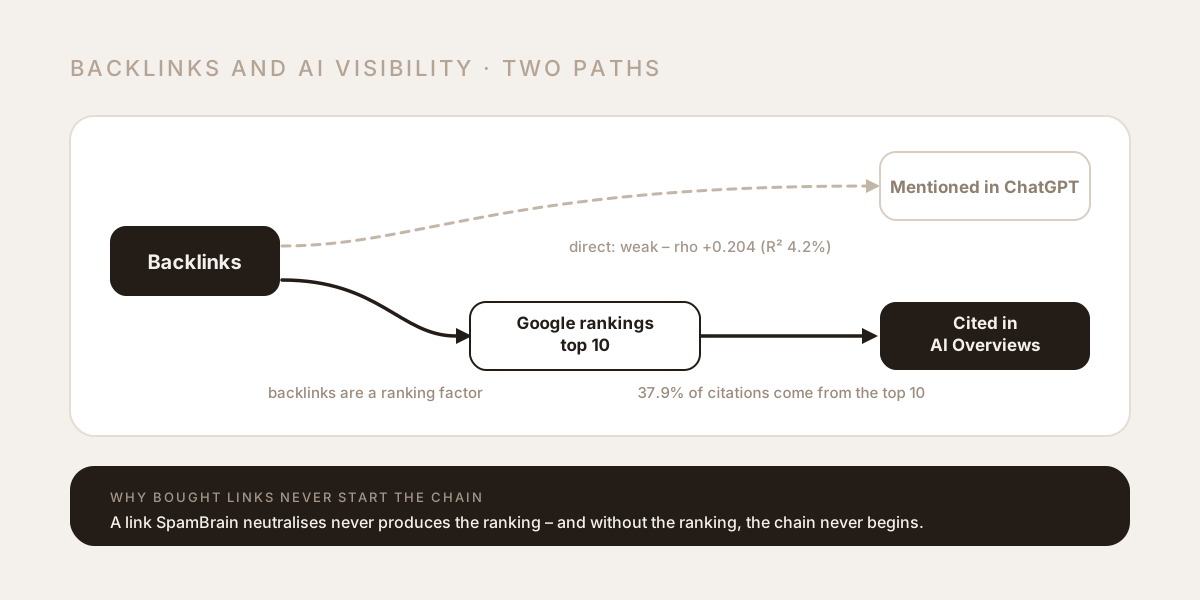
So the chain runs: backlinks → better rankings → a higher chance of being cited in AI Overviews. Two caveats belong with it. First, that path is weakening: in July 2025 the share was around 76%, and Google increasingly pulls sources from outside the original result list. Second, the chain mainly applies to Google. For ChatGPT, which isn't built on Google's ranking, the effect stays weak.
The other half of AI visibility runs on something else. An AirOps analysis of 21,311 brand mentions across 500 commercial queries shows 85% come from third-party sources, only 13.2% from the brand's own domain, and nearly 90% of those third-party sources are listicles, comparisons and reviews. So you need both — references that carry your rankings, and mentions where comparing and recommending happens. We describe how to build that in Increasing your recommendation probability in AI assistants.
None of this changes the buying decision — it sharpens it. Backlinks are worth having because they carry rankings, and rankings feed AI answers. Which is exactly why buying them is pointless: a link SpamBrain neutralises never produces the ranking that would start the chain. You pay for the first step and receive none of it.
What works instead of buying links
The order matters, because the first two steps cost almost nothing and most SMEs have never finished them.
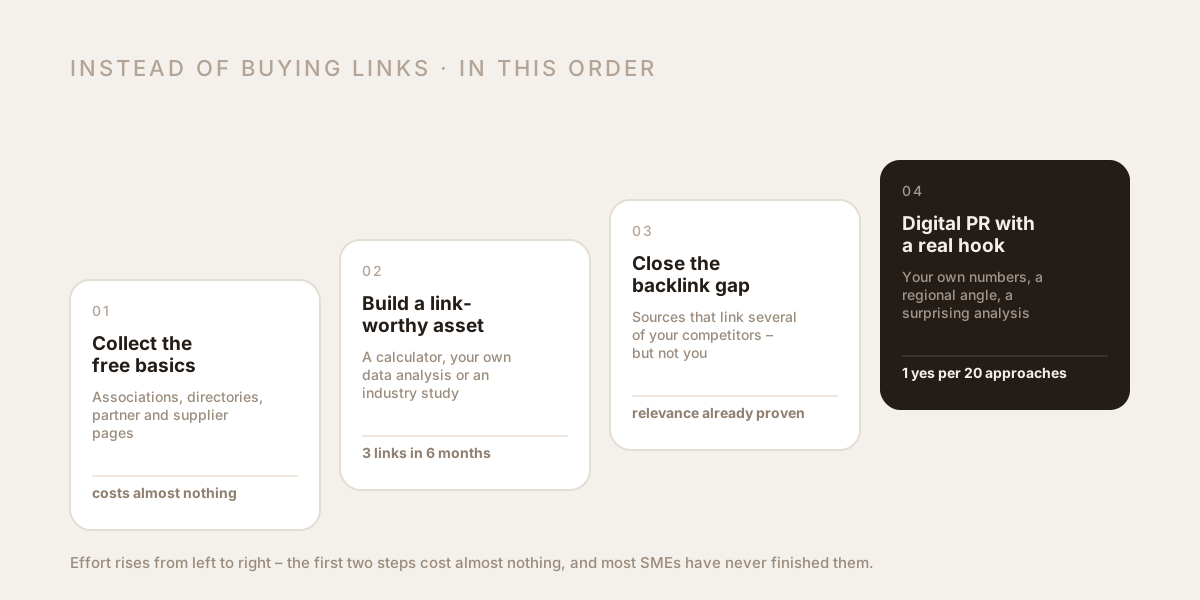
1. Collect the free basics. Industry associations, chambers, directories like local.ch and search.ch, supplier and partner pages, customer reference lists, sponsorship mentions from local clubs. Unglamorous, but these are exactly the signals that establish local relevance in the Swiss market.
2. Build a linkable asset. A calculator, an original data analysis, an industry study — something that provides a standalone reason to link. In our case study with a solar provider it was a solar and energy cost calculator. It earned three backlinks in six months — we name the figure precisely because it's unspectacular. Three earned references still outweigh ten bought ones that get devalued, and the same calculator converted at 12% along the way. An asset that generates leads funds its own link building.
3. Close the backlink gap deliberately. Read the link profiles of your three strongest competitors and filter for sources that link to several of them but not to you. Topical fit is already proven there — it's the most pragmatic entry point available.
4. Digital PR with a real hook. Your own numbers, a regional angle, a surprising analysis: something a newsroom picks up out of genuine interest. Expect roughly one placement per twenty approaches — that's our hit rate, and it's why outreach has to run as a process rather than a campaign. Slower than placing an order, but the result is yours.
The same budget over twelve months
The honest comparison isn't "buying versus building" but the question of what's still there after a year. Take CHF 12,000 over twelve months:
| Bought placements | Own asset + outreach | |
|---|---|---|
| What you get | roughly 15 links on other people's sites | a calculator or study plus references to it |
| Ownership | none — you're renting space | entirely yours |
| If the budget stops | rented links disappear | asset and references remain |
| Risk | devaluation by SpamBrain, site reputation abuse | neither applies |
| Side effect | none | leads, mentions, material for sales |
| Effect on AI visibility | only via rankings, which devalued links don't deliver | a citable source for comparisons and rankings |
The difference isn't moral, it's an accounting one: in one case you create a recurring expense, in the other an asset.
When a paid link is still defensible
Not every paid placement is a mistake — it just isn't SEO. A sponsored article in a trade magazine your audience actually reads can pay for itself through reach, brand awareness and direct enquiries. Marked correctly with rel="sponsored", it's policy-compliant and entirely fine.
The difference lies in the expectation: you're buying attention, not ranking signals. Budget it that way and it's a clean media decision — and you should then measure it as one, in enquiries and mentions rather than positions. Spend the same money expecting rankings and you've bought a hope.
Conclusion
Backlinks remain valuable: they carry Google rankings, and rankings feed citations in AI Overviews. Which is precisely why buying them is a poor deal. Google names the money-for-links exchange explicitly as spam, properly labelled links pass no signals, and SpamBrain neutralises unnatural references on both sides — so the exact ranking benefit you paid for disappears without you noticing. You're buying the mechanism you need in the one form where it doesn't work.
For legacy links, the news is reassuring. On the disavow tool, Google itself writes that in most cases it can assess which links to trust, and that most sites will not need the tool. Put the effort into new sources rather than reprocessing old ones.
Hierarchy builds link acquisition as digital PR rather than procurement: competitor analysis, linkable assets, personal outreach to trade portals and regional media. That's our Link Building & Digital PR service.
Have an offer for backlinks on your desk and want to know what it's worth? Let's talk.
Sources
- Google – Spam policies for Google web search – definition of link spam, examples of buying and selling links, site reputation abuse.
- Google Search Central – December 2022 link spam update – SpamBrain neutralises unnatural links on both the buying and selling side; the ranking benefit is lost.
- Google – Qualify outbound links –
rel="sponsored"for advertisements and paid placements;nofollowstill acceptable,sponsoredpreferred. - Google Search Console Help – Disavow links to your site – disavow only with a manual action; most sites will not need the tool.
- The Digital Bloom – LLM Ranking Factors 2026 – OppAlerts analysis across 145 industries and 105,000 ChatGPT prompts: backlinks rho +0.204 (R² 4.2%).
- Ahrefs – 38% of AI Overview Citations Pull From The Top 10 (March 2026) – 863,000 SERPs and 4M AI Overview URLs: 37.9% of citations come from the first ten positions, down from roughly 76% in July 2025.
- AirOps – The Influence of Offsite Signals in AI Search – 21,311 brand mentions across 500 queries: 85% from third-party sources, 13.2% from the brand's own domain.

About the author