Wealth Manager Marketing Zurich: Who AI Recommends
Wealth managers in Zurich: in chat, every second AI mention goes to a bank, in Google AI Mode one in six. The question that makes independents visible.
Wealth management is the industry with the highest memory share in our study: 56 percent of AI mentions are produced without any page being read. Half of all mentions in ChatGPT, Gemini and Claude go to UBS, Zürcher Kantonalbank, Julius Bär and other banks, and on the English question it is 73 percent. In Google AI Mode it is one mention in six. Independent Zurich managers still have two ways into the answer: a particular kind of question and a particular channel. This article shows both, plus the checklist the assistants hand your prospects.
Someone in Zurich with a million to invest and no interest in a bank now sometimes asks an assistant first: «I would like to have about one million francs managed and am looking for an independent wealth manager in Zurich. Do you have a recommendation?» The answer comes instantly, with names, reasons and a list of questions for the first meeting. Google publishes no reliable search volumes for phrasing like this. What can be measured is who appears in the answers, and why.
For our AI visibility study Zurich 2026 we analysed answers from Claude, ChatGPT and Gemini across twelve Zurich industries. For this article we went back through the wealth management rows one by one, merged duplicate mentions under different company names and removed authorities and associations: 15 answers to five questions, 162 mentions, 52 providers, plus 16 search queries in Google AI Mode. The questions:
- «Which wealth managers in Zurich can you recommend?»
- «I would like to have about one million francs managed and am looking for an independent wealth manager in Zurich. Do you have a recommendation?»
- «best wealth manager zurich»
- «Name me 5 good wealth managers in Zurich and what speaks for them.»
- «Which wealth managers in Zurich would you recommend?»
The first four questions were asked in German, the last one in English.
The industry where the least gets looked up
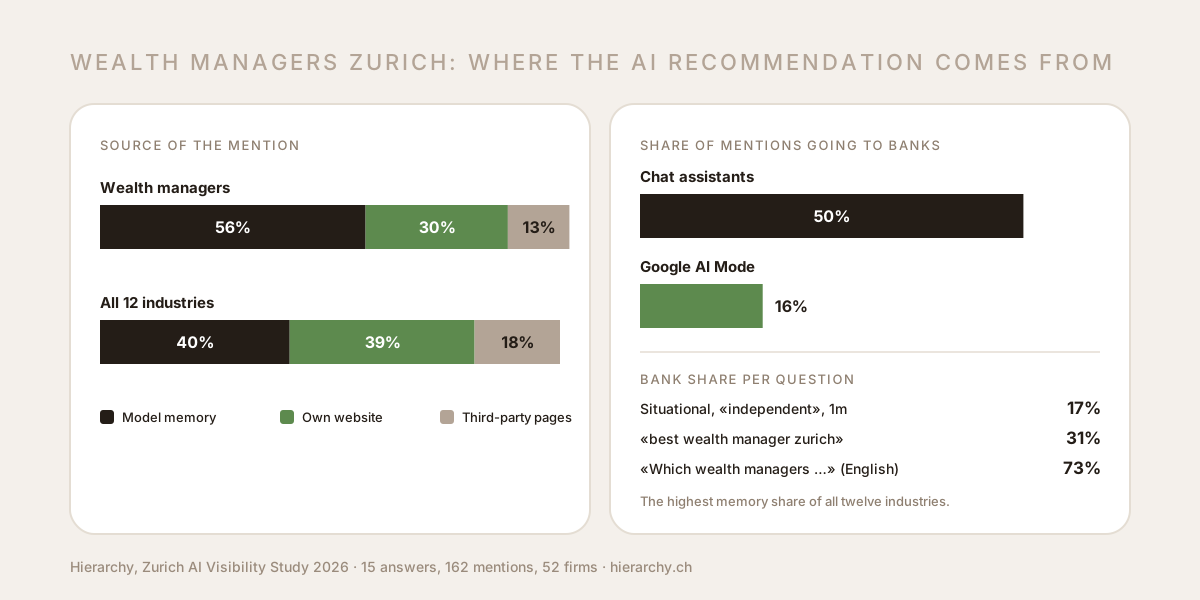
An assistant names a firm from the model's memory, from the firm's website that it reads during the answer, or from a third-party page. Across all twelve industries that splits 40, 39 and 18 percent. For wealth managers it looks like this:
| Source of the mention | Wealth managers | All twelve industries |
|---|---|---|
| Model memory | 56% | 40% |
| Provider's website | 30% | 39% |
| Third-party pages (lists, articles, portals) | 13% | 18% |
56 percent is the highest memory share in the entire study. Closest are architecture firms at 52 and business law firms at 51 percent. What all three have in common is that access runs through reputation and publicity rather than through a description of services.
The average is a mean across three very different assistants:
| Assistant | from memory | from the provider's website | from third-party pages |
|---|---|---|---|
| Gemini | 92% | 5% | 3% |
| Claude | 23% | 26% | 49% |
| ChatGPT | 24% | 74% | 0% |
92 percent is the highest memory share Gemini reaches in any industry in our study. Gemini searched on only two of the five questions, and only on the search term «best wealth manager zurich» did any of its mentions rest on pages it read. ChatGPT carries three out of four mentions via the firm's own website. Claude mainly reads third-party pages: lists, ratings and articles.
In practice: a reworked service page can change your position on ChatGPT within weeks, on Gemini only with the next model. A report that rolls the three assistants into one number hides exactly this difference.
Half of all mentions go to banks
Most often named were UBS and Zürcher Kantonalbank with 13 mentions each, Julius Bär with 12 and Vontobel with 10, then Pictet, Lombard Odier and the digital provider True Wealth with six each. Only then come the first independent firms: Tareno, Lakefield Partners, swisspartners, Asset Management Group Schweiz, Marcuard Heritage and the Aquila group with five mentions each.
The top ten take 50 percent of all mentions, and 25 of the 52 providers came up exactly once. So the problem for independent managers is not that a small group sweeps everything. It is that half of the answer space goes to banks. That applies to all three assistants: 56 percent on Gemini, 46 on ChatGPT, 44 on Claude.
How much depends on the question:
| Question | Bank share | from memory | Mentions |
|---|---|---|---|
| Situational question «independent manager, around 1m» | 17% | 61% | 23 |
| «best wealth manager zurich» | 31% | 37% | 35 |
| «Which wealth managers in Zurich can you recommend?» | 55% | 76% | 29 |
| «Name me 5 good wealth managers …» | 56% | 74% | 27 |
| «Which wealth managers in Zurich would you recommend?» | 73% | 46% | 48 |
Only one of the five questions contains the word «independent», and only on that one does the bank share drop markedly. The four banks that still came up there were all named by Gemini. Claude named only independent firms on this question, namely Tareno, Format Vermögen & Anlagen, Portas Capital, Premium Strategy Partners and Lakefield Partners, even though it explicitly declined to give a personal recommendation. ChatGPT named Montvalor Partners, ROC Investment, Consus Finance, Aquila, sihlinvest, CV Invest Partners and True Wealth. 23 mentions were spread across 22 providers, and nine of them came up on no other question.
In English you compete with the big banks
The English question is the most bank-heavy of all: 73 percent of mentions went to banks. It also produced the most mentions, 48, including 12 providers not named on the German recommendation question, among them international firms such as Stonehage Fleming and Notz Stucki.
How the answers came about is telling. Gemini named everything from memory in English. Claude declined to recommend and named 18 firms anyway, 89 percent of them based on third-party pages. Among them, twice, was Credit Suisse, which no longer exists as an independent bank since its takeover by UBS. What sits on an outdated list ends up in a current answer.
So anyone pitching for international mandates competes mainly with banks in the English AI answer. An English page that clearly describes independence, mandate size and target clients is the precondition for being read there at all.
What the assistants hand your prospects
The assistants do not just supply names. In three of the five answers Claude explicitly declined to give a personal recommendation and referred to qualified advice; asked for the «best» manager, it wrote that there is no single best one. Most answers also contain a list of points to check before choosing:
| Checkpoint in the answer | Answers (of 15) |
|---|---|
| FINMA authorisation, supervision | 13 |
| Retrocessions, conflicts of interest | 12 |
| Fee model, all-in fee, total costs | 11 |
| Custodian bank, separation of management and custody | 9 |
| Minimum investment, entry threshold | 9 |
| Initial meetings with several providers | 8 |
For a wealth manager this table matters more than any ranking. It shows the questions prospects bring to the first meeting, and it shows what an assistant looks for on your website when it reads it. If you clearly describe your authorisation status, supervisory organisation, fee model, handling of retrocessions, custodian banks and minimum investment, you answer the checklist before it is asked.
Among the reasons given for individual firms, independence, personal service and boutique character or owner management came up most often. Fees, minimum investment, performance and sustainability, by contrast, were the reason for a specific firm in only a handful of mentions, even though they appear as general criteria in many answers. That is a gap: if you put your fee model and minimum investment concretely on your website, you supply exactly the information the assistants name as a criterion but can rarely attach to a firm.
Google AI Mode is the other market
The sharpest contrast in the analysis lies between the chat assistants and Google AI Mode. We queried Google AI Mode separately with 16 search queries.
| Chat assistants | Google AI Mode | |
|---|---|---|
| Bank share | 50% | 16% |
| Providers named | 52 | 63 |
| Of which also in the other channel | 20 | 20 |
In Google AI Mode the front runners are Tareno, Wenzinger & Tschan, Descartes, Everon, Maerki Baumann, Woodman and PostFinance. 43 of the 63 providers did not appear in the chat answers. As sources, Google mainly uses independent providers' websites, plus bilanz.ch, moneyland.ch and the map panel with Google Business Profiles. That is where independent Zurich managers are present. In the chat answers, by contrast, banks lead, whether from memory or from lists that were read.
For an independent firm, Google AI Mode is today the channel where visibility is most within reach. In the chat assistants it has to be earned over years. Anyone who checks only ChatGPT and concludes that AI visibility is hopeless for independents is measuring the wrong channel.
What named firms do differently
We compared 60 named Zurich wealth managers with 12 comparable firms that appeared in none of the 15 answers. The median:
| Metric (median) | named | not named |
|---|---|---|
| Web mentions in total | 720 | 4 |
| External domains mentioning the firm | 32.5 | 2.5 |
| Referring domains | 350.5 | 36 |
| Keywords in Google's top ten | 25 | 0.5 |
| Indexed pages | 10 | 2 |
| Words on the homepage | 478.5 | 299 |
| Google reviews | 6 | 1.5 |
| Star rating | 4.6 | 5.0 |
| Structured data present | 65% | 33% |
The gap in web presence is enormous. Named firms are mentioned hundreds of times on the web, comparable unnamed ones hardly at all, and they rank for 25 keywords in Google's top ten rather than almost none. On the homepage the difference is smaller, and the star rating is actually higher among the unnamed. As always with comparisons like this: these are correlations from a small sample, not proof.
A look at the industry as a whole rounds out the picture. Across 93 Zurich firms we measured, the median homepage has 470 words, 44 percent use LocalBusiness schema, 90 percent have a Google Business Profile and not a single one has FAQ schema.
The diagnosis: in this industry, what decides above all is whether anyone writes about a firm. Press and mentions cannot be ordered. That makes the part you can control count all the more.
Directories really work here
Of the providers that appeared on a listing page an assistant read, 41 percent were also named in the same answer. Across all twelve industries it is 25 percent. Only IT support firms are higher at 48 percent; accounting firms reach 15 and dentists 11 percent.
The listing sources actually opened during the answers are Wikipedia, bilanz.ch, digitalmedia.ch, valindex.ch, bellevue.ch and listenchampion.de. Across all citations, finguide.ch, descartes.swiss, finma.ch and bilanz.ch lead.
When an assistant reads a list for this industry, it takes over an above-average share of it. At the same time the source landscape is thin and partly international. For an individual firm that means a few good listing slots already move a lot.
What a Zurich wealth manager can actually do
Answer the assistants' checklist on your website. FINMA authorisation and supervisory organisation, fee model, handling of retrocessions, custodian banks, how the first meeting works. These are the points that appear in most answers.
State your minimum investment. It was a criterion in nine answers, and it is the information that lets an assistant match a request with an amount to a firm.
Back up independence concretely. Independent of banks, owner-managed, no in-house products, free choice of custodian bank. Independence is among the most frequent reasons given for an individual firm, and only the question containing that word pushes the banks back.
Add FAQ sections. None of the 93 firms we measured has FAQ schema. In an industry where prospects have very specific questions, that is unoccupied ground.
Maintain the English version as its own page. The English question produced the most mentions and the highest bank share. To hold your own against banks there, you need a page ChatGPT and Claude can read.
Treat Google AI Mode separately. That is the reachable channel: a complete Google Business Profile, clean location data, presence on the pages Google reads there.
Build mentions outside your own domain. 720 against 4 web mentions is the hardest finding in this analysis. Market commentary with its own page, expert articles, association appearances, talks, interviews. It works slowly, and it is the only thing that moves the memory share.
Checklist: 12 points for your wealth management firm's website
And a 13th point that does not sit on the website: measure it, and measure Google AI Mode separately. How that works is described in Measuring AI visibility.
What we do for wealth managers
Hierarchy is a full-funnel marketing and AI agency for SMEs in Zurich, specialising in SEO, GEO and paid ads, with marketing and engineering in one team of four people. We base our recommendations on our own data study of AI recommendations and implement the changes ourselves: copy, service and profile pages, schema, English version, directory and profile upkeep. Where your firm stands today is shown by the free AI visibility check. Service details: SEO & AI visibility.
Conclusion
Wealth management is the industry where the assistants look things up least: 56 percent of mentions come from model memory. Half of all chat mentions go to banks, three quarters on the English question. Two findings still give independents a way in: when the question contains an investment amount and the word «independent», the bank share drops to 17 percent and a broad field appears. And in Google AI Mode the bank share is 16 percent. On top of that comes a checklist the assistants hand most prospects: authorisation, fees, retrocessions, custodian bank, minimum investment. Answer it on your website and you are prepared for assistant and prospect alike. The figures for all twelve industries are in the AI visibility study Zurich 2026. How other advisory professions fare: Law firm marketing Zurich and Accounting firm marketing Zurich.
Frequently asked questions
- Do ChatGPT and Gemini recommend specific wealth managers in Zurich?
- Yes, albeit with caveats. Across five questions, ChatGPT, Gemini and Claude named a specific provider 162 times in 15 answers, spread across 52 firms. In three answers Claude explicitly declined to give a personal recommendation and referred to professional advice, but named firms anyway. Most answers also came with a list of points to check: FINMA authorisation, fee model, retrocessions, custodian bank.
- Where do the assistants get their recommendation for a wealth manager?
- 56 percent of mentions come from the model's memory, without any page being read during the answer. That is the highest memory share of all twelve industries in our study; across all industries it is 40 percent. 30 percent rest on the provider's website, 13 percent on third-party pages. On Gemini, as much as 92 percent of mentions come from memory.
- Why do the assistants name banks when I ask for a wealth manager?
- Because banks lead both in the model's memory and on the lists and ratings that get read. Across all five questions, half of all mentions go to banks: UBS, Zürcher Kantonalbank, Julius Bär, Vontobel, Pictet, Lombard Odier and others, whether from memory or from pages that were read. On the English question it is 73 percent. Only on the situational question about an independent manager for around one million francs does the share drop, to 17 percent.
- Does Google AI Mode name different wealth managers than ChatGPT?
- Clearly different ones. In the chat answers half of all mentions go to banks, in Google AI Mode 16 percent. Google AI Mode named 63 providers across 16 search queries, and only 20 of them also appeared in the chat answers. At the front stand independent firms such as Tareno, Wenzinger & Tschan, Descartes and Everon.
- Which providers are named most often?
- UBS and Zürcher Kantonalbank with 13 mentions each, Julius Bär with 12, Vontobel with 10, then Pictet, Lombard Odier and True Wealth with 6 each. The first independent managers follow with five mentions each, among them Tareno, Lakefield Partners and swisspartners. The top ten take 50 percent of mentions, and 25 of the 52 named providers came up exactly once.
- What do the assistants tell prospects to look out for?
- 12 of the 15 answers dealt with retrocessions and conflicts of interest, 11 with the fee model, and 13 brought up FINMA authorisation. 9 answers dealt with the custodian bank and with the minimum investment, and in 8 the assistants advised initial meetings with several providers. Answering these questions on your website gives the assistant the material it passes on anyway.
- What separates named from unnamed wealth managers?
- Visibility outside their own website, and by a wide margin. At the median, named providers have 720 web mentions, comparable unnamed ones 4. They are mentioned on 32.5 rather than 2.5 external domains, have 350.5 rather than 36 referring domains and rank for 25 keywords in Google's top ten, while unnamed ones rank for almost none. On the homepage the gap is smaller: 478.5 against 299 words.
- Do directories and comparison portals help wealth managers?
- More than in almost any other industry. Of the providers that appeared on a listing page an assistant read, 41 percent were named in the same answer. Across all twelve industries it is 25 percent; only IT support firms are higher. The most-read listing sources are Wikipedia, bilanz.ch, digitalmedia.ch, valindex.ch and bellevue.ch.
- How many Google reviews does a wealth manager need?
- Few, but more than none. Named Zurich wealth managers have a median of 6 Google reviews, comparable unnamed ones 1.5. The star rating is actually higher among the unnamed, 5.0 against 4.6. 90 percent of the industry has a Google Business Profile, so it is a baseline rather than a differentiator.
- How do I check whether an AI recommends my wealth management firm?
- Ask ChatGPT, Gemini, Claude and Google AI Mode the same five questions every month, including one with an investment amount and the word «independent» and one in English, and record who gets named and with what justification. Check Google AI Mode separately, because a different set of providers appears there. Hierarchy's free AI visibility check does this once for you.
About the author
Tenzin Langdun
AI Expert & Marketing Lead at Hierarchy
Tenzin is an AI expert and marketing lead with an MSc in Artificial Intelligence from the University of Bath and over 10 years of marketing experience across strategy, paid acquisition, and SEO. He has held roles at leading organisations including KPMG, EY, Siemens, and Adnovum — with expertise in AI, cybersecurity, audit and consulting, and the insurance sector. Together with Martin Oswald, he co-authored an award-winning research paper on AI-based cancer detection, published in Nature and recognised with the National Siemens Excellence Award and the Lab Sciences Award.