Contents
As of October 2026. Data: AI Visibility Study Zurich, August 2026.
The word the customer chooses decides what kind of firm the AI recommends. When an SME asks for «IT service providers in Zurich», up to 60 percent of the firms named are software houses and consultancies that focus on software projects rather than looking after SME IT. When it asks for an IT partner for support and Microsoft 365, none of them are, and 81 percent of mentions go to support firms. Those support firms get named 61 percent of the time because the assistant reads their website. This article shows which questions lead to which firms, which pages ChatGPT, Gemini and Google AI Mode read, and what you should change on your website.
A click on a Google ad for «IT support KMU» (SME) costs around CHF 50 in Switzerland, and almost CHF 80 for «Microsoft 365 Partner». For the general term «IT support Zürich» it is around CHF 12. The difference shows what a new SME client is worth to an IT firm. Managing directors now increasingly put the same question to an AI assistant: «I run an SME with 20 employees in Zurich and I am looking for an IT partner. Do you have a recommendation?» The answer is a list of five to fifteen firms with reasons. Whoever is on it gets the enquiry without paying for the click.
For our AI Visibility Study Zurich 2026 we analysed answers from Claude, ChatGPT and Gemini across twelve Zurich industries. For this article we went through the IT rows again one by one, merged duplicate mentions under different firm names and removed portals: 15 answers to five questions, 118 mentions, 50 firms, plus 47 mentions from Google AI Mode. The questions (four in German, translated here, one in English):
- «Which IT service providers (IT-Dienstleister) in Zurich can you recommend?»
- «I run an SME with 20 employees in Zurich and I am looking for an IT partner for support and Microsoft 365. Do you have a recommendation?»
- «bester it dienstleister zürich» (best IT service provider Zurich)
- «Name 5 good IT service providers in Zurich and what speaks for them.»
- «Which IT support companies in Zurich would you recommend?»
The word decides: «IT-Dienstleister» brings software houses
«IT-Dienstleister» is a catch-all term in German. It covers the firm that manages the laptops at an accounting office just as much as the 1,000-person software house building an app for a bank. The assistants do not resolve this ambiguity; they take the term literally. We assigned each of the 50 firms named to one of four groups: support firms and system integrators, software houses and consultancies, security specialists, and telecoms.
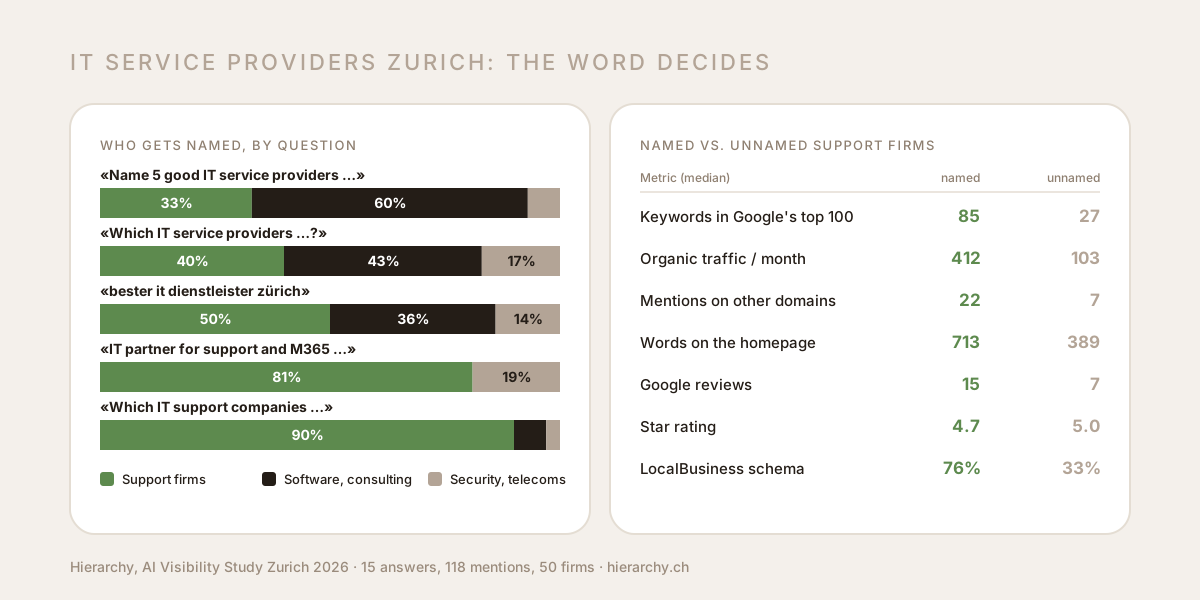
| Question | Mentions | Support firms | Software houses and consultancies | Security and telecoms |
|---|---|---|---|---|
| «Name 5 good IT service providers in Zurich …» | 15 | 33% | 60% | 7% |
| «Which IT service providers in Zurich can you recommend?» | 30 | 40% | 43% | 17% |
| «bester it dienstleister zürich» | 28 | 50% | 36% | 14% |
| «IT partner for support and Microsoft 365 …» | 16 | 81% | 0% | 19% |
| «Which IT support companies in Zurich …» | 29 | 90% | 7% | 3% |
On the three questions using «IT-Dienstleister», large software houses such as Zühlke, ti&m, ELCA or Netcetera end up on the same lists as firms looking after an office with 15 workstations. The assistants are aware of the problem: ChatGPT and Gemini split their answers to the open question into categories such as «managed services for SMEs», «software development» and «consulting for large projects» and ask at the end what kind of service is meant. Claude named no firm at all on the open question; it asked about the need and pointed to comparison portals.
For a support firm, this leads to an uncomfortable conclusion: the question on which you are most reliably named is not the one using the word you use most yourself. It is the question that describes the need: support, Microsoft 365, SME, number of workstations. Your website therefore needs to describe exactly that need in full sentences, not just «your IT service provider in Zurich».
Where the mentions come from
An assistant names a firm from the model's memory, from the firm's website that it reads live while answering, or from a third-party page. Across all twelve industries in our study, that splits 40, 39 and 18 percent. For IT service providers it looks like this:
| Source of the mention | IT service providers | All twelve industries |
|---|---|---|
| Firm website | 46% | 39% |
| Model memory | 31% | 40% |
| Third-party pages (portals, lists, articles) | 22% | 18% |
The average hides two worlds. Support firms are named 61 percent of the time via their own website and only 17 percent from memory. For software houses it is the other way round: 53 percent of their mentions come from memory, only 24 percent from their own website. Large software houses have appeared in rankings, trade media and job portals for years; the model knows them. It does not know a support firm with 25 employees. That firm gets named when the assistant searches, finds its page and reads it.
Whether the assistant searches at all depends on the question again. Gemini ran no search at all on the open question or on the request for five names, and named every firm from memory, hence all the software houses. On the support and Microsoft 365 question, the search term and the English question, Gemini did search, and that is where the support firms appear. Across all assistants, 77 percent of mentions on the open question come from memory; on the support and Microsoft 365 question, 81 percent are grounded in the firm's website.
What the assistants say about IT firms
The assistants justify every mention. We counted which criteria appear in the 15 answers:
| Criterion in the answer | Answers (of 15) |
|---|---|
| SME focus, «for small and medium-sized businesses» | 15 |
| Security, backup, cybersecurity | 15 |
| Service level, response time | 12 |
| On-site service, proximity, local | 11 |
| Microsoft partner, Microsoft 365 | 11 |
| 24/7 support | 8 |
| References, reviews | 6 |
| Fixed price, flat rate per workstation | 5 |
| Get several quotes, initial meeting | 5 |
| ISO certification | 4 |
The assistants carry over facts, not adjectives. The answers contain sentences such as «1h SLA and personal support», «over 128 Swiss SMEs trust them with their IT», «fixed monthly fee, cancellable monthly», «tailored to SMEs with 5 to 150 employees», «working exclusively for SMEs for over 20 years» or «Microsoft Solutions Partner». These phrases come almost word for word from the respective firm's website. Generic adjectives like «competent» or «reliable» barely appear in the reasons, because the assistant has nothing in them to pass on.
What the assistants advise the customer is telling too. In the answers to the support and Microsoft 365 question, they explain which licence makes sense for 20 workstations, that Microsoft 365 is not backed up without a separate backup, that a Microsoft partner status is a verified certification and not a marketing claim, and that you should get two to three quotes. They even give typical price ranges per user per month. An IT firm whose website answers these questions itself supplies exactly the material the assistant is looking for.
What named support firms do differently
To compare like with like, we removed the large software houses and telecoms providers and compared only support firms: 35 named against 18 comparable firms that did not appear in any of the 15 answers. The medians:
| Metric (median) | Named support firms | Unnamed firms | Factor |
|---|---|---|---|
| Indexed pages (sample) | 10 | 6 | 1.7× |
| Keywords in Google's top 100 | 85 | 27 | 3.1× |
| Estimated organic traffic per month | 412 | 103 | 4.0× |
| Mentions on other domains | 22 | 7 | 3.4× |
| Domains linking to the website | 155 | 84 | 1.8× |
| Internal links on the homepage | 48 | 28 | 1.7× |
| Words on the homepage | 713 | 389 | 1.8× |
| Google reviews | 15 | 7 | 2.1× |
| Google star rating | 4.7 | 5.0 | |
| LocalBusiness schema present | 76% | 33% | |
| FAQ schema present | 12% | 0% |
Three things stand out.
Named IT firms have homepages almost twice as long. Unlike physiotherapy practices, where homepage length explains nothing, named IT firms have 713 instead of 389 words on the homepage. The reason is in the table above: the assistants look for target group, scope of services, response time and partnerships, and that does not fit into 389 words with three icons.
Mentions on other sites separate more strongly than links. Named firms are mentioned on 22 other domains, unnamed ones on 7. For linking domains, the gap is smaller. Partner directories from Microsoft and other vendors, portal profiles, trade articles and case studies on client sites count, even when they do not link.
The star rating explains nothing. Unnamed firms actually have the better median rating, 5.0 against 4.7, with less than half as many reviews. For AI recommendations, what counts is that the firm can be found and is described, not how perfect its average is.
As always with comparisons like this: these are correlations from a small sample, not proof. But the direction is the same across almost every metric.
Which pages the assistants read
The assistants cited a source 200 times in their IT answers. Two patterns stand out.
Service pages with the search term in the title. The most-cited firm pages are called «IT-Support», «IT-Dienstleister Zürich» or «IT-Partner Zürich» and have 700 to 2,000 words with seven to twenty subheadings. They are not homepages but pages created specifically for the exact term a customer types. A «Microsoft 365 for SMEs» page was cited four times, including on the support and Microsoft 365 question. The assistants search with the customer's words and take the page that carries those words in its title.
One portal supplies a fifth of all sources. The comparison portal it-provider.ch accounted for 40 of the 200 citations, more than any single firm. The portal's most-cited pages are the overview for the canton of Zurich, the one for the city of Zurich, and a list of managed services providers.
Portals have a stronger effect for IT firms than in any other industry. Of the IT firms that appeared on a page the assistant had read during the answer, 48 percent were named in the same answer. Across all twelve industries it is 25 percent, and the next highest, wealth managers, is 41 percent. The base is small because there are only a few such lists for IT support in Zurich. That is exactly why a complete profile pays off: whoever is on one of the few lists that get read has a good chance of being carried over. On the open question, Claude also explicitly recommended it-provider.ch, firma-finden.ch and the procurement portal gryps.ch as the way to search.
Google AI Mode: half of the firms differ
For the same search terms, Google AI Mode named 30 IT firms. 15 of them also appeared with ChatGPT, Gemini or Claude, 15 only in AI Mode. As sources, Google mainly uses the firms' websites, plus it-provider.ch, gryps.ch, employer reviews on kununu and discussions on Reddit.
Classic Google search also says little about who gets recommended. Of the firms the assistants named, only six were in Google's top 10 for «bester it dienstleister zürich», whether in regular search or Google Maps. The rest were named even though they do not rank at the top for that term.
German and English: two different markets
For the German question and its English counterpart, the assistants named 25 and 22 firms. Only 7 appeared in both; 15 appeared only in English. The English question about «IT support companies» also produces the cleanest lists: 90 percent support firms, because the English term is not ambiguous.
For Zurich this is not a footnote. International companies, startups and branch offices ask in English, and 69 percent of the mentions in those answers are grounded in the firms' websites. A support firm without an English service page has a poor chance in these answers, even if its team speaks English.
How do I get ChatGPT and Google to recommend my IT firm?
You cannot buy it. There is no sign-up and no paid slot in the answer, and anyone selling you a «ChatGPT listing» is selling something that does not exist. But for IT support firms the path is short, because six out of ten mentions rest on the assistant reading your website.
Write in your customers' words. A managing director does not search for «holistic ICT solutions» but for «IT support for 20 workstations with Microsoft 365». Create a separate page for each such need and name it in the title: «IT support for SMEs in Zurich», «Microsoft 365 for SMEs», «IT support for medical practices», «IT support for international companies in Zurich».
Make yourself quotable. Response time in hours, number of firms served, client size in workstations, service area for on-site visits, contract term, partner status with level. Each of these is a sentence an assistant can carry into its answer.
Answer the questions the assistant asks the customer. Which licence, how Microsoft 365 backup works, what happens in an emergency, how switching from the current provider works. Whoever explains this on their website gets found for exactly these questions.
Maintain the few portals. A complete profile on it-provider.ch and the vendor directories, because lists are carried over particularly often in this industry.
How we implement this is described under GEO agency.
Checklist: 12 points for your IT firm's website
And a 13th point: measure it. The same questions every month to ChatGPT, Gemini and Google AI Mode, in your customers' words, and count the mentions. How to do that is in Measuring AI visibility.
What we do for IT service providers
Hierarchy is a full-funnel marketing and AI agency for SMEs in Zurich, specialising in SEO, GEO and paid ads, with marketing and engineering in one team of four people. We base our recommendations on our own data study of AI recommendations and implement the changes ourselves: service pages for your customers' search terms, copy with quotable facts, an English version, portal profiles, structured data. Where your firm stands today is shown by the free AI visibility check.
Conclusion
For IT service providers, the word decides first. Ask for an «IT-Dienstleister» and you get software houses from the model's memory. Ask for support and Microsoft 365 and you get support firms, specifically those whose website describes that need in full sentences. Named support firms have longer homepages and more indexed pages, are mentioned on three times as many other sites and use structured data. The star rating plays no role; a portal profile plays a bigger one than elsewhere. The figures for all twelve industries are in the AI Visibility Study Zurich 2026.

About the author