Contents
As of October 2026. Measured on 13 October 2026.
In aesthetic medicine, AI asks about the specialist first. We asked ChatGPT, Claude, Gemini and Google AI Mode eight questions about cosmetic surgery, Botox and fillers, and hair transplants in Zurich: 32 answers, 178 mentions, 78 clinics and doctors. The field is broad, and half of them were named only once. The most common reasons given are specialisation, experience, method and the FMH specialist title. 27 of 32 answers address the specialist. Advertising in the classic sense is largely closed to the industry, factual information is not.
"Botox Zürich" is searched around 1,900 times a month, "Haartransplantation Schweiz" 1,600 times, "Schönheitsklinik Zürich" 480 times. Google Ads estimates around USD 21 per ad click for "Brustvergrösserung Zürich" and around USD 12.50 for "Haartransplantation Zürich". The procedures are self-funded, so every patient is correspondingly valuable. And with a personal topic like this, many people ask an AI first before they call a clinic.
For this article, on 13 October 2026 we put eight questions to four assistants: ChatGPT, Claude and Gemini with web search and a Zurich location, Google AI Mode with the location set to the canton of Zurich:
- "Welche Schönheitschirurgen in Zürich kannst du empfehlen?"
- "Brustvergrösserung in Zürich: Welche Klinik ist empfehlenswert?"
- "Wo kann ich in Zürich Botox oder Filler machen lassen? Welche Praxis ist gut?"
- "Haartransplantation in Zürich oder der Schweiz: Welche Klinik würdest du empfehlen?"
- "Ich überlege eine Haartransplantation. Lieber in der Schweiz oder in der Türkei, und welche Schweizer Kliniken sind gut?"
- "Nenne mir 5 gute Kliniken für ästhetische Medizin in Zürich und was für sie spricht."
- "beste klinik für fettabsaugung zürich"
- "Lidstraffung Zürich: welcher Chirurg ist gut?"
Aesthetic medicine: one umbrella term, three markets
Aesthetic medicine covers plastic-aesthetic surgery (breast, eyelids, liposuction), minimally invasive treatments with botulinum toxin and fillers, and hair surgery. People search for the individual procedure, though, and the AI answers per procedure too: for eyelid lifts it names different doctors than for hair transplants. Of the 178 mentions, 92 concerned surgery, 44 hair surgery, 25 Botox and fillers, and 17 clinics with a broad offering.
Who gets named: a broad field
No answer refused to make a recommendation. ChatGPT named three clinics or doctors per answer on average, Google AI Mode five, Gemini six to seven, Claude nearly eight.
| Clinic | Answers (of 32) | Named by |
|---|---|---|
| Zurich Plastics | 9 | three assistants |
| University Hospital Zurich (USZ) | 9 | two |
| Klinik Pyramide am See | 8 | all four |
| The Gentlemen's Clinic | 7 | three |
| Swiss Hair Doctor | 7 | all four |
| Swiss Derma Clinic | 5 | two |
The five most-named account for only 22 percent of all mentions. For real estate agents it was 44 percent. 39 of the 78 clinics and doctors appeared exactly once. For a smaller practice that is good news: whoever has the most convincing page for a particular procedure gets named for exactly that question, even alongside well-known clinics.
What AI checks: specialist, specialisation, method
The assistants' reasoning is strikingly medical. The most frequent factors were specialisation in one procedure (90 times), experience (48), technique and method (44) and the specialist title (37). Reviews came up 22 times, location 12 times, price only 10 times.
Almost every answer also includes advice for the patient: 27 of 32 address the specialist, 19 explicitly the title "Plastic, Reconstructive and Aesthetic Surgery (FMH)", meaning the FMH specialist title in Plastic, Reconstructive and Aesthetic Surgery. Several point out that "cosmetic surgeon" is not a protected term and recommend checking the title in the Medical Professions Register (MedReg) or in the list of the professional society Swiss Plastic Surgery. For hair transplants, several answers refer to the professional society ISHRS.
For a clinic's website, that means: specialist titles, further training, memberships and focus areas for each doctor belong prominently on the team page, as text, not just as a logo. The assistant searches for exactly that.
Where AI gets its clinic recommendations
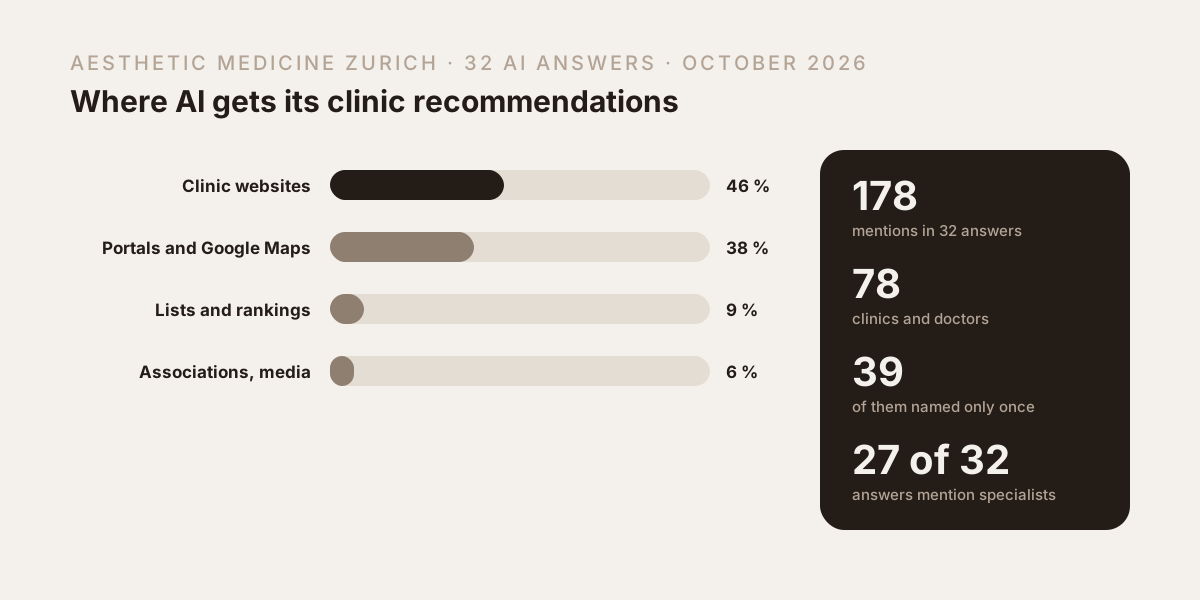
46 percent of the cited pages are websites of clinics and practices, 38 percent portals and Google Maps, 9 percent lists and rankings, 6 percent associations and media. The most-cited clinic domain is University Hospital Zurich (USZ), whose pages on breast surgery and liposuction appeared in 9 answers. Among the lists, a "Toplist" of the best cosmetic clinics on stilpunkte.de and clinic overviews on German hair portals stood out. Among the portals, it was mainly onedoc.ch and online booking sites.
What matters for clinics: the assistants mainly read the page about the procedure, not the homepage. Of 108 cited clinic pages, only 32 were homepages, the rest were subpages such as "Brustvergrösserung", "Fettabsaugung" or "Haartransplantation", with procedure, method and doctor. A clinic that lists ten treatments on one page gives the assistant too little to work with.
Advertising law: what is allowed and what is not
Hardly any industry is as restricted in its marketing. That has direct consequences for what may go on the website:
- Medical Professions Act: Doctors may only advertise in a way that "is objective, meets the public need and is neither misleading nor intrusive" (Art. 40 lit. d MedBG).
- FMH professional code: Information should be factual and true and must not harm the standing of the profession. Restraint is advisable, and you should not raise unjustified expectations.
- Botulinum toxin: It is prescription-only, and advertising it to the public is not permitted under the Therapeutic Products Act. Swissmedic states: no brand names such as "Botox" on websites, no before-and-after images of such treatments, no discounts or promotions. General information about wrinkle treatment without reference to a product is possible.
- Fillers: Hyaluronic acid fillers are medical devices, not medicines. The advertising ban on medicines does not apply to them, but the Medical Devices Ordinance prohibits advertising to the public for devices used only by professionals (Art. 69(3) MedDO). So advertise the treatment, not a filler product. Professional law and unfair competition law apply on top.
- Hair transplants: They count as a medical procedure. Diagnosis, planning and the surgical steps are reserved for the doctor.
The contradiction is interesting: 15 of the 32 AI answers advise patients to ask to see before-and-after images, usually in the consultation. On the website, such images are not allowed for Botox treatments and delicate for other procedures. The right place for them is the consultation.
For marketing, this means: classic forms of advertising are heavily restricted, while factual and detailed information is explicitly allowed. This is exactly the information the AI assistants read and cite. This overview does not replace legal advice. When in doubt, it is worth having a specialist review it.
Google AI Mode and ChatGPT Ads
For 7 of 8 questions, Google AI Mode relied on Google Maps data. The suggested clinics had a median of 4.9 stars and 103 reviews, none below 4.5. A complete Google Business Profile with the right category, such as "cosmetic surgeon" or "hair transplant clinic", is therefore mandatory. How Google AI Mode selects across all industries is shown by our measurement with 100 questions.
Paid visibility in ChatGPT does not exist for this industry: ChatGPT Ads for health services are prohibited outside the US. The organic recommendation is the only way in ChatGPT.
Hair transplants: Switzerland or Turkey?
Three of the four assistants answer the question about Turkey with an open cost comparison: for Switzerland usually CHF 6,000 to 20,000 or a price per graft, for Turkey packages of around EUR 1,500 to 5,000. Then almost always the same arguments for treatment close to home follow: in-person medical assessment, aftercare, and who actually operates. ChatGPT cited a warning from the ISHRS about procedures carried out by unqualified staff.
For a Swiss hair clinic, that is the template: an honest page "Hair transplant in Switzerland or abroad?" that compares costs, procedure, operating doctors and aftercare factually answers exactly the question patients put to the AI.
How do I get ChatGPT and Google to recommend my clinic?
- One page per procedure. Procedure, method, duration, risks, aftercare, cost range and who operates. This is the page the assistant reads.
- Team page with titles. Specialist title, further training, focus areas and memberships per person, as text.
- Factual, not promotional. No superlatives, no promotions, no product names for botulinum toxin. That protects against legal trouble and matches what the assistants cite.
- Answer the patients' questions. Costs, downtime, scars, aftercare, Switzerland or abroad. Ideally as an FAQ per procedure.
- Association and register entries. The Swiss Plastic Surgery list, MedReg, and for hair surgery the professional societies. The assistants send patients exactly there.
- Complete Google Business Profile. Right category, services, photos of the premises, opening hours.
Templates you can copy
The following templates put the data into practice and stay within Swiss professional and therapeutic products law. Replace the placeholders in square brackets. Not legal advice.
One page per procedure, using an eyelid lift as the example
Page title:  Lidstraffung in Zürich: Ablauf, Risiken, Kosten | [Clinic]
URL:         /lidstraffung-zuerich

H1   Eyelid lift in Zurich
     Intro: who the procedure is suitable for and who performs it at
     your clinic, with specialist title. As of: [month year].
H2   Who operates                              name, FMH specialist title, focus,
                                               training, memberships
H2   Process                                   consultation, examination, procedure,
                                               anaesthesia, duration
H2   Risks and possible side effects           factual and complete
H2   Aftercare and downtime                    check-ups, stitches, return to work
H2   Cost range                                range, what is included, whether health
                                               insurance pays in exceptional cases
H2   Frequently asked questions                scars, pain, result, age
Write the page in German for your Zurich patients; the English outline is only here for readability. What does not belong on the page: superlatives, discounts and promotions, promises of results, patient testimonials, and for botulinum toxin, brand names and before-and-after images.
Team page: the title as text
Dr. med. [Name]
Fachärztin für Plastische, Rekonstruktive und Ästhetische Chirurgie (FMH)
Schwerpunkte: [eyelid surgery, breast surgery]
Weiterbildung: [hospital, years]
Mitgliedschaften: [professional society]
Im Medizinalberuferegister (MedReg) eingetragen
Structured data for a clinic
{
  "@context": "https://schema.org",
  "@type": "MedicalClinic",
  "name": "[Clinic]",
  "url": "https://[your-domain].ch",
  "telephone": "+41 [number]",
  "address": {
    "@type": "PostalAddress",
    "streetAddress": "[street no.]",
    "postalCode": "[postcode]",
    "addressLocality": "[town]",
    "addressCountry": "CH"
  },
  "medicalSpecialty": "PlasticSurgery",
  "employee": [{
    "@type": "Person",
    "name": "Dr. med. [Name]",
    "jobTitle": "Fachärztin für Plastische, Rekonstruktive und Ästhetische Chirurgie (FMH)"
  }],
  "sameAs": ["[Google Business Profile link]"]
}
Every detail must match the visible text.
Checklist: 10 points for your clinic's website
And an eleventh point: Measure it. Ask ChatGPT, Gemini and Google AI Mode the same five questions about your most important procedures every month and note who gets named. How to do that is covered in measuring AI visibility.
What we do for clinics
Hierarchy is a full-funnel marketing and AI agency for SMEs in Zurich, specialised in SEO, GEO and paid ads, with marketing and engineering in a team of four. For clinics and practices, we build treatment and team pages so that Google and the AI assistants find and cite them, factually and within what professional law and therapeutic products law allow. Plus the Google Business Profile, structured data and monthly reporting of AI mentions. Where your clinic stands today is shown by the free AI Visibility Check. Details: SEO & AI visibility.
Conclusion
In aesthetic medicine, the AI decides like a cautious patient: it asks about the specialist, specialisation, method and experience, and it recommends clinics whose websites answer these questions. The field is broad, half of the clinics were named only once, and whoever has the best page for a procedure appears in the answer for exactly that question. Because advertising is heavily restricted in the industry and ChatGPT Ads are not permitted for health services in Switzerland, factual, detailed information is the most important lever. How other industries fare: dentists, physiotherapy, real estate agents and bathroom renovation and kitchen building.
About the author