Contents
ChatGPT Ads have run in Switzerland since 24 August 2026, and since 31 August SMEs can book them themselves, from CHF 20 a day. The ads appear below the answer, only for users on the Free and Go plans, and in Switzerland currently without personalisation: ChatGPT selects them based on the topic of the current chat. Not every industry may advertise. Outside the US, health, financial and legal services are currently excluded.
Since ads launched in Switzerland, many agencies have written about them, and some of it is already out of date. It is still often said, for example, that Swiss companies can only book through OpenAI itself. This article summarises what actually applies according to OpenAI (as of 13 October 2026): who sees the ads, who may advertise, what it costs and how to set up a first campaign.
What are ChatGPT Ads?
ChatGPT Ads, in other words advertising in ChatGPT, are paid ads. They appear below the answer, labelled as sponsored and visually separated from the answer. When an ad fits the conversation, ChatGPT shows one or more ad units, which can contain one or more offers. Through an ad's menu, users can hide it, report it, see why it is shown to them, or ask ChatGPT about it.
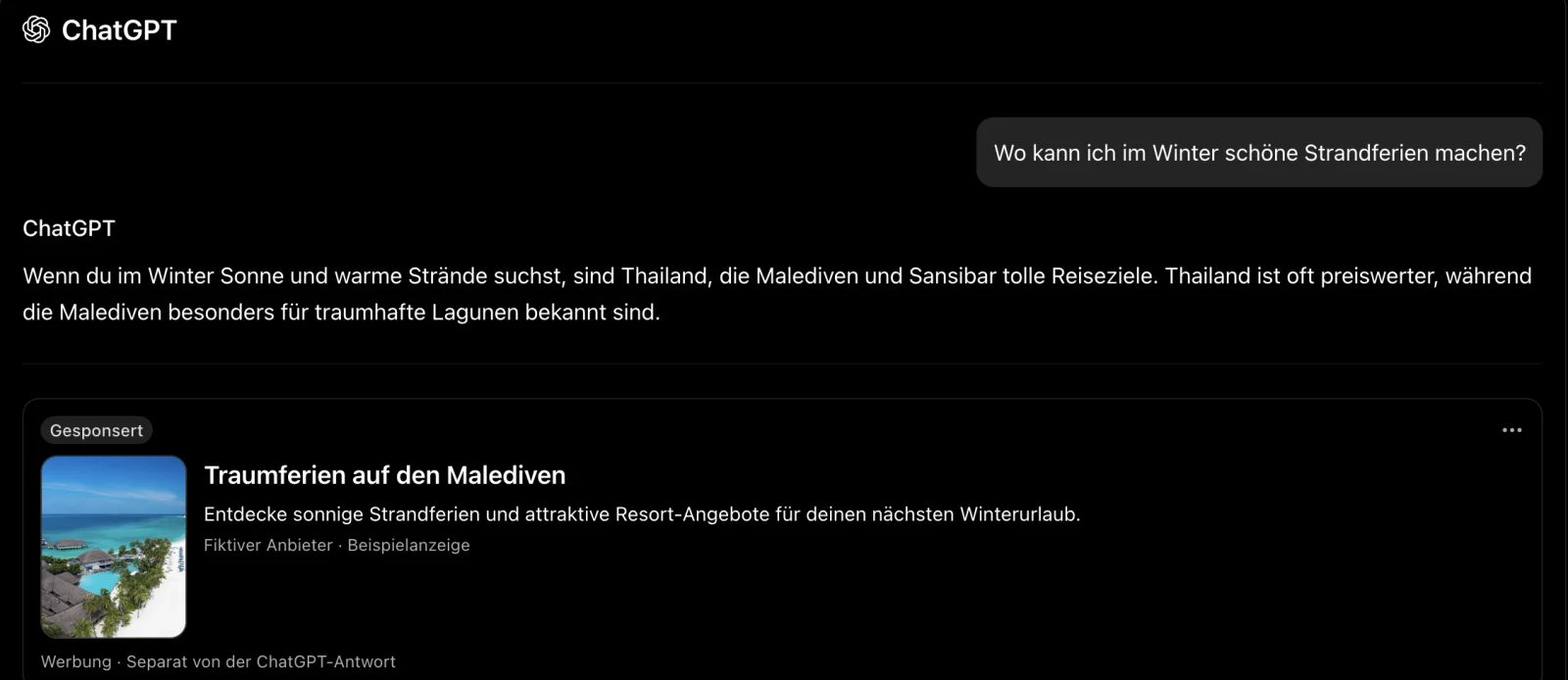
Important for expectations: according to OpenAI, ads do not influence the answers. They run on separate systems, and advertisers have no ability to shape, rank or alter answers. So an ad buys the space below the answer, not a recommendation in the answer.
Timeline: since when ChatGPT Ads have been available in Switzerland
| Date | What happened |
|---|---|
| 9 February 2026 | Ad tests start in the US |
| 18 August 2026 | OpenAI announces ChatGPT Ads for 31 European markets, including Switzerland |
| 24 August 2026 | Ads run in Switzerland, initially only through OpenAI's ads team and partners |
| 31 August 2026 | Self-service in Ads Manager becomes available in all 31 European markets |
For self-service, the company that advertises and is billed must be based in a supported country. Switzerland is listed as available on OpenAI's list.
Who sees the ads
- Only the Free and Go plans. Plus, Pro, Business, Enterprise and Edu are ad-free. Free users can switch ads off, but then get fewer messages and no access to tools such as image generation.
- No minors. Accounts that OpenAI classifies as under 18 see no ads.
- No sensitive conversations. No ads appear next to topics such as personal and mental health or politics, nor in Temporary Chats.
It follows that the audience is ChatGPT's Free and Go users. Many business users on paid plans cannot be reached with ChatGPT Ads.
Targeting in Switzerland: context instead of profile
Personalised ads are not available in Switzerland and the EEA for now. Here ChatGPT selects ads based on the topic of the current chat, the approximate location and the language. Past chats, memories and previous ad interactions are not used. Advertisers never see chats, names, email addresses or precise locations, only aggregated figures such as impressions and clicks.
Advertisers can control:
- Locations: countries and, where available, regions, cities and postal codes. For a Zurich tradesperson, the canton or the city is enough.
- Platforms: Android app, Android web, desktop web, iOS app, iOS web.
- Context hints: hints at ad group level about which conversation topics an ad fits. To some extent they replace the keywords familiar from Google Ads.
Custom audiences, meaning your own customer lists, do exist, but OpenAI explicitly advises against using them for campaigns in Switzerland or the EEA while personalisation is unavailable there.
What ChatGPT Ads cost
For each campaign you choose an objective, and the objective determines the price:
| Objective | You pay | Suited for |
|---|---|---|
| Views | per 1,000 impressions (CPM) | Awareness |
| Clicks | per valid click (CPC) | Website visits |
| Conversions | per click (oCPC) or per 1,000 impressions (oCPM), optimised for a conversion | Enquiries, purchases, sign-ups |
Even with the Conversions objective you don't pay per conversion, but per click or impression. ChatGPT only optimises delivery towards it.
Minimum budget: CHF 20 a day for an ad account billed in Swiss francs, EUR 15 for billing in euros. The daily budget is an average over the week: on individual days ChatGPT can spend up to twice the amount, but never more than seven times over seven days. According to OpenAI, newcomers should start with a daily budget rather than a total budget for the whole campaign.
Click prices: there are no reliable figures for Switzerland yet, not even from OpenAI. The figures in circulation come from the US pilot phase and cannot be transferred to the Swiss market. So plan the first month as a test with a fixed budget and measure what an enquiry actually costs.
Who ChatGPT Ads pay off for, and who may not advertise at all
This is the key question for Swiss SMEs, and here Switzerland differs clearly from the US. During the test phase, OpenAI focuses advertising on consumer and household goods, local services, travel and experiences, and digital products and education. Special rules apply to health, financial and legal services, which amount to a ban outside the US.
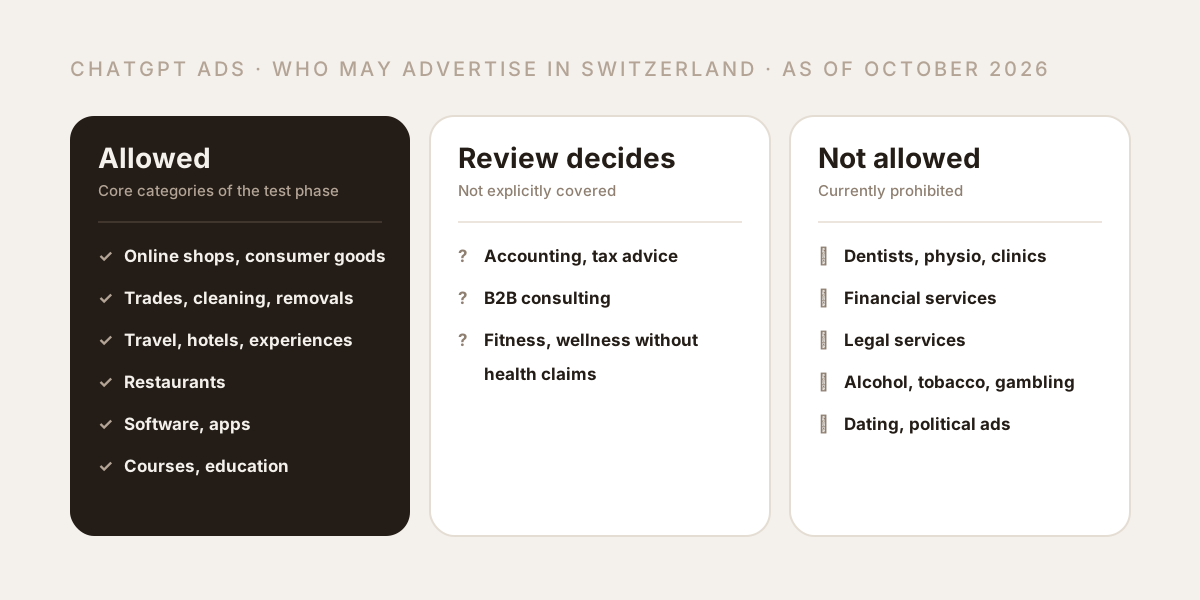
| Industry | ChatGPT Ads in Switzerland | Why |
|---|---|---|
| Online shop, consumer goods | suitable | core category of the test phase |
| Trades, cleaning, removals, landscaping | suitable | local service, targeting by city or postal code possible |
| Hotels, travel, experiences, restaurants | suitable | travel and experiences are allowed; alcohol must not be the focus |
| Software, apps, courses, training | suitable | digital products and education are allowed |
| Fitness, wellness | with care | allowed without medical or health claims |
| Dentist, physiotherapy, medical practice | not allowed | health services are prohibited outside the US |
| Wealth management, insurance, loans | not allowed | financial services are prohibited outside the US |
| Law firm | not allowed | legal services are prohibited outside the US |
| Individual job or housing listings | not allowed | only links to platforms, not to individual listings |
Borderline cases such as accounting, tax advice or B2B consulting are not explicitly covered in the policies. Here OpenAI's review decides, which checks advertisers, ads and landing pages individually. Expect a rejection if the landing page looks like a financial service.
For industries that may not advertise, ChatGPT remains an important channel: patients, clients and customers ask ChatGPT for recommendations, and there only organic visibility counts. What that looks like for dentists, law firms and wealth managers is shown in our industry analyses.
How to set up ChatGPT Ads
- Open an account at ads.openai.com, with the company as the advertiser. Identity is verified and billing details are added.
- Create a campaign: objective (Views, Clicks or Conversions), budget, schedule, countries and locations, and optionally platforms. A note from OpenAI: for your first campaign, start and end dates can sometimes only be edited after it has been created. So don't publish too early, or the ad may start sooner than planned.
- Ad groups with context hints: one group per topic, for example "planning a bathroom renovation" and "bathroom remodel costs", each with matching hints.
- Create ads: title, ad copy, an image depending on the format, plus the landing page. The landing page must match the offer and must not link to excluded content.
- Set up measurement: the OpenAI Pixel on your website or the Conversions API, so campaigns can be optimised for enquiries rather than just clicks.
- Wait for review and launch: ads only run once they have passed review and the account, billing, budget and schedule are in order.
New self-service accounts can initially only advertise in their home country. For Swiss SMEs looking for customers in Switzerland, that is no limitation.
ChatGPT Ads or Google Ads?
| Google Ads | ChatGPT Ads | |
|---|---|---|
| Trigger | Search term (keyword) | Conversation topic, steered via context hints |
| Personalisation in Switzerland | yes | not for now |
| Reach | all Google users | only ChatGPT Free and Go users |
| Industries | almost all, with conditions | restricted; health, finance and legal excluded |
| Benchmarks for Switzerland | years of click price data | no published figures yet |
| Minimum budget | no fixed minimum | CHF 20 a day |
For most SMEs, ChatGPT Ads are therefore not a replacement for Google Ads but an additional test. They make most sense when people really ask ChatGPT for advice on your topic, for example before a purchase, a trip or a renovation, and when your landing page and tracking already work.
Ad and recommendation: occupy both spots
Showing an ad and being named in the answer are two different things. Because, according to OpenAI, ads do not influence the answer, you cannot buy a recommendation. Conversely, this means: if you are named organically and advertise below the answer, you occupy both spots. If you only advertise, you may appear below an answer that recommends three competitors.
How to get into the answers themselves is described in How do I get recommended by ChatGPT?. How Google selects businesses in AI Mode is shown in our measurement One year of Google AI Mode in Switzerland.
How Hierarchy helps
Hierarchy is a full-funnel marketing and AI agency in Zurich, specialised in SEO, GEO and paid ads. We first check whether your industry is allowed and whether ChatGPT Ads make sense for your offer. Then we set up the campaigns in your own account, with the Pixel or Conversions API, and steer them toward enquiries and revenue rather than clicks. Because SEO, GEO and paid ads sit in the same team, we connect the ads with your organic visibility in ChatGPT. More on the paid ads and growth marketing page.
Conclusion
Since the end of August 2026, ChatGPT Ads have been open to every company in Switzerland, with a minimum budget of CHF 20 a day. Targeting currently works without personalisation, through the conversation topic and location, and click prices for Switzerland are still unknown. For online shops, software, courses, travel and local service providers, a properly measured test is worthwhile. Health, financial and legal service providers may not currently advertise in Switzerland and are better off focusing on organic recommendations.
Whether ChatGPT already recommends your business today is shown by the free AI visibility check.
About the author