ChatGPT or Claude for Architects? Which AI Fits Which Workflow, and Why Astra Is the Choice for 3D (2026)
Should an architecture firm use ChatGPT or Claude? Claude for competition texts, standards and contracts, ChatGPT for images and renderings, and GPT-6 Astra for 3D: from floor plan through Blender to a walkable Unreal Engine scene. With data protection rules for Swiss firms.
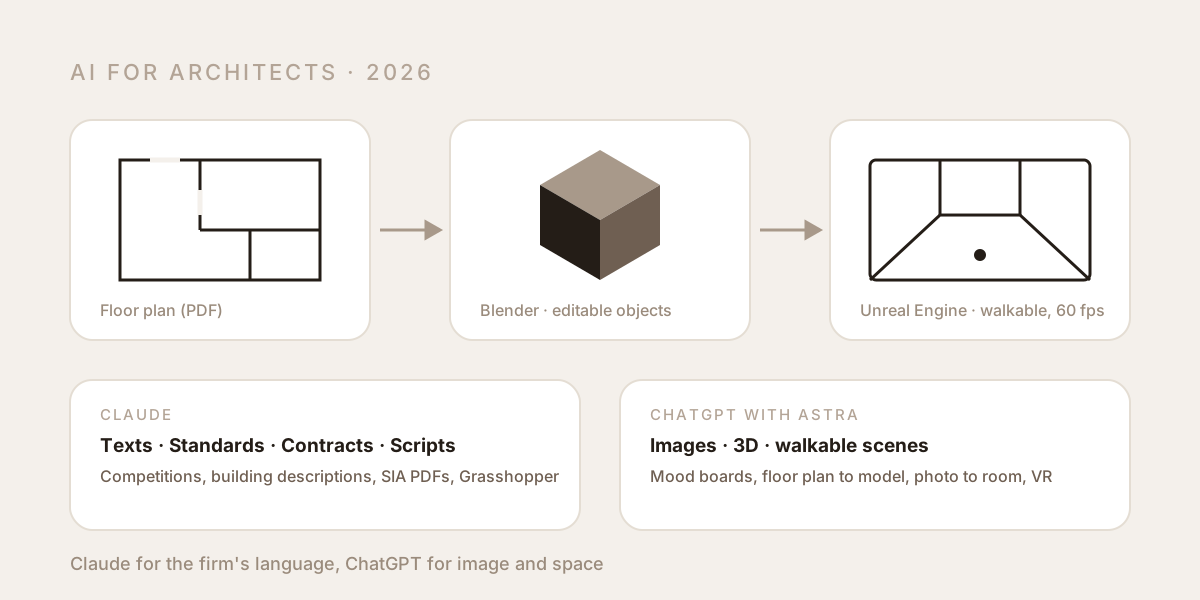
In 2026 an architecture firm needs both assistants, but not for the same tasks. Claude is the better choice for everything made of text: competition entries, building descriptions, standards, works contracts, scripts for Rhino and ArchiCAD. ChatGPT is the better choice for images and, since the GPT-6 Astra model, for everything three-dimensional. Astra is so good at 3D that the workflow from floor plan to walkable Unreal Engine scene can be set up with it in an afternoon.
I have been asked this question in training sessions for a year, mostly by firms of five to thirty people who want to buy one subscription, not three. The answer shifted in the first week of September. Anthropic released Claude Fable 5.1, OpenAI released GPT-6 Astra two days later, and I spent a week testing both on exactly the tasks that come up in an office. The model comparison with benchmarks is in GPT-6 Astra vs. Claude Fable 5.1; this piece is about the work of an architecture firm, task by task.
The short answer
| Task | Recommendation | Why |
|---|---|---|
| Competition texts, building descriptions, fee proposals | Claude | Better prose, keeps the firm's tone across projects |
| Reading standards, building codes, works contracts | Claude | More reliable in documents of several hundred pages |
| Mood boards, image variants, rendering post-production | ChatGPT | Generates images right in the chat, Claude not at all |
| Floor plan to 3D model, walkable scene, VR | ChatGPT with Astra | Builds in Blender and Unreal on its own, spatially precise |
| Scripts for Grasshopper, Dynamo, ArchiCAD, IFC | Claude | Works through interfaces directly in Rhino and ArchiCAD |
| Emails, minutes, quick questions | either | Both equally good, use the plan you have |
| Client data, objections, land registry | Team plan, never the free tier | Data protection, see below |
Texts: competition entries, building descriptions, fee proposals
The biggest time sink in a small firm is not drawing, it is writing: the explanatory report for the competition, the building description for the planning application, the fee proposal under SIA 102, the reply to the client's third follow-up. Here Claude is clearly ahead. It writes longer texts with fewer stock phrases, holds an argument together across ten pages and, this is the real advantage, it learns the firm's tone. A Claude project holds the last three explanatory reports, the mission statement and the phrases the firm never wants to read again. Every new text then comes in that language, not in a marketing chatbot's.
ChatGPT writes well too, but it sounds like ChatGPT. For the quick email to the site manager that does not matter. For the text a jury reads, it does.
Where both hit their limits: tenders. A bill of quantities under BKP or eBKP-H is structure, not prose, and neither ChatGPT nor Claude knows the current items and prices in your region. Both help phrase the items and check for gaps; the quantities and prices come from your software.
Standards and contracts: the question that costs the most
Every firm wants the same thing: ask "what does SIA 118 say about notice of defects?" or "which setbacks apply in this zone?" and get an answer with a clause number. Both assistants deliver that answer, convincingly phrased, and sometimes the clause number is invented. The models do not know what they do not know. There is no documented case yet of a firm being held liable over an invented standard; I would rather no reader of this piece becomes the first.
The fix is simple and works with both: upload the standard or the building regulations as a PDF and demand the answer with a page reference. Then the model can only cite what is in the document, and you check the passage in thirty seconds. Claude is better at this task. It finds the one clause on page 180 of a 280-page works contract, while ChatGPT tends to summarise very long documents rather than search them. ChatGPT is ahead on scanned documents, though: old plans, handwritten annotations, tables in building permits from the nineties it reads more reliably.
Images: mood boards, variants, renderings
Here it is the other way round. ChatGPT generates images right in the conversation, Claude not at all. For mood boards, for the quick facade variant in three materials, for the sky in a rendering and for extending an image edge, ChatGPT is the tool, and for most firms it is enough together with the generative features in Photoshop. Anyone visualising daily has Midjourney or a Stable Diffusion plugin in Revit or SketchUp anyway, and Twinmotion's 2026 release brings an AI denoiser and photo matching without altering your scene.
A warning from practice: AI images are mood, not planning. An image a client has seen in a competition becomes an expectation. Do not show anything you cannot build.
3D: from floor plan to walkable Unreal scene
This is the part that changed in September, and the reason a firm that visualises needs ChatGPT. GPT-6 Astra is better at 3D than I would have credited any language model with.
My test went like this: a floor plan as a PDF, a detached house with three bedrooms, an office and a courtyard, plus a short brief on materials. Astra reads the plan as a plan, not as a picture. It writes Python scripts for Blender, launches Blender in the background, builds walls, openings, slabs and roof as individual, named, editable objects, renders a preview, looks at it, measures and corrects. The wall thicknesses matched the plan, the doors sat where they were drawn, and the kitchen was fitted out.
Then the step that used to be manual work: Astra wrote the export to Unreal Engine 5 itself. Not through Datasmith, but as its own bridge of FBX geometry and a description file with positions, materials, lights and cameras. In Unreal it converted units and axes, created materials and collisions, placed a character at eye height and made doors, drawers and appliances operable. In the end a standalone application ran at 60 frames per second that you walk through with a keyboard or a VR headset. From floor plan to there: one afternoon, and I mostly watched.
Three more things that matter to architects:
- Photos become space. From a handful of photos of an existing building, Astra builds a proportionally correct model. For conversions without plans, that is the fastest route to a first massing study you then refine in Blender or via export.
- Parametrics instead of finished meshes. Ask Astra to build a Geometry Nodes system with exposed parameters, say for a facade division with density, grid and random seed, and you get a system the firm turns itself afterwards. That is closer to Grasshopper than to an image generator.
- The client walks through the design. The Unreal scene goes onto a Quest headset or onto the screen in the meeting room. What used to be a commission for a visualisation studio is now an interim state you build on Friday for Monday.
What Astra does not replace: the eye. Materials, lighting mood, the precision of detail design and code-compliant dimensions are still checked by a person. The first run in a locked-down environment crashed on me, the Blender 5 interface produces warnings, and every larger scene costs noticeable quota. Astra thinks for a long time before it builds, and the weekly limits in the ChatGPT plan are reached quickly.
Claude Fable 5.1 can do Blender too, through a Blender interface, with a view into the viewport and its own error correction, and it is faster and cheaper doing so. For landscapes from GIS data or a video from an address it is a good choice. On spatial accuracy from references, though, Astra is a class above, and that is exactly what counts in architecture.
BIM, Rhino, ArchiCAD: scripts and interfaces
Anyone in the office who writes Grasshopper, Dynamo, pyRevit or GDL, or wants it written, is better served by Claude. Through interfaces Claude works directly in Rhino and writes Grasshopper definitions for facade divisions, shell relaxation or solar analyses, checks the result in the viewport and corrects. For ArchiCAD there is a connector through which Claude queries and changes elements and properties directly in the model without writing GDL. And for IFC models there is a route via Blender and the Bonsai add-on, still a prototype today, but it shows where things are heading.
Two practical notes: neither model reads DWG files directly; exported as DXF it works. And both write GDL or Dynamo scripts that are eighty percent right. The remaining twenty percent is found by whoever tests the result in the application and feeds back the error message.
Data protection: what a Swiss firm has to observe
A floor plan is not personal data. A floor plan with the client's name, the parcel number and the neighbour's objection is, and the planning application even more so. Three rules apply to such documents:
- No free tier and no Plus plan. In its individual plans ChatGPT trains on your inputs by default unless you switch that off. Claude does not do that in any plan, without you setting anything. In both vendors' Team and Business plans there is no training.
- Assess the transfer to the USA. Neither OpenAI nor Anthropic offers its own EU data zone for its newest models; Astra runs only in global and US zones at launch. Claude can be operated via AWS or Google in European regions, which is rarely practical for a firm without IT staff. For everyday use that means: sign a data processing agreement and document the transfer under Article 16 of the Data Protection Act. How to do that is in AI and data protection in Switzerland.
- Leave out personal data where you can. For the standards question, the building description and the 3D model, the model needs no name. Whoever calls the client "family M." and omits the parcel has solved ninety percent of the problem.
The SIA rulebook says nothing about AI so far. Responsibility for the content stays with the firm, no matter who wrote the first draft.
Costs and limits
The subscriptions are not the problem. Claude Team and ChatGPT Business cost about as much per seat as one lunch a week. The problem is the quotas of the new models. In the ChatGPT plan Astra is limited by messages per week, and a 3D scene uses many of them; the most expensive Pro plan gives two hundred messages per week, the cheaper tiers considerably fewer. Claude Fable 5.1 counts double in the Claude plan and is available in Pro and standard Team seats only through credits. Anyone using 3D seriously plans one or two expensive seats for it and lets the rest of the office work with the standard models, which are entirely sufficient for text and documents.
A setup for a firm of five to thirty people
If you want only one subscription: a firm whose work consists mainly of text and documents takes Claude. A firm that visualises a lot and wants to go from floor plan to walkable scene takes ChatGPT. For the general comparison of the two assistants without an industry angle, see ChatGPT vs. Claude for SMEs.
Conclusion
The question "ChatGPT or Claude?" has a clear answer for architects, it just is not one name. Claude is the assistant for the firm's language: texts, standards, contracts and scripts. ChatGPT is the assistant for the image, and with Astra, for the first time, for space. That a language model builds a scene from a floor plan in an afternoon that a client walks through does not change designing, but it changes when and how often you show a design. If you want to see that in your own office: in our AI training we build exactly this workflow with your plans, and in AI automation we turn it into a process that runs without us.
And the other direction, if you want to know what those same assistants say about your firm: we analysed 170 AI mentions of Zurich architecture firms. 52 percent come from the model's memory, only 27 percent from the firm's own website, the lowest figure of all twelve industries we measured. The analysis is in Architecture firm marketing Zurich 2026.
Frequently asked questions
- Should an architecture firm use ChatGPT or Claude?
- Both, but for different tasks. Claude is stronger on long texts and long documents: competition entries, building descriptions, standards, works contracts. ChatGPT is stronger on images and, with the GPT-6 Astra model, on everything three-dimensional: floor plan to Blender model to walkable Unreal Engine scene. If you want only one subscription, take Claude for a text-heavy office and ChatGPT for an office that visualises a lot.
- Can AI turn a floor plan into a walkable 3D model?
- Yes, in usable quality since September 2026. GPT-6 Astra reads the floor plan, builds the house in Blender via Python script, renders, checks the image and corrects. It then exports the geometry to Unreal Engine 5 and sets up camera, doors and lighting there. The result is a scene a client walks through with a keyboard or a VR headset. Materials, lighting mood and code-compliant dimensions are still checked by a person.
- Can AI build a 3D model from photos of an existing building?
- For a first massing study, yes. GPT-6 Astra builds a proportionally correct model from a handful of photos that you can refine in Blender. It does not replace a survey: the dimensions are plausible, not measured. For conversions without plans it is the fastest route to a volume for the first meeting; for execution, the laser scan or manual survey remains.
- Can ChatGPT or Claude create renderings?
- ChatGPT generates images right in the chat, Claude not at all. These images are mood images from a description or a sketch, not renderings of your model. For images that show your geometry the route is still Twinmotion, Enscape or Unreal, with AI helping before on the mood board and afterwards with sky, surroundings and image edges. Do not show a client anything you cannot build.
- Can AI write a competition entry or explanatory report?
- The text yes, the concept no. Claude writes an explanatory report in your firm's language if your earlier reports and mission statement are in the project. What you have to supply is the design idea, the urban stance and the decisions that carry the design. A jury recognises texts written without that substance. Also check the competition brief: some organisers regulate whether AI texts and AI images are permitted.
- Can AI prepare a building description or planning application?
- The building description yes, the application only in part. Claude writes a complete building description from your plans and keywords and checks it against the municipal building and zoning regulations if you upload them as a PDF. The forms, the floor area ratio calculation and the signatures stay with you, and every figure from the regulations is looked up in the original.
- Can AI check whether my design complies with the building regulations?
- As a preliminary check yes, as proof no. Upload the zoning regulations and have setbacks, building height, floor area ratio and building length checked point by point against your values, with page references. That catches violations that get overlooked. Whether the municipality's interpretation agrees is still settled by the building authority.
- Can I rely on SIA standards that ChatGPT or Claude cites?
- No. Both models phrase standard texts convincingly even when the clause number or value is invented. Upload the standard as a PDF and have the answer backed with a page reference; Claude is more reliable on documents of several hundred pages. Every figure that goes into a plan or a submission is looked up in the original.
- Can AI estimate construction costs by BKP or eBKP-H?
- The structure yes, the numbers no. Both assistants organise a project cleanly by BKP or eBKP-H, phrase items and find gaps in the bill of quantities. They do not know the benchmark values and prices in your region, and what they quote sounds plausible and is guessed. Quantities and unit prices come from your cost software and your completed projects.
- Can AI write scripts for Revit, ArchiCAD or Grasshopper?
- Yes, and Claude is the better choice for it. Through interfaces it works directly in Rhino and writes Grasshopper definitions, for ArchiCAD it queries and changes elements in the model, and Dynamo or pyRevit scripts emerge in dialogue. Expect a script to be eighty percent right; the rest is found by whoever runs it in the application and feeds back the error message.
- Can AI read my plans: PDF, DWG, IFC?
- PDF yes, both. Neither model reads DWG directly; exported as DXF it works. IFC models can be connected via Blender and the Bonsai add-on, which is a prototype today. Scanned old plans with handwritten annotations are read more reliably by ChatGPT, very long text documents by Claude.
- May I upload plans and client data to ChatGPT or Claude?
- Plans without personal data, yes. As soon as they contain names of clients, neighbours or objectors, addresses or land registry data, you need a Business or Team plan that does not train on your data and an assessment of the data transfer to the USA under Article 16 of the Swiss Data Protection Act. As of September 2026 neither OpenAI nor Anthropic offers its own EU data zone for its newest models; Claude is available via AWS and Google in EU regions.
- Who is liable if the AI makes a mistake?
- The firm, as with any employee who writes a first draft. The SIA regulations say nothing about AI; the duty of care applies unchanged. Treat AI output like the work of a capable intern: usable, but every clause number, every dimension and every cost figure is checked before release. Document in the office what AI is used for and what has to be checked.
- Does AI replace our visualisation studio?
- For interim states yes, for the competition image no. Astra builds a walkable scene on Friday for Monday's meeting, and for many client conversations that is enough. The image that decides a competition needs a visualiser's eye for material, light and framing. The difference is that you now need the studio only for that one image, not for every variant.
- Where should a firm start?
- With the tasks that come up daily and contain no personal data: meeting minutes from notes, replies to standard client questions, standards questions with an uploaded PDF, the first draft of every building description. That saves a small firm several hours a week and needs no setup. 3D with Astra comes as a second step, with the person who visualises anyway.
- What does an AI setup cost for an architecture firm?
- For a firm of five to thirty people: Claude Team for everyone who works on texts and documents, one or two ChatGPT Pro seats for images and 3D with Astra, plus your existing visualisation software. That is a few hundred francs per month. It gets more expensive if you use Astra intensively for 3D: the model burns through quotas quickly, and the weekly limits are tight.

About the author
Tenzin Langdun
AI Expert & Marketing Lead at Hierarchy
Tenzin is an AI expert and marketing lead with an MSc in Artificial Intelligence from the University of Bath and over 10 years of marketing experience across strategy, paid acquisition, and SEO. He has held roles at leading organisations including KPMG, EY, Siemens, and Adnovum — with expertise in AI, cybersecurity, audit and consulting, and the insurance sector. Together with Martin Oswald, he co-authored an award-winning research paper on AI-based cancer detection, published in Nature and recognised with the National Siemens Excellence Award and the Lab Sciences Award.