GPT-6 Astra vs. Claude Fable 5.1: Benchmarks, a Blender Test and One Week in Practice (2026)
OpenAI's GPT-6 Astra and Anthropic's Claude Fable 5.1 compared: benchmarks on coding, agents and 3D, what developers say after one week, and my own hands-on test. Astra is outstanding in Blender and 3D, Fable 5.1 stays ahead for coding.
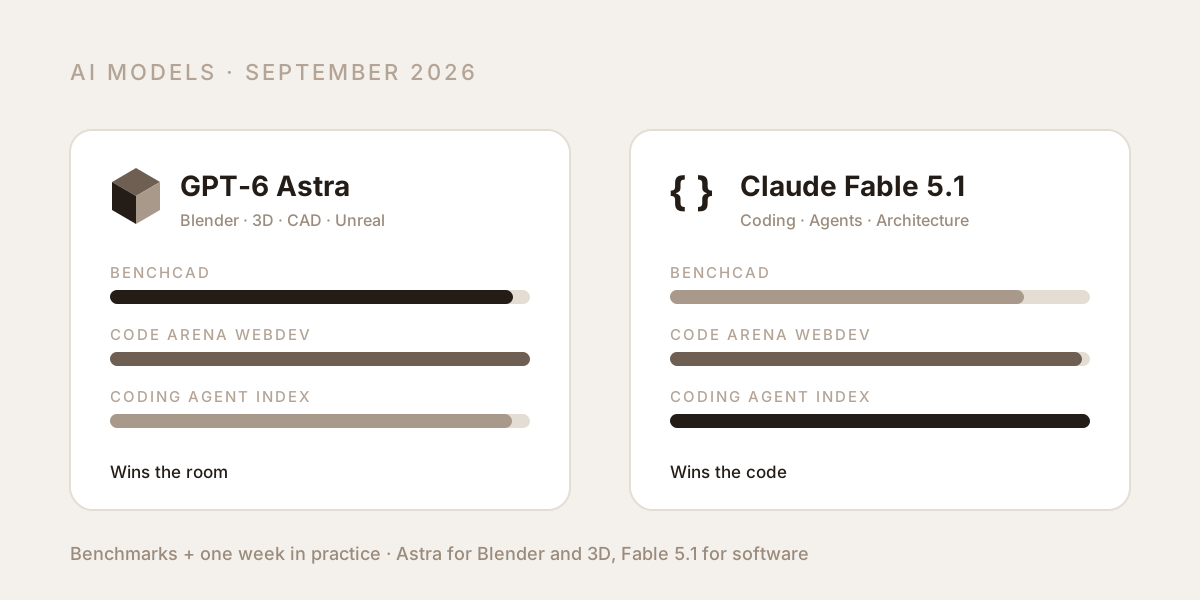
GPT-6 Astra and Claude Fable 5.1 are closer on paper than any two frontier models before them: same price, same context window, same spot on the intelligence index. In practice they are very different. Astra is the best model I have ever used in Blender and 3D. Fable 5.1 remains the model I build software with, even though some coding benchmarks come out in Astra's favour.
Anthropic released Claude Fable 5.1 on 1 September 2026, alongside Mythos 5.1, the same model without the additional safeguards and available only to vetted organisations. Two days later OpenAI shipped GPT-6 Astra, the successor to GPT-5.6 Sol. Both cost USD 10 per million input tokens and USD 50 per million output tokens, both have a context window of around one million tokens, both are marketed as a generational leap. In July I compared Fable 5, GPT-5.6 Sol and Kimi K3 and recommended an orchestrator-executor setup. This piece is the sequel: the public benchmarks, the mood among developers after the first week, and my own test of both models in Blender, Unreal Engine and real software projects.
One week is short, and both vendors kept adjusting limits, prices and indices during it. The numbers below are a snapshot as of 8 September 2026.
How do Astra and Fable 5.1 score on the benchmarks?
The Artificial Analysis Intelligence Index was revised twice within two days. In the first version Fable 5.1 led Astra by five points, in the current one they are tied. That says less about the models than about the indices: at this density at the top, the test configuration decides the ranking.
| Benchmark | GPT-6 Astra | Claude Fable 5.1 | Note |
|---|---|---|---|
| Intelligence Index (Artificial Analysis) | tied | tied | index revised twice in two days |
| Coding Agent Index (Artificial Analysis) | 67 | 70 | Astra uses far fewer tokens to get there |
| Code Arena WebDev (Elo) | 1,797 | 1,762 | Fable 5.1 held #1 until Astra launched |
| Terminal-Bench 4.0 | 57.7% | 55.8% | Mythos 5.1 without safeguards: 60.9% |
| AutomationBench (Artificial Analysis) | 68 | 59 | Astra's biggest lead |
| BenchCAD (image to CAD code) | 95.9% | 84.3% | 3D and space: Astra clearly ahead |
| GPQA Diamond | 96.0% | 92.6% | PhD-level science |
| Humanity's Last Exam (with tools) | 57.2% | 65.0% | Fable 5.1 ahead |
| Price per million tokens (in / out) | USD 10 / 50 | USD 10 / 50 | identical |
| Cache read per million tokens | ~USD 1 | USD 0.25 | Fable 5.1 four times cheaper |
| Output speed | ~57 tokens/s | ~69 tokens/s | Fable 5.1 faster |
Two things stand out. First, OpenAI published no SWE-Bench numbers for Astra, only its own coding benchmarks, and Anthropic's SWE-Bench Pro score of 81.2% for Fable 5.1 is self-reported. The direct coding comparison that still existed in July is missing. Second, ARC-AGI-3 shows how far apart headline and measurement can be: OpenAI reports 99.9% with its own test harness, the independent operator measures 62.7% with the standard harness. Same model.
Blender and 3D: this is where Astra is really, really good
I gave both models the same task: a floor plan as a PDF, from that a detached house in Blender with interiors, furniture, lighting and materials, and at the end a walkable scene in Unreal Engine 5.
Astra did not treat it as a picture but as a building plan. It writes Blender Python scripts, launches Blender in the background, renders, looks at the image, measures and corrects. After about forty minutes there was a house made of several thousand individually named, editable objects, with modifiers instead of baked-in geometry, wall thicknesses that matched the plan, and doors where the floor plan puts them. Astra built the export to Unreal itself, tested it and fixed it until the scene ran at 60 frames per second. Even small things like the kitchen appliances were where they belonged. That is the kind of work I used to hand to a visualiser for a week.
Three things impressed me most:
- Geometry from references. From a handful of photos of a room, Astra builds a proportionally correct reconstruction. Fable 5.1 builds something from the same photos that looks like the room but does not fit it. That is exactly what BenchCAD measures, and the eleven-point gap feels bigger in practice.
- Geometry Nodes. Brief Astra like a procedural artist, asking for a node tree with exposed parameters for density, seed and width instead of just "make a forest", and you get usable systems. The briefing is what matters.
- The pipeline out. Unreal, Unity, Godot, Three.js: Astra knows the engines' command-line modes, plays through the result itself, checks screenshots and repairs. On Three.js scenes Fable 5.1 is its equal, on anything that has to go through Blender it is not.
Not everything is smooth with Astra either. The first run inside a locked-down sandbox crashed; Blender only ran without the sandbox. The Blender 5.x API has quirks that Astra acknowledges with deprecation warnings but does not always handle cleanly. And every larger scene costs noticeable tokens; Astra thinks for a long time on 3D before it writes.
Fable 5.1 is not bad in Blender. Through a Blender MCP server it builds scenes, looks at the viewport and corrects its own mistakes, and it is faster and cheaper than Astra while doing so. For videos from an address, for landscapes from GIS data or for larger projects where the scene has to stay consistent as code, it is a good choice. Once, though, it made a style decision I had not asked for, and only admitted it when I asked. For anything that has to be spatially accurate, I use Astra.
Coding: why Fable 5.1 still comes out ahead
The benchmarks are split on coding. In practice, for me, they are not. I used both models this week in the same projects: this website, two automation agents for clients and a data pipeline for our visibility study.
Fable 5.1 gets things finished. It plans the architecture before it touches the first file, works through long tasks without asking, and is the first model that reliably simplifies code instead of multiplying it. In code reviews it writes fewer comments, but better ones. The writing style has improved, with fewer of the typical Claude mannerisms. And it is noticeably cheaper in agent workloads because cache reads got three quarters cheaper.
Astra stops too early. It asks for confirmations I have already given, takes old rules from configuration files so literally that it halts where a human would carry on, and produces more filler code. In two of my builds features were outwardly finished and did not work: an API integration without real data flow and an agent that could not call itself. Fable 5.1 clearly won the same tasks twice and drew once, and was faster doing it. Anyone migrating from GPT-5.6 Sol also has to adapt the API: temperature and sampling parameters are gone, the response format has a new name, the streaming events have a new shape.
That is no absolution for Fable 5.1. It uses far more tokens per task than Fable 5, sometimes three times as many, which eats the cheaper cache right back up. It over-delivers if you let it: ask for ten quotes, get forty, some of them invented. It launches sub-agents in numbers nobody ordered and does not always stop when interrupted. And at the highest effort level it is slow, taking a good half longer than Fable 5 for a review.
Still: if I had to hand a project to someone else and could pick only one model, it would be Fable 5.1. It understands what I mean even when I have not spelled it out. Astra understands what I wrote.
What developers say after one week
The mood in forums, on X and in both vendors' developer communities follows the same curve for both models, just offset by two days.
For Astra the first days were loud: viral 3D demos, houses from floor plans, games built overnight, labels up to and including "AGI". From day five it turned. Usage limits in Codex were gone after twenty minutes, OpenAI cut the limits for heavy users fourfold after the fact, and the price of 2.5 times Sol became the main topic. Experienced developers wrote that the benchmark jumps did not match their experience and that for big architecture builds they would keep reaching for Fable 5.1. On top of that came a controversy that has nothing to do with the technology: OpenAI advertised Astra with Blender, open-source software built by its community, and part of the Blender artist community saw that as an appropriation of their work. The tech community was thrilled, the art community was hurt.
For Fable 5.1 day one was "Anthropic is back", day two brought the anger about limits: one user burned through the weekly quota of the most expensive plan with a single prompt in under an hour. Anthropic reset the limits and handed out extra quota until mid-September. Then came the complaint that comes with every Claude model: that it is no longer as good as on launch day, probably because of safeguards tightened afterwards. Nobody could prove it; most of those writing it still called Fable 5.1 the best model by a wide margin in the same breath.
What I dislike about both
- Both burn through quotas. A Fable conversation counts double against the Claude limit, Astra is gone after one long session. Anyone working with them seriously plans quota like a budget.
- Astra has no EU data zone at launch. Only global and US. For Swiss companies with personal data that means assessing the transfer under Article 16 of the Data Protection Act or picking another model for those tasks. Details in AI and data protection in Switzerland.
- Fable 5.1 is not in every plan. In Claude Code it is included only for Max and premium Team seats; Pro users pay for it through credits at API rates. And certain requests, for example in the security domain, are silently rerouted to an Opus model by a classifier.
- Astra is hard-locked in the security domain. Exploit-adjacent requests fail at the API, even with authorisation; access to the corresponding programme takes weeks. For penetration testers that is a real obstacle.
- Both vendors report themselves that they can monitor their models less well than the predecessors. Not a day-to-day user problem, but a reason to keep agents with real permissions on a short leash.
My setup after one week
What is new compared to July is not the division of labour but that 3D is on the list at all. Until a week ago, "Blender by voice" was a demo. Now it is a tool I can hand to an architect, a product designer or a property marketer. Anyone wondering whether that pays off for their company will find the everyday assistant view in ChatGPT vs. Claude for SMEs; this piece is about the models underneath.
Conclusion
Astra and Fable 5.1 are not better or worse, they are different. Astra is the first model that truly understands three-dimensional space, and for anyone working with geometry that changes more than any coding benchmark. Fable 5.1 is the model that brings software projects to completion, with judgement you do not have to explain to it every time. If you can pick only one, pick by task. If you combine both, you have for the first time a setup that reaches from floor plan to finished product. Those are exactly the multi-model systems we build at Hierarchy in AI automation for SMEs, and exactly what we show in our AI training.
Frequently asked questions
- Is GPT-6 Astra better than Claude Fable 5.1?
- It depends on the task. On the overall intelligence index they are tied, Astra leads on terminal tasks, web-frontend duels and above all on 3D and CAD, while Fable 5.1 leads on agentic coding, is faster and, thanks to cheaper cache reads, noticeably cheaper in agent workloads. In my practice Astra clearly wins in Blender and 3D, and Fable 5.1 remains the model that gets software projects finished.
- Which AI model is better for Blender and 3D?
- GPT-6 Astra, by a wide margin. It writes Blender Python scripts, renders in the background, looks at the image and corrects until geometry and proportions are right. A floor plan becomes an editable scene and, from there, a walkable Unreal Engine scene. On the CAD benchmark Astra scores 95.9%, a good eleven points ahead of Fable 5.1.
- Which AI model is better for coding in 2026?
- Claude Fable 5.1, despite individual benchmarks in Astra's favour. Fable 5.1 plans architecture better, works through long tasks without asking, simplifies code instead of inflating it, and shipped fewer half-finished features in my builds. Astra asks for confirmation too often, takes old prompt rules too literally and cost more per finished feature.
- What do GPT-6 Astra and Claude Fable 5.1 cost?
- Both cost USD 10 per million input tokens and USD 50 per million output tokens on the API. The difference is in the fine print: Fable 5.1 bills cache reads at USD 0.25, Astra at around USD 1 per million tokens, and Astra doubles its price above roughly 272,000 input tokens to USD 20 and 75. For agents that read the same files over and over, Fable 5.1 usually ends up cheaper.
- Can Swiss companies use Astra with customer data?
- With caution. At launch OpenAI offers only global and US data zones for Astra, no EU data zone. Anyone processing personal data has to assess the transfer under Article 16 of the Swiss Data Protection Act or switch to a model with European data residency, for example Claude via AWS Bedrock or Google Vertex in an EU region. For tasks without personal data, such as 3D models or code, this does not matter.

About the author
Tenzin Langdun
AI Expert & Marketing Lead at Hierarchy
Tenzin is an AI expert and marketing lead with an MSc in Artificial Intelligence from the University of Bath and over 10 years of marketing experience across strategy, paid acquisition, and SEO. He has held roles at leading organisations including KPMG, EY, Siemens, and Adnovum — with expertise in AI, cybersecurity, audit and consulting, and the insurance sector. Together with Martin Oswald, he co-authored an award-winning research paper on AI-based cancer detection, published in Nature and recognised with the National Siemens Excellence Award and the Lab Sciences Award.