Contents
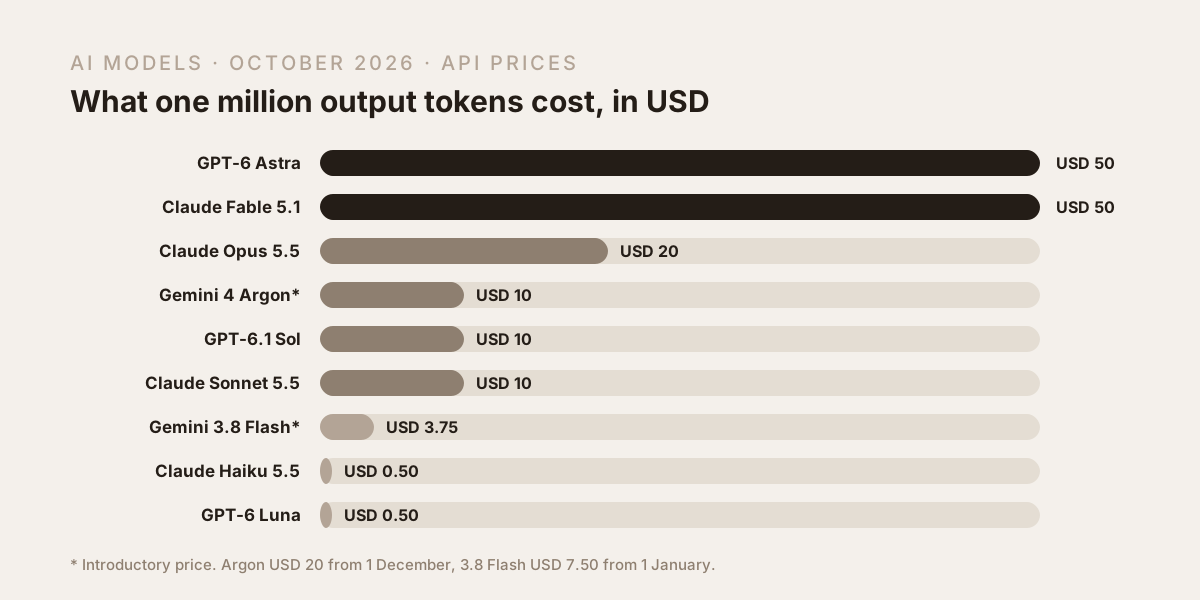
In autumn 2026, less changed at the top than in the middle. GPT-6 Astra and Claude Fable 5.1 are still the strongest models. What is new is that GPT-6.1 Sol, Claude Opus 5.5 and Claude Sonnet 5.5, plus Google's new top model Gemini 4 Argon at its introductory price, deliver almost the same performance for a fifth to two fifths of the price. For most tasks in an SME, the most expensive model is no longer the right choice.
Since my comparison of GPT-6 Astra and Claude Fable 5.1 in early September, eight new models have come out within five weeks. This article puts them in context: what they cost, what the benchmarks show, what we measured ourselves with three current models, and which model I now use for which task. If you are choosing an assistant for everyday office work rather than the model behind it, ChatGPT vs. Claude for SMEs will help.
What changed since September
| Date | What | Why it matters |
|---|---|---|
| 22 September | OpenAI GPT-6 Sol and GPT-6 Luna | Middle tier and budget model, both permanently cheaper than their predecessors |
| 22 September | Claude Opus 5.5 | Almost Fable level for USD 4 and 20 instead of 10 and 50 |
| 28 September | Claude Sonnet 5.5 | Anthropic's new middle tier; Sonnet 5 is now legacy |
| 29 September | GPT-6.1 Sol | Close to Astra at around a fifth of the price |
| 6 October | Mistral Large 4 preview | European model, open weights announced |
| 7 October | Claude Haiku 5.5 | Budget model with a 1 million token context |
| 13 October | Gemini 4 Argon goes public | Google's new top model; in the app only on the AI Pro and Ultra plans |
Two things stand out. First, OpenAI did not ship an Astra successor; instead it made the mid-tier model so strong that it comes close to Astra for many tasks. Second, all three big providers are cutting prices in the middle while the top models stay expensive.
The price list
API prices in USD per million tokens, input and output. For the ChatGPT, Claude and Gemini subscriptions you pay a monthly fee, and what counts there are the usage limits.
| Model | Provider | Input | Output | Tier |
|---|---|---|---|---|
| GPT-6 Astra | OpenAI | 10 | 50 | Top model |
| Claude Fable 5.1 | Anthropic | 10 | 50 | Top model |
| Claude Opus 5.5 | Anthropic | 4 | 20 | Upper middle |
| Gemini 4 Argon | 2 (4 from 1 December) | 10 (20 from 1 December) | Top model, introductory price | |
| GPT-6.1 Sol | OpenAI | 2 | 10 | Middle |
| Claude Sonnet 5.5 | Anthropic | 2 | 10 | Middle |
| Gemini 3.8 Flash | 0.75 (until year end) | 3.75 (until year end) | Cheap, fast | |
| Claude Haiku 5.5 | Anthropic | 0.10 | 0.50 | Budget, up to 100,000 tokens per request |
| GPT-6 Luna | OpenAI | 0.10 | 0.50 | Budget |
What that means in practice: a task that costs one franc with Fable 5.1 costs around twenty centimes with Sonnet 5.5 or GPT-6.1 Sol and around one centime with Haiku 5.5 or Luna. At a hundred such tasks a day, that is the difference between a budget line and a footnote.
What the benchmarks show
Benchmarks are harder to compare in autumn 2026 than they used to be. The long-standard SWE-bench Verified is essentially maxed out, vendors publish different tests, and many figures are vendor-reported. The table below only shows figures available for at least two models on the same test.
| Benchmark | GPT-6 Astra | Claude Fable 5.1 | Gemini 4 Argon | What it measures |
|---|---|---|---|---|
| Terminal-Bench 4.0 | 57.7% | 55.8% | 57.6% | Agentic work in the terminal |
| Humanity's Last Exam (with tools) | 57.2% | 65.0% | – | Very hard expert questions |
| GPQA Diamond | 96.0% | 93.7% | – | PhD-level science questions |
For the middle tier there is a shared index from an independent analysis firm, with the cost per task. It measures general intelligence across many tests and shows what you pay per task:
| Model | Intelligence index | Cost per task |
|---|---|---|
| Claude Sonnet 5.5 | 56.0 | USD 1.08 |
| Gemini 4 Argon | 52.6 | USD 1.99 |
| GPT-6.1 Sol | 51.8 | USD 0.72 |
| GPT-6 Astra (for comparison) | – | USD 3.26 |
For Claude Opus 5.5, Anthropic has only published relative comparisons: better than GPT-6 Astra on a coding test at around a fifth of the cost per task, level with Astra on Terminal-Bench 4.0 at around 40 percent of the cost. Independent figures are still pending.
What we measured ourselves
For our industry studies in October, we put identical questions to three of the current models with web search: GPT-6.1 Sol in ChatGPT, Claude Sonnet 5.5 and Gemini 3.8 Flash. 32 answers per model about real estate agents, aesthetic medicine, bathroom renovation and HVAC and plumbing in Zurich. It is not a benchmark, but it shows the models' personalities very clearly:
| GPT-6.1 Sol (ChatGPT) | Claude Sonnet 5.5 | Gemini 3.8 Flash | |
|---|---|---|---|
| Firms per answer | around 3 | around 7 to 9 | around 6 to 8 |
| Cited sources per answer | around 3 to 4 | around 5 to 6 | around 7 to 9 |
| Length per answer | around 300 words | around 350 to 400 words | around 370 to 420 words |
GPT-6.1 Sol selects and justifies briefly. Ask ChatGPT for a provider and you get a short list, often with a clear personal recommendation. Claude Sonnet 5.5 names more firms and is more cautious: asked about an emergency plumber, it distinguished on its own between firms based in Zurich and pure referral hotlines, and advised asking about prices in advance. Gemini 3.8 Flash reads the most sources and gives the longest answers, with many names from directories and lists.
For businesses that want to appear in these answers, this means ChatGPT is the tightest bottleneck. To be among its three names, you need the most convincing page for the question asked. How to measure that is covered in measuring AI visibility.
Which model I use for which task
| Task | My pick | Why |
|---|---|---|
| Demanding coding, architecture | Claude Fable 5.1 | Still the best coding model for me, despite split benchmarks |
| Everyday coding, multi-step agents | Claude Opus 5.5 | Almost Fable level for less than half |
| 3D, Blender, Unreal | GPT-6 Astra | Astra is really, really good here |
| Texts, emails, concepts | Claude Sonnet 5.5 or Opus 5.5 | Natural tone, good German |
| Research with many sources | Gemini 4 Argon or GPT-6.1 Sol | Argon strong at explanations and languages, Sol cheap and precise |
| Agentic tasks with many calls | GPT-6.1 Sol | Lowest cost per task in the middle tier |
| Classifying, summarising at volume | Claude Haiku 5.5 or GPT-6 Luna | Costs almost nothing, enough for well-defined tasks |
My setup from July, a strong model as planner and a cheaper one as executor, works even better with the new middle tier: Fable 5.1 or Opus 5.5 plans and reviews, GPT-6.1 Sol or Sonnet 5.5 carries out the individual steps. For agents in a business, AI agents in the enterprise describes how to build something like this safely.
What developers say after the first weeks
- Claude Opus 5.5: Praised for a more natural writing style and efficiency. Criticism focuses on the weekly usage limits in the subscriptions, which multi-agent work reaches quickly, and on refusals around security topics. Many ask why they should not just use Sonnet 5.5.
- Claude Sonnet 5.5: Seen as a good, cheap choice for clearly scoped tasks.
- GPT-6.1 Sol: The price-performance ratio is praised almost across the board. Discussion centres on the model, according to OpenAI's own safety documentation, sticking with a task more often than Astra when it should stop.
- Gemini 4 Argon: Praised for writing, explanations, non-English languages and speed. Criticised for reasoning loops that do not end, a gap to Claude in agentic coding, and a confusing launch limited to expensive plans.
Data protection: what Swiss SMEs should check
Choosing a model is also a contract question. For company data, three things need settling: a business or API contract that excludes training on your data, a data processing agreement under the Swiss revDSG and, depending on the data, hosting in the EU or Switzerland. Microsoft offers OpenAI models via Azure in the Switzerland North region, and Claude is available via AWS and Google Cloud in EU regions. New models often arrive there with a delay, so check for each model whether it is already offered in your region. More in AI and data protection in Switzerland and internal AI policy.
Conclusion
The most important change in autumn 2026 is not a new top model but the new middle tier. GPT-6.1 Sol, Claude Opus 5.5, Sonnet 5.5 and, for now at its introductory price, Gemini 4 Argon make the most expensive models unnecessary for most tasks. My recommendation for SMEs: a mid-tier model by default, a top model only for the genuinely hard tasks, a budget model for volume. And before any bigger decision, a test with your own tasks. How your team puts this into practice day to day is what our AI workshops for SMEs cover. The July comparison of Fable 5, GPT-5.6 Sol and Kimi K3 is in AI models compared 2026.

About the author