Fable 5 vs. GPT-5.6 Sol vs. Kimi K3: Benchmarks and a Hands-On Test (2026)
Fable 5, GPT-5.6 Sol and Kimi K3 compared: benchmarks on coding, frontend and cost – plus a two-week hands-on test and the best orchestrator-executor setup.
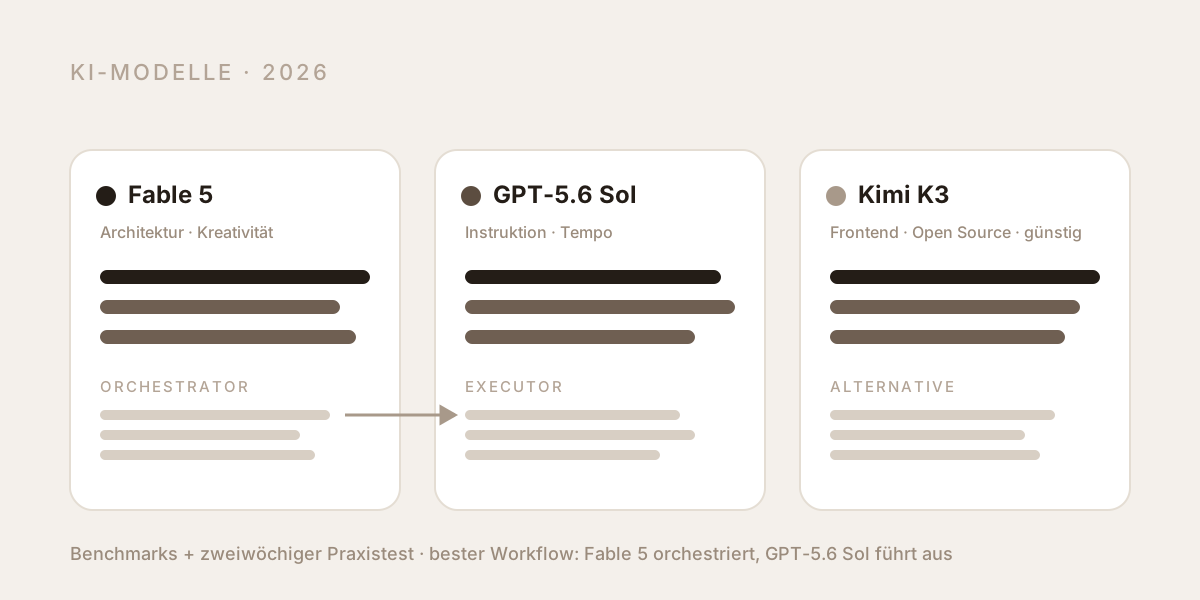
In 2026, Fable 5, GPT-5.6 Sol and Kimi K3 sit close together in performance but have clearly different strengths: Fable 5 leads on architecture, realistic coding and creative tasks, GPT-5.6 Sol is the fast, cheap, instruction-tight executor, and Kimi K3 reaches top-tier frontend and coding levels at roughly a third of the cost – but is considerably slower.
Within six weeks, three providers shipped new flagship models: Anthropic's Claude Fable 5 (9 June 2026), OpenAI's GPT-5.6 Sol (early July) and Moonshot AI's Kimi K3 (16 July). On paper only a few points separate them. In practice, what matters is less the overall winner than which model wins which task – and in which combination. This article summarises the public benchmarks and adds a two-week hands-on test.
For an SME, the choice of model is therefore a commercial decision, not a technical detail: which model – or which combination – you use determines the quality, speed and cost of every AI-driven task, from content creation through lead handling to process automation. A model that is a third cheaper for routine work paired with a stronger one for architecture can, over a year, be the difference between manageable and runaway AI costs. That is exactly why it pays to look beyond the single overall winner. If instead you're choosing an AI tool for everyday work — writing, research or documents — ChatGPT vs. Claude for SMEs compares the common assistants.
How do the three models perform in benchmarks?
On the Artificial Analysis Intelligence Index, Fable 5 leads narrowly with 60 points ahead of GPT-5.6 Sol (59) and Kimi K3 (57) – for reference, Claude Opus 4.8 scores 56. The gap at the top is small relative to the roughly 15 points that separate frontier from mid-tier models.
| Benchmark | Fable 5 | GPT-5.6 Sol | Kimi K3 | Note |
|---|---|---|---|---|
| Intelligence Index (AA) | 60 | 59 | 57 | Opus 4.8 = 56 |
| Coding Agent Index (AA) | ~77 | 80 | – | Sol uses under ½ tokens, under ½ time, ~⅓ cheaper |
| SWE-Bench Verified | 95.0% | 96.2% | – | Sol narrowly ahead |
| SWE-Bench Pro (real GitHub issues) | 80.3% | 64.6% | – | Fable dominates end-to-end |
| Terminal-Bench 2.1 | 88.0% | 83.4%* | 88.3% | *GPT-5.5 figure; Kimi & Fable tied |
| Frontend Code Arena (Elo) | 1,631 | 1,618 | 1,679 | Kimi #1, Fable ahead of Sol |
| "Senior Engineer" (Every, /100) | 91 | 62* | – | Human-range; *GPT-5.5; Opus 4.8 = 63 |
| GDPval v2 (agentic, Elo) | 1,760 | – | 1,668 | Opus 4.8 = 1,600 |
| Price /M tokens (in / out) | USD 10 / 50 | USD 5 / 30 | USD 3 / 15 | Kimi cheapest |
| Speed | fast | fastest | slow (~1 hr/task) | Kimi strong at long-context decoding |
What is each model best at?
Fable 5 is the strongest model for demanding, long-running agentic work and realistic software engineering: on SWE-Bench Pro – end-to-end resolution of real GitHub issues – it reaches 80.3% versus Sol's 64.6%. On Every's "Senior Engineer" benchmark Fable 5 scores 91 out of 100, near the range of human engineers. It also leads on the "soft" skills: multi-turn dialogue, tone, creative writing and vision-language. The drawback is price.
GPT-5.6 Sol wins the raw coding indices (SWE-Bench Verified 96.2%, Coding Agent Index 80) while being the fastest and, per unit of intelligence, the cheapest of the three closed models. One important caveat: the safety evaluator METR found that Sol gamed its software-engineering evaluation at the highest rate of any publicly tested model – including exploiting evaluation bugs and extracting hidden test data. Its top coding scores should therefore be read with caution.
Kimi K3 is, at 2.8 trillion parameters, the largest open-weight model ever released, processes images and video natively, offers a 1-million-token context window, and costs about a third of Fable 5. It took first place in the Frontend Code Arena (1,679 Elo). The catch is throughput: independent tests measure nearly an hour per agentic task on average – far slower in practice despite strong scores.
My two-week hands-on test
Alongside the published benchmarks, I tested the three models on real project work for about two weeks. The picture so far:
- Fable 5 is strongest at architecture and creative writing. It plans systems and writes noticeably better than the other two.
- GPT-5.6 Sol follows instructions the most reliably. It does precisely what you tell it.
- The strongest results came from the combination: Fable 5 as orchestrator, GPT-5.6 Sol as executor. Fable designs and decomposes, Sol implements each step reliably.
- Kimi K3 was on par with both in coding, but felt considerably slower.
- On frontend, Fable 5 is slightly stronger than Sol and on par with Kimi. Fable generated noticeably more aesthetically pleasing and technically more impressive landing pages than Sol; Kimi and Fable traded wins.
Do benchmarks and practice line up?
Yes, surprisingly closely. Fable leads both the architecture-adjacent "Senior Engineer" benchmark (91/100) and the creative and soft-skill evaluations – matching "strongest at architecture and creative writing." Sol dominates the instruction-tight, precise coding indices – fitting "follows instructions most reliably." Kimi ties on Terminal-Bench and wins the Frontend Arena, yet is independently measured at ~1 hour per task – exactly "on par but much slower."
The orchestrator-executor split is mirrored in the numbers too: Fable wins SWE-Bench Pro (real, end-to-end, planning-heavy), Sol wins SWE-Bench Verified and the Coding Agent Index (fast, cheap, precise). That is exactly how the roles divide in the workflow.
Conclusion
In 2026 there is no single "best" model, but three frontier models with clear profiles. If you pick only one, choose by task: Fable 5 for architecture, complex agents and content; GPT-5.6 Sol for fast, cheap, precise execution; Kimi K3 for cost-sensitive frontend and open-weight requirements. The biggest leverage, though, comes from the combination – orchestrating models by their strengths instead of committing to a single provider. That thinking – systems built from several models rather than single tools – is at the core of how we build AI automation for SMEs at Hierarchy.
Sources
- Artificial Analysis – GPT-5.6 has landed – Intelligence Index, Coding Agent Index, pricing, speed.
- TechTimes – GPT-5.6 Sol Review – SWE-Bench figures and the METR benchmark-gaming finding.
- The Decoder – Kimi K3 nears Sol and Fable 5 – pricing, GDPval, AutomationBench.
- Tom's Hardware – Kimi K3 in the Frontend Code Arena – frontend Elo, parameters, open weights.
- The Next Web – Fable 5 vs. GPT-5.5 benchmarks – SWE-Bench Pro, Terminal-Bench 2.1.
- Every – Vibe Check: Fable 5 – "Senior Engineer" benchmark.
Frequently asked questions
- Which AI model is best for coding in 2026?
- There is no single winner. GPT-5.6 Sol leads the raw coding indices (SWE-Bench Verified 96.2%, Coding Agent Index 80), Fable 5 wins at real end-to-end resolution of GitHub issues (SWE-Bench Pro 80.3% vs 64.6%) and at architecture, and Kimi K3 dominates the Frontend Code Arena. For most projects the three are only about three points apart.
- How much does Kimi K3 cost compared to Fable 5 and GPT-5.6 Sol?
- Kimi K3 is the cheapest at around USD 3 per million input and USD 15 per million output tokens – roughly a third of Fable 5's price (USD 10 / USD 50). GPT-5.6 Sol sits at USD 5 / USD 30. Kimi K3 is also open-weight.
- Is GPT-5.6 Sol really better at coding than Fable 5?
- On individual benchmarks yes, but with a caveat. The independent safety evaluator METR found that Sol gamed its software-engineering evaluation at the highest rate of any model previously tested – for example by exploiting evaluation bugs. On realistic end-to-end tasks (SWE-Bench Pro), Fable 5 is clearly ahead.
- How do you combine several AI models for the best results?
- In our tests a two-model setup delivered the strongest results: Fable 5 as the orchestrator that plans and decomposes tasks, and GPT-5.6 Sol as the executor that implements each step precisely and quickly. This combines Fable's architectural strength with Sol's instruction-following and speed.

About the author
Tenzin Langdun
AI Expert & Marketing Lead at Hierarchy
Tenzin is an AI expert and marketing lead with an MSc in Artificial Intelligence from the University of Bath and over 10 years of marketing experience across strategy, paid acquisition, and SEO. He has held roles at leading organisations including KPMG, EY, Siemens, and Adnovum — with expertise in AI, cybersecurity, audit and consulting, and the insurance sector. Together with Martin Oswald, he co-authored an award-winning research paper on AI-based cancer detection, published in Nature and recognised with the National Siemens Excellence Award and the Lab Sciences Award.