From SEO to GEO: Staying Visible in Google AI Overviews and ChatGPT (2026)
What GEO is, how it differs from SEO, how to get cited in AI Overviews and ChatGPT - and why your own website is only half the job. With a checklist.
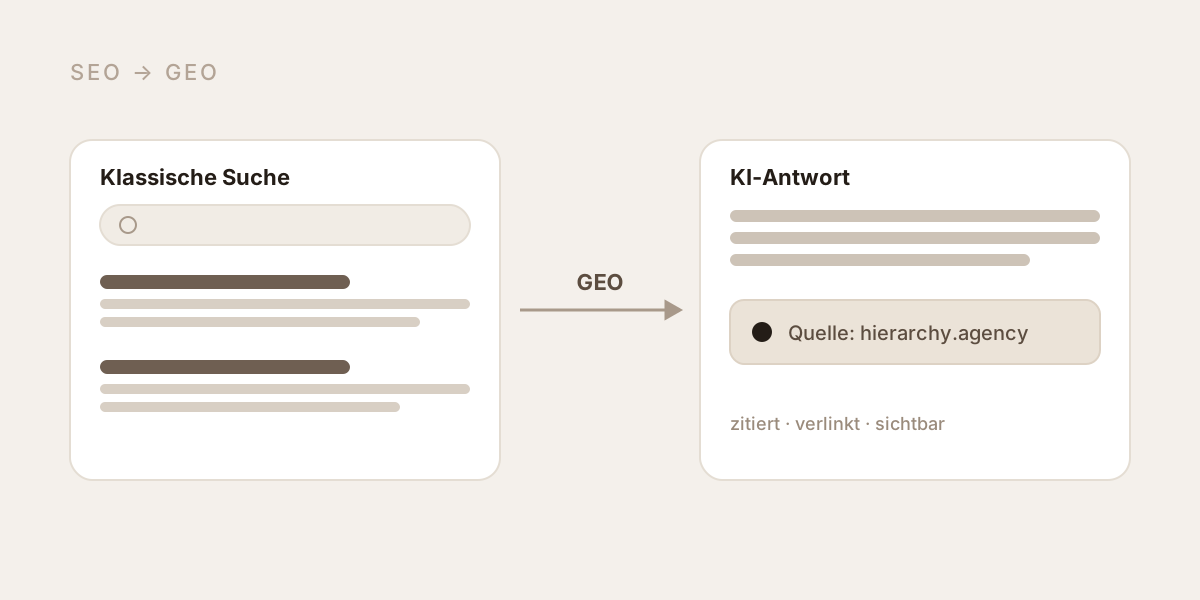
Generative Engine Optimization (GEO) is the practice of optimizing so that AI systems such as Google AI Overviews, ChatGPT, Gemini and Perplexity name a brand and cite its content. 68% of Google searches end without a click according to SparkToro/Similarweb (as of 2026), ChatGPT counts around 900 million weekly users, and in Switzerland 60% of the population uses AI tools according to the IGEM Digimonitor. Visibility increasingly happens inside the answer itself, not in the results list.
For businesses, this shifts the goal: ranking number one is no longer enough. You need to be the source the AI builds its answer from - or be on the page it reads to build it.
What is GEO?
GEO covers every measure that gets a brand into AI-generated answers: as a recommendation ("Which fiduciaries in Zurich can you recommend?"), as a mention, or as a cited source. How a recommendation comes about and which levers make it more likely is covered in How do I get recommended by ChatGPT?. The term comes from a Princeton study from 2023, which showed that statistics, source references and citable structure raise visibility in AI answers by up to 40%. Related terms are AEO (Answer Engine Optimization, answering one specific question) and LLMO. In practice they all mean the same thing: being found when someone asks an assistant instead of Google.
How does GEO differ from SEO?
SEO optimizes for people finding your page through the results list. GEO optimizes for machines understanding, trusting and citing your content. Both share the foundation - crawlable, structured, credible content - but GEO additionally works on the sources outside your website and on the models' memory.
| Aspect | SEO (traditional) | GEO (AI search) |
|---|---|---|
| Goal | Click on the page | Mention or citation in the AI answer |
| Unit | Page / keyword | Statement / entity / prompt |
| Success | Ranking, clicks | Mention rate across a prompt set, citations |
| Format | Title, meta, content | Clear answers, prices, FAQ, structure |
| Source | your own page | own page, third-party pages, the model's memory |
| Competition | ten blue links | three to eight names per answer |
The most important difference is the last row: an AI answer compresses the market to a handful of names. If you are not among them, you do not exist for that query.
Why isn't traditional SEO enough in 2026?
Because the assistants keep their own shortlist. In our AI visibility study of 1,515 AI answers and 14,135 traced mentions across 12 Zurich industries, roughly three quarters of the recommended firms were not in Google's top 10 - even for the exact searches the assistants ran themselves. A good ranking is the ticket in, not the selection.
Add the click loss: when 68% of searches end without a click, you lose reach the moment your brand doesn't appear in the answer. GEO makes sure you get named there.
How do you get cited in AI Overviews and ChatGPT?
AI systems favor pages they can easily excerpt and substantiate. Our study compared the own pages that were cited with those retrieved but ignored: pages with an FAQ section are cited 1.6 times as often, pages that name Zurich explicitly 1.35 times. Hence:
- Answer first: Answer the central question in the opening sentences - who, what, for whom, where, from what price.
- Organize by questions: Phrase headings as real user questions, the way customers put them to an assistant.
- Concrete details: Prices, formats, duration, location, numbers. Assistants often lift such sentences verbatim into their recommendation; claims like "tailored" and "holistic" they do not.
- Self-contained paragraphs: Every paragraph should make sense without context, because it gets cited on its own.
- FAQ section: Short, precise answers to the questions that come up in a first call.
- Structured data:
Organization,ServiceorLocalBusiness,FAQPageandArticleschema, with price data where possible. - Access for AI crawlers: Don't block GPTBot, ClaudeBot, PerplexityBot and Google-Extended; provide an
llms.txt. A blocked page cannot be cited. - E-E-A-T: Make author, date and expertise visible.
Is optimizing your own website enough?
No. That is the most common false assumption in GEO guides, and our data contradicts it on two counts.
First, a large share of mentions has no source at all. About 40% of the 14,135 mentions in our study came from the model's memory: the assistant already knew the firm without opening a page while answering. Across all twelve industries, 39% of mentions relied on the firm's own website and 18% on third-party pages. The split varies a lot by industry: for dentists, 50% of mentions come straight from the practice website, for physiotherapy 69%, for wealth managers 57% come from memory. What to do first therefore depends on the industry.
Second, which page you are on matters more than how good you are. Among firms on a list page the assistant demonstrably read, the stronger half was picked 42% of the time, the weaker half 32% - a factor of 1.3. Being on that page at all is worth 8.2 times as much. And within the page, firms in the top third are named 31% of the time, firms in the bottom third 21%. Moving up a list usually costs an email, not a budget. For broader markets, AirOps puts brand mentions from third-party sources at 85%, almost all of them lists, comparisons and reviews.
On top come two thresholds the study made visible: the share of named firms rises from 67% at 1 to 9 Google reviews to 91% at 30 to 99 reviews, then flattens; the star rating itself barely separates named from unnamed firms. For referring domains the threshold sits at around 99, beyond which more of the same changes almost nothing. What this looks like for your industry is in the study, with lever tables for all twelve industries. Where you stand today is shown by the free AI visibility check.
How fast does GEO work? An example on ourselves
This website went live in June 2026. On 8 September 2026 we asked ChatGPT, Gemini and Claude, each with web search, 14 questions customers ask about AI workshops in Zurich. ChatGPT named hierarchy.ch in 11 of 14 questions, Gemini in 6, Claude in 2 - next to providers that have ranked for those terms for years. All three quoted the wording of our workshop page verbatim: formats, deliverables, review after 30 days, prices. In Google, the same pages still sat at positions 50 to 90 for the matching search terms.
That shows two things. Assistants with web search judge a page by its content when they retrieve it, not by domain age; concrete details work as soon as the page is indexed. The route through the models' memory, the 40% of mentions with no source opened, does not get shorter because of it: it builds over months from mentions in third-party sources and only becomes visible through repeated measurement.
Checklist for GEO-ready content
- Answer the core question in the first 2-3 sentences, including location and starting price.
- Phrase headings as questions people actually ask.
- Concrete details instead of claims: formats, duration, deliverables, numbers.
- Add a table or list for comparable information.
- Include an FAQ section with short, precise answers.
- Serve structured data: Organization/Service, FAQPage, Article, with prices.
- Allow AI crawlers and provide an
llms.txt. - Show authorship, date and sources.
- Get onto the list pages and directories of your industry that the assistants demonstrably read - and as high up on them as possible.
- Build your Google review profile towards 30 reviews; beyond that the effect flattens.
- Set up a fixed prompt set and measure monthly whether your mention rate is rising.
How do I measure GEO success?
Not by rankings. The unit of measurement is a fixed set of real customer questions, put repeatedly to ChatGPT, Gemini, Claude, Google AI Overviews, AI Mode and Perplexity. For each answer you record: named, cited or merely retrieved, at which position, which sources were cited instead. Supplement that with the AI assistant channel in Google Analytics 4 and Google's Search Console report on generative AI features. How such a setup is built is described in Measuring AI visibility.
GEO is part of a larger system of technology, content and distribution - just like growth through systems rather than manual work. We run it as part of our SEO & AI visibility service: website, third-party sources and measurement from one team, from CHF 600 per month.
Want to know whether ChatGPT names you today? The AI visibility check is free - or let's talk.
If you would rather not build this yourself: our comparison of SEO, GEO and AEO agencies in Zurich shows what the market charges and which questions to ask in a first meeting.
Sources
- Hierarchy - AI Visibility Study Zurich 2026 - 1,515 AI answers, 14,135 mentions, 5,110 firms, 12 industries; source shares, list-page effect 8.2x, FAQ effect 1.6x, review and link thresholds.
- Search Engine Land - SparkToro/Similarweb zero-click study 2026 - 68% of US Google searches end without a click.
- TechCrunch - ChatGPT reaches 900M weekly active users (February 2026)
- IGEM Digimonitor 2025 - 60% of the Swiss population uses AI tools.
- AirOps - The Influence of Offsite Signals in AI Search - 85% of brand mentions come from third-party sources.
- Aggarwal et al. - GEO: Generative Engine Optimization (KDD 2024) - up to 40% visibility gain through content optimization.
- Google - Generative AI performance reports in Search Console (June 2026)
- Own sample of 8 September 2026: 14 questions about AI workshops in Zurich put to ChatGPT, Gemini and Claude with web search, once each, searcher located in Zurich.
Frequently asked questions
- What is Generative Engine Optimization (GEO)?
- GEO is the practice of optimizing so that AI systems such as Google AI Overviews, AI Mode, ChatGPT, Gemini and Perplexity name a brand in their answers and cite its content as a source. It covers citable pages of your own, mentions in the third-party sources the assistants read, and technical access for AI crawlers.
- How does GEO differ from SEO?
- SEO optimizes a page to rank in Google's results list and get clicked. GEO optimizes to be named or cited inside an AI answer. The foundation is the same, but GEO additionally works on third-party sources and on the models' memory - and roughly three quarters of the firms AI assistants recommend are not in Google's top 10 at all.
- How do you get cited in Google AI Overviews and ChatGPT?
- With pages that answer the core question in the opening sentences, contain concrete details such as prices, formats and location, have an FAQ section and are reachable for AI crawlers. In our study, own pages with an FAQ section were cited 1.6 times as often, pages naming the location explicitly 1.35 times.
- Is optimizing your own website enough?
- No. About 40 percent of AI mentions in our study had no source at all - the assistant already knew the firm. And where it did open a page, it was often a third party's: being on a list page the assistant reads multiplies the chance of being named by 8.2. Your own website, third-party sources and reviews belong together.
- How fast does GEO work?
- With assistants that use web search, within weeks, because they read a page live while answering. Our own website went live in June 2026; in September 2026 ChatGPT with web search named it in 11 of 14 questions about AI workshops in Zurich. Mentions from the models' memory take longer and are built through third-party sources.
- How do I measure GEO success?
- With a fixed prompt set of real customer questions, put repeatedly to several AI systems. You record whether the brand is named or cited, at which position, and which sources are cited instead - supplemented by AI traffic in Google Analytics and the Search Console reports on generative AI features.
About the author
Tenzin Langdun
AI Expert & Marketing Lead at Hierarchy
Tenzin is an AI expert and marketing lead with an MSc in Artificial Intelligence from the University of Bath and over 10 years of marketing experience across strategy, paid acquisition, and SEO. He has held roles at leading organisations including KPMG, EY, Siemens, and Adnovum — with expertise in AI, cybersecurity, audit and consulting, and the insurance sector. Together with Martin Oswald, he co-authored an award-winning research paper on AI-based cancer detection, published in Nature and recognised with the National Siemens Excellence Award and the Lab Sciences Award.