Contents
Google AI Overviews appear in Switzerland almost every time someone asks a question, and almost never when someone searches for a provider. On 25 October 2026 we ran 84 searches from 12 industries twice each from Zurich. For 56 of 60 questions about costs, problems, rules, terms and comparisons, Google showed an AI Overview. For the 24 searches for a provider, it did so only twice. 39 percent of citations go to provider websites, many of them practices and smaller businesses. And more than a quarter of sources come from Germany, even for Swiss questions.
This article shows which searches trigger AI Overviews, who they cite and what Swiss companies can do with that. Google's AI Mode, which Google offers in its own tab, is covered in our measurement of Google AI Mode. What GEO is in general is explained in Generative Engine Optimization (GEO).
What are Google AI Overviews?
An AI Overview is the summary Google shows above the normal search results. It answers the question directly, in a few sentences or bullet points, and links to the websites it built the answer from. Unlike AI Mode, which users open deliberately, the overview appears unprompted in normal search. In our measurement it sat at the very top of the page in 49 of 58 cases, above the first organic result.
That changes clicks. According to an analysis by Pew Research, Google users in the US clicked a result in 8 percent of searches with an AI summary and in 15 percent without one. If you want to be found for questions, you need to appear in the overview itself.
Our measurement: 84 searches, 12 industries, 7 query types
For twelve industries where Zurich SMEs operate, we wrote seven typical searches each, from dental practices and physiotherapy to fiduciaries, law firms and architecture, through to removals, building services and wealth management. The seven types:
| Query type | Example (searched in German) |
|---|---|
| Provider search | dentist Zurich |
| Best-of search | best fiduciary Zurich |
| Cost | what does a bathroom renovation cost |
| Problem | heating not working what to do |
| Comparison | heat pump or pellet heating |
| Rules | from when is VAT mandatory in Switzerland |
| Term | what does an owner's representative do |
We ran every search twice on 25 October 2026, with the location set to the city of Zurich, language German, on desktop. We sorted the cited websites by hand into four groups: providers (practices, businesses, consultancies, online services), portals and media (comparison sites, advice portals, newspapers, YouTube, forums), large companies (banks, insurers, manufacturers, utilities), and authorities and associations. We count each website an overview links to once per overview as a citation. In four cases Google returned an empty AI Overview without text; we do not count those as overviews. The figures below refer to the first run unless stated otherwise.
Finding 1: AI Overviews appear for questions, not for provider searches
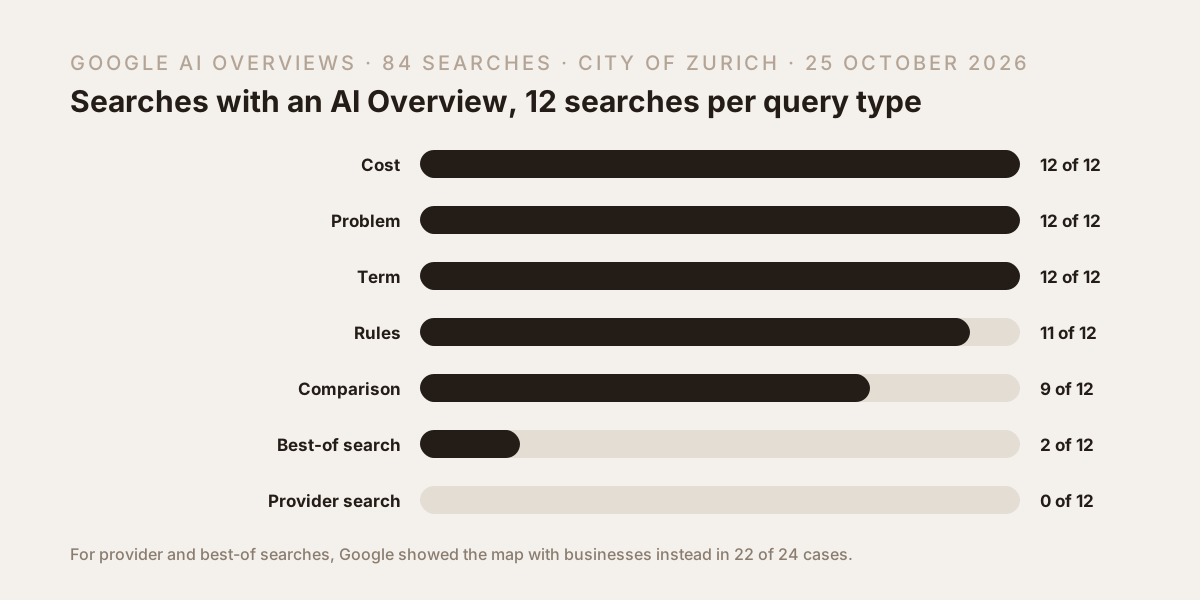
For cost, problem and term questions, Google showed an AI Overview in all twelve cases, for rules questions in eleven, for comparisons in nine. For the twelve plain provider searches such as «physiotherapy Zurich» or «removal company Zurich» there was not a single overview with content. Among the twelve best-of searches there were two: for IT service providers and for wealth managers, perhaps because customers there do not necessarily look for someone nearby.
Instead, Google showed the map with businesses from Google Maps for 22 of the 24 provider and best-of searches. For local businesses this means: when people search for a provider in your field, your Google Business Profile, reviews and the map decide, not the AI Overview. The AI Overview matters for the questions customers ask beforehand: What does it cost? Do I need a permit? What is the difference?
Finding 2: SME websites get cited too
An AI Overview cited a median of seven different websites, at most fifteen. In total we counted 426 citations:
| Source | Share of citations |
|---|---|
| Provider websites (practices, businesses, consultancies) | 39 % |
| Portals, comparison sites, media, forums | 28 % |
| Large companies (banks, insurers, manufacturers) | 20 % |
| Authorities and associations | 13 % |
53 of 58 AI Overviews cited at least one provider website. How much depends on the query type:
- Cost questions: 59 percent of citations went to providers. If your website shows specific prices and worked examples, you have a good chance of being cited here. For «what does dental hygiene cost» and «physiotherapy cost without a referral», the sources were mostly practices.
- Terms: 45 percent providers. If you explain what a root canal treatment, a geothermal probe or an owner's representative is, you give Google the material for the overview.
- Rules: Authorities and associations dominate here with 42 percent, such as the Canton of Zurich, the City of Zurich, the Federal Tax Administration or the tenants' association. Providers got 23 percent.
- Problems: Only 25 percent providers, with many health insurers, manufacturers and advice portals.
Finding 3: A good ranking helps, but is not a requirement
48 of 58 AI Overviews cited at least one of the top three organic results. If you rank high for a question, you have a good chance of appearing in the overview too. At the same time, only half of the cited websites were in the top 10 for that search at all: 215 of 426 citations. Google took the other half from further down.
That fits what Google says about how it works: for an overview, search runs several related searches in the background and assembles the answer from the best passages. A page that answers a sub-question precisely can therefore be cited even if it does not rank highly for the main search.
Finding 4: Swiss questions, German answers
27 percent of all citations went to German websites with a .de domain, 52 percent to websites with a .ch domain. 34 of 58 AI Overviews cited at least one German source, and for eleven at least half of the sources came from Germany. Two examples:
- For «bathroom renovation rented flat who pays», the overview relied on German sources such as a German property owners' association and a German legal insurance provider, and for rent increases after a modernisation it referred to section 559 of the German Civil Code. For a rented flat in Zurich, however, Swiss tenancy law applies.
- For «what does an architect cost for a detached house», the overview first explained the German fee schedule HOAI with amounts in euros. The Swiss fee schedule SIA 102 came second, backed by a single Swiss source.
For Swiss companies this may be the biggest opportunity in this measurement. Google probably does not cite German pages because they are better, but because many questions have no good Swiss answer. If you describe Swiss prices in francs, Swiss rules and Swiss processes specifically, you fill a gap that Google visibly leaves open.
Finding 5: Whether an overview appears is stable, but who it cites is not
Whether an AI Overview appeared was the same in both runs for 81 of 84 searches. The cited websites, on the other hand, changed a lot. For the 56 searches with an overview in both runs, the sources overlapped by only 61 percent on average. Most clearly for the question about the best IT service provider for SMEs in Zurich: the first time the overview relied on the websites of four IT firms, the second time on seven entirely different sources, including a best-of list and LinkedIn. Not a single website appeared in both answers.
For measurement this means: a single query says little. If you want to know whether your company appears in AI Overviews, you have to ask the same questions repeatedly and count. How that works is in Measuring AI visibility.
What this means for SMEs
- For provider searches, the map counts. For «your profession plus location», Google almost never shows an AI Overview but almost always the map. Maintain your Google Business Profile, collect reviews and keep your details consistent everywhere. Details are in our measurement of Google AI Mode.
- One page per customer question. Costs, process, rules and terms from your field: every important question deserves its own page or section that answers it in the first paragraph. For cost questions, providers were cited most often in our measurement.
- Specific, not general. Prices in francs with a worked example, deadlines, responsibilities, standards. «Depending on effort» gives the overview nothing to cite.
- Make the Swiss context explicit. Name the canton, law, standard and authority. Where German pages are cited today, there is room for a good Swiss answer.
- Headings as questions. Google asks sub-questions in the background. A heading that matches one such sub-question, with a direct answer below it, is easier to cite than a long block of text.
- Do not neglect rankings. Four out of five overviews cited at least one of the top three results. Classic SEO remains an important ticket in.
What Search Console shows and what it does not
Google Search Console does not report AI Overviews separately. Clicks and impressions from the overview are included in the normal web search figures. A typical pattern points to AI Overviews: impressions for questions stay stable or rise while the click-through rate falls. Check in Search Console which queries this happens for, and search those questions yourself to see whether and how you appear in the overview.
If you do not want your content used in AI Overviews, Google says you can restrict it with snippet controls such as nosnippet. But that also removes the normal text snippets below your search result. For most SMEs that is the wrong way.
Limitations of this measurement
We measured on one day, from one location, on desktop and without being signed in. AI Overviews can differ by device, history and timing, as the second run shows. We wrote the 84 searches ourselves; they are typical but not representative of all searches in Switzerland. We sorted the sources into four groups by hand and infer a website's origin from its domain ending (.ch, .de). Some websites could belong to more than one group, but that does not change the orders of magnitude.
How Hierarchy helps
Hierarchy is a full-funnel agency in Zurich specialising in SEO, GEO and paid ads. As an AEO agency we work to get Google to show your company as the answer: in AI Overviews, in AI Mode and on the map. We build pages that answer customer questions specifically, maintain your Google Business Profile and measure which questions you are cited for.
Conclusion
In Switzerland, AI Overviews are the norm for questions and the exception for provider searches. For SMEs they matter mainly in the phase before someone looks for a provider: costs, rules, terms and comparisons. There, provider websites get cited often, even without a top ranking, and for many questions a good Swiss answer is missing today. Whether your company appears in AI answers today is shown by the free AI visibility check.
Sources
- Hierarchy's own measurement: 84 searches, 12 industries, location city of Zurich, desktop, two runs on 25 October 2026.
- Pew Research Center: Google users are less likely to click on links when an AI summary appears in the results (July 2025)
- Google Search Central: AI features and your website

About the author