Contents
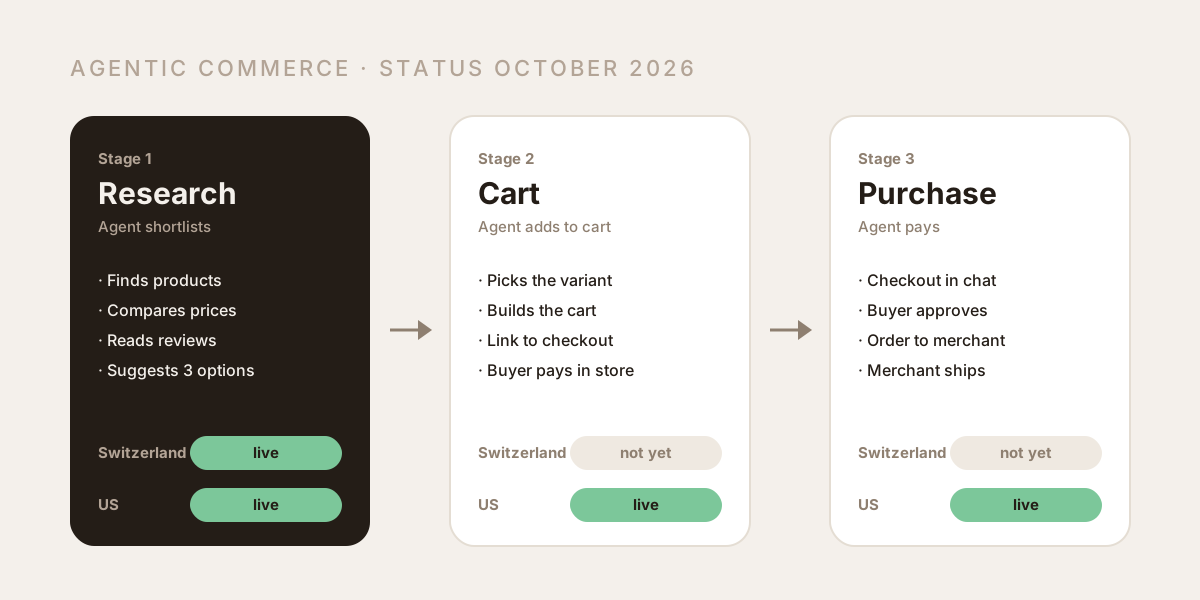
A customer asks ChatGPT for a waterproof bike backpack for the commute, gets three suggestions with price and rating, and clicks straight through to the store named first. They never see the online store that might have the better product. That is what agentic commerce looks like in Switzerland today. In the US it goes one step further: there, the agent creates the basket and pays. This post explains what is behind the term, what is really live in Switzerland as of the end of October 2026, what protocols such as UCP and ACP do, and what your store needs now to be found and recommended by AI agents.
What is agentic commerce?
Agentic commerce, often also called agentic shopping, means an AI agent takes over steps that customers used to do themselves. An agent is more than a chatbot. It searches several sources on its own, compares, asks follow-up questions and, if you allow it, can carry out actions. How AI agents work in general is described in our practical guide to AI agents in business. When it comes to shopping, there are three stages:
- Research: The agent looks for suitable products, reads data sheets, reviews and test reports, compares prices and delivery times, and suggests a small selection. The purchase happens in the store.
- Basket: The agent puts the chosen product, in the right variant, into the store's basket and sends the customer to checkout with a ready-made link.
- Purchase: The agent completes the order on the customer's behalf, with a stored payment method and her approval.
The difference from classic search is not the technology but who makes the selection. On Google, the customer sees ten results and decides for herself. An agent shows her three products, often with a reason. If you are not among those three, you don't exist.
An example: the same purchase in Zurich and in New York
Let's say Lea from Zurich is looking for a waterproof backpack that fits her 15-inch laptop, for her daily ride on the bike.
In Zurich, today: Lea asks ChatGPT or Google AI Mode. The agent names three to five models with a price range in francs, material, volume and a short reason, sometimes with stars and retailers. Lea clicks on a suggestion, lands on a store's product page and buys there as usual. The agent made the pre-selection, the purchase goes through the store.
In New York, today: The same question in Google AI Mode, in Gemini or in Microsoft Copilot. The agent suggests models, Lea picks the colour, and the agent puts the backpack in the basket and completes the order with Google Pay or a stored account, without Lea ever opening the store. The merchant remains the seller, receives the order in its system and ships the parcel.
For the store, the important part is the same in both cases: it has to be in the pre-selection. That is decided in the research stage, and research is already happening in Switzerland.
Agentic commerce in Switzerland: what is live today and what isn't
The announcements of the last twelve months make it sound as if you can already shop in a chat everywhere. The details paint a different picture. As of 31 October 2026:
| Channel | What it can do today | Switzerland |
|---|---|---|
| ChatGPT Shopping | Product search and comparisons, click through to the store's checkout. Since March 2026, OpenAI has focused on product search instead of its own checkout. | Product search yes, purchase in the chat no |
| Google AI Mode and Gemini | Product suggestions from Google's product data. Purchase directly in the agent via UCP, and since October 2026 also a cross-merchant basket. | AI Mode available since October 2025, purchase in the agent US only, Canada and Australia announced |
| Microsoft Copilot | Copilot Checkout for English-speaking merchants selling to the US. | no |
| Perplexity | Instant Buy with PayPal for users in the US. | no |
| Amazon Alexa+ | Shopping assistant, Early Access in Germany and Austria since May 2026. | no |
Shopify itself puts it clearly: Agentic Storefronts are available worldwide to merchants selling to buyers in the US, and purchasing across all channels is currently limited to US buyers. A Swiss Shopify store that ships to the US can already use the channels for those customers today. For customers in Switzerland, no platform has named a date yet.
How people in Switzerland already shop with AI
Several surveys from this year show the same pattern: researching with AI is widespread, autonomous buying is not.
- Visa, October 2026, 1,260 respondents in Switzerland: 70 percent have already used AI programs to prepare purchases. Only 17 percent could imagine allowing an AI to make fully autonomous purchases, payment included. A good two thirds want to trigger every payment themselves.
- Swiss Post and Ipsos, E-Commerce Sentiment Barometer 2026, 1,050 respondents: The share using AI when shopping online rose from 1 percent (2024) to 4 percent (2025) to 9 percent (2026). As the starting point for product searches, search engines are once again ahead of Digitec Galaxus.
- University of St. Gallen, June 2026, almost 3,000 respondents in Switzerland, Germany and Austria: Around 15 percent have already used AI agents for online purchases.
On the merchant side, Shopify sees the growth in its own figures. In the first quarter of 2026, according to Shopify, traffic from AI tools to Shopify stores grew to eight times the previous year's level, and orders from AI searches to almost thirteen times. The starting values were small, and growth has slowed since. The direction is still unmistakable.
The building blocks: Universal Commerce Protocol, ACP, Shopify Catalog and Agentic Storefronts
Behind agentic commerce are a few terms that trade articles often mix up. Briefly explained:
Universal Commerce Protocol (UCP)
The Universal Commerce Protocol is an open standard that Shopify and Google introduced in January 2026. UCP describes how an agent searches a store, creates a basket, goes to checkout and looks up an order. The merchant remains the seller, and payment providers can be freely chosen. UCP is supported by Google, Microsoft, Meta, Amazon, Salesforce and Stripe, among others.
Agentic Commerce Protocol (ACP)
The Agentic Commerce Protocol is the standard from OpenAI and Stripe, launched in September 2025 with purchasing directly in ChatGPT. Since OpenAI scaled back its own checkout in March 2026, ACP mainly serves to submit product feeds to ChatGPT.
Shopify Catalog
Shopify Catalog is an index run by Shopify containing the products of all eligible Shopify merchants, continuously updated with prices and inventory. ChatGPT, Copilot, Google and other agents pull product data from it. Shopify enriches and standardises the data with its own language models. According to Shopify, AI searches based on the Catalog convert twice as well as searches based on scraped data.
Shopify Agentic Storefronts
Agentic Storefronts is the setting in the Shopify admin under Sales channels where you decide which AI channels receive your products and whether direct purchase is allowed. For eligible stores it is active by default.
Knowledge base
The Knowledge base has been a page of its own in the admin since the Fall '26 Edition at the end of October 2026. There, Shopify suggests facts about your store, such as return periods, shipping countries or gift services. None of it reaches an agent before you approve it.
MCP interfaces: what every Shopify store can already do
Every Shopify store provides an interface at /api/ucp/mcp through which agents work using the Model Context Protocol. We checked this with a Zurich label on Shopify: the store publishes a machine-readable profile at /.well-known/ucp with 16 tools for agents, from catalogue search through basket and checkout to order lookup, and Google Pay as the payment method. The merchant didn't have to program anything for this. An agent that wants to use these tools has to identify itself with its own profile.
So the technology is there for every Shopify store. What makes the difference is not the interface, but what passes through it: the product data.
What AI agents need from your store
An agent can only recommend what it understands. The requirements from Shopify, Google and OpenAI spell out fairly precisely what that means:
A category for every product. Shopify assigns products to a category from the Standard Product Taxonomy. Products that Shopify classifies as "Uncategorized" are excluded from the Shopify Catalog. A product without a category is invisible to agents through this route.
The basics. Title, at least one image, a price above zero, a unique product URL, published in the online store and not hidden from search engines.
Complete attributes. Material, dimensions, weight, colour, size, compatibility, care. Shopify attaches its own category metafields to each category, such as neckline and sleeve length for shirts. The more complete these fields are, the better an agent can answer a question like "waterproof, 15 inch, under 200 francs". Shopify itself points out that the fields the Catalog fills in are only as good as the merchant's data.
Clean variants. Every size and colour as its own variant with its own inventory and, where available, its own GTIN.
Unique identifiers. GTIN or EAN, brand and manufacturer part number. OpenAI's product feed requires a valid check digit for the GTIN.
Clear policies. Shipping, delivery time, returns and warranty, identical in the store and in the feeds. According to Shopify, legal notices must appear in the first 6,000 characters of the product description to reach ChatGPT and Google.
Answers to typical questions. Google Merchant Center has introduced new, optional attributes for conversations with AI: questions and answers about the product, links to guides and data sheets, matching accessories, variant names and popularity. They don't affect the approval of existing products, but they give an agent exactly the material it needs to advise a customer.
Reviews. Agents show stars and summarise reviews. In our own measurement, two thirds of the products Google displayed in Swiss shopping searches carried a star rating.
Why this is ultimately a question of SEO and GEO
An agent assembles its pre-selection from several sources: product feeds and the Shopify Catalog, Google's product data, the store pages themselves, and sources about the products, meaning test reports, comparison articles, forums and reviews. No platform discloses which source counts for how much, and the systems differ widely. A study from September 2026 of more than 2,500 commercial questions found that ChatGPT and Gemini cited only 5.4 percent of the same domains on average.
Our own measurement with 15 shopping searches from Zurich also shows how heavily Google relies on its own product data for product questions: Google AI Mode based 14 of 15 answers on product listings from Google's Shopping data, and only one answer named a classic website as a source. The full analysis and what it means for Shopify stores is in Shopify SEO and GEO: how your store gets found in Google, AI Mode and ChatGPT.
In practice, this means product data, technical SEO, content and mentions outside the store are no longer separate projects. They have to say the same thing about the same products for an agent to trust your store.
Checklist: is your store ready for AI agents?
- Does every product have a category from the Shopify taxonomy, and are the category metafields filled in?
- Do all products have a GTIN, brand and manufacturer part number where they exist?
- Are variants set up cleanly, with their own inventory and their own images?
- Do price, availability, shipping costs and return policies match across the store, Google Merchant Center and feeds?
- Are legal notices at the start of the product description?
- Is your store approved in Google Merchant Center, and do you use the new attributes for questions, accessories and guides?
- Have you reviewed and approved Agentic Storefronts and the Knowledge base under Sales channels?
- Do you collect reviews, and do they appear in structured form on the product pages?
- Do your product and collection pages answer the questions customers would ask an agent: for whom, for what, which size, what's different?
- Do you know for which questions ChatGPT, Gemini and Google AI Mode name your products today, and for which they don't?
If you are unsure about more than three of these points, your biggest lever is not the agent but your own catalogue.
How Hierarchy builds your store for agentic commerce
As a Shopify agency in Zurich, we build stores that are made for customers and for AI agents from the start. Marketing and engineering sit in the same team.
A catalogue that isn't built by hand. Our own workflows and MCP servers read supplier lists, data sheets and old stores, assign every product to the right category, fill in attributes from verified sources and create the products in Shopify in a structured way. Your team reviews and approves instead of typing. How this works in detail is shown in our post creating Shopify products automatically instead of by hand.
Data that is the same everywhere. Store, Google Merchant Center, Shopify Catalog and feeds pull from the same source. Every store we set up is approved by Google Merchant Center.
Visibility in Google and AI assistants. Technical SEO, structured data, content that offers real buying advice, and mentions in the sources agents read. We measure for which questions your products are named and build on that in a targeted way.
Ready for purchasing inside the agent. Agentic Storefronts, Knowledge base, shipping and return policies and payment methods set up so that your store is included as soon as purchasing inside the agent launches for Swiss customers, and for US customers already today if you ship there.
Already have a store on Magento, WooCommerce or Shopware? How the move works without losing rankings is in Switching to Shopify, and a concrete project in our case study: Magento 2 to Shopify.
In short
Agentic commerce has arrived halfway in Switzerland: AI agents already make the pre-selection, while purchasing inside the agent is reserved for the US for now. Shopify provides the interfaces to every store automatically. But only stores with complete, consistent product data that appear in the sources agents trust get recommended. That is exactly what you can work on today.
Want to know how ready your store is for AI agents, or have a new store built that is ready from the start? Book a free intro call. We'll look at your catalogue and tell you where the biggest lever is.

About the author