Case Study: From Magento 2 to Shopify – with a Universal Product Database and Agent-Driven Enrichment
How we migrated a Magento 2 store to Shopify: a universal product database as the single source of truth, bidirectional sync, and an agent-first architecture for enrichment, analysis, and SEO – with measurable time savings.
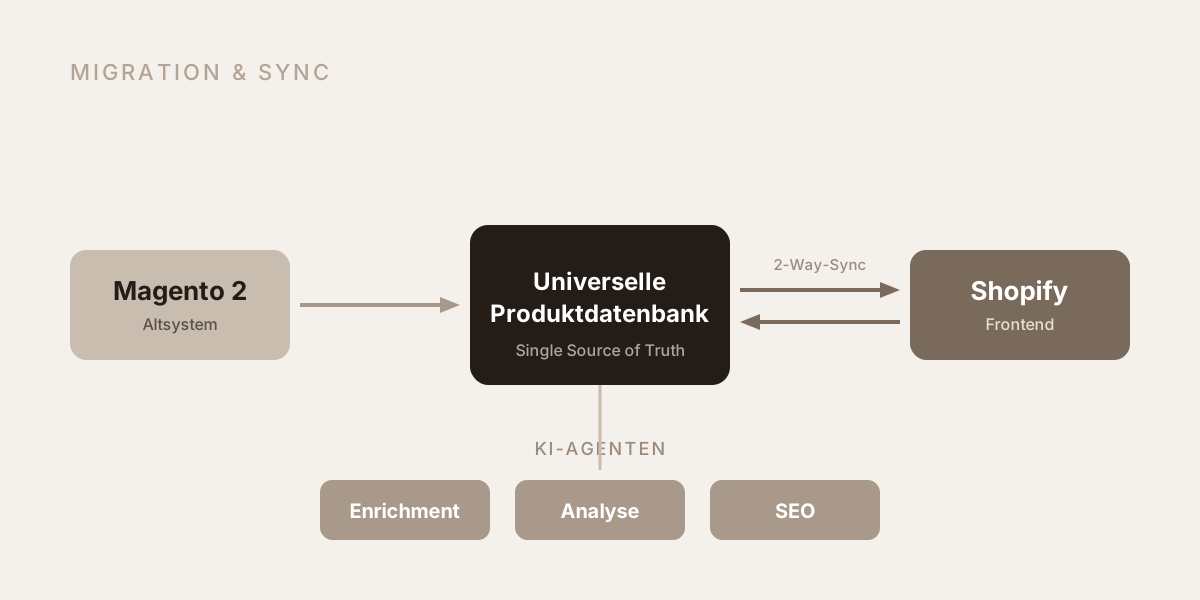
An established retailer wanted to move from Magento 2 to Shopify – without losing the product catalog built up over years and without months of manual work. Instead of simply "relocating" the data, we built a universal product database as the single source of truth, synced it bidirectionally with Shopify, and put an agent-first architecture in front of it that automates enrichment, analysis, and SEO optimization. The result: a clean catalog, a faster frontend, and significantly less manual maintenance.
The Starting Point
Magento 2 was powerful but expensive to run: demanding hosting, long update cycles, and a data model in which attributes, copy, and categories had grown inconsistently over the years. Every product change cost time, and data quality varied from one employee to the next.
The Solution: Database First, Then the Shop
The decisive step was to decouple the product data from the shop system. We built a central product database (PIM) that is independent of Magento or Shopify. It holds the canonical truth – Shopify becomes an interchangeable frontend.
| Building Block | Role |
|---|---|
| Universal product database | system-independent single source of truth for all data |
| Mapping & normalization | unifies attributes, units, and categories |
| Bidirectional Shopify sync | keeps database and shop consistent without duplicate effort |
| AI enrichment agents | add copy, attributes, metadata, and internal links |
| Analysis layer | finds gaps, duplicates, and SEO potential in the catalog |
Agent-First: Enrichment, Analysis, SEO
On top of the database, specialized AI agents do the work. They handle exactly the tasks that previously took thousands of clicks:
// Every product runs through the pipeline – humans only give the final approval.
async function processProduct(product: RawProduct) {
  const normalized = normalize(product);          // unify attributes & units
  const enriched   = await enrichWithAI(normalized); // copy, missing attributes, metadata
  const seo        = await optimizeSEO(enriched);    // title, description, internal links
  const issues     = analyze(seo);                   // gaps, duplicates, inconsistencies

  return issues.length ? flagForReview(seo, issues) : publishToShopify(seo);
}
In concrete terms: the enrichment agent writes conversion- and search-engine-optimized product copy, fills in missing attributes, and generates metadata. The analysis agent checks the entire catalog for gaps, duplicate content, and inconsistencies. The SEO agent optimizes titles, descriptions, and internal linking. It's the same division of labor as in any AI agent system in the enterprise: volume automated, judgment human.
The Results
- Enormous time savings in product maintenance: enrichment and SEO run automatically, the team only gives approval instead of typing it all out.
- Consistent data quality across the entire catalog – uniform attributes, complete copy, clean metadata.
- Faster frontend and lower maintenance effort after the move to Shopify.
- Future-proof: marketplaces and new channels pull their data from the same source.
In Brief
The migration was never the goal, but the by-product of a better data structure. That's exactly the approach behind growth through systems instead of manual work and ties directly into AI automation for mid-sized businesses.
Are you planning a shop migration or want to automate your product maintenance? Book an introductory call.
Frequently asked questions
- Is it worth switching from Magento 2 to Shopify?
- For many SMEs, yes: Shopify significantly reduces maintenance and hosting overhead and is faster in day-to-day operations. What matters most is a clean migration of product data – ideally via a central product database that stays independent of the shop system and also safeguards a future platform switch.
- What is a universal product database (PIM)?
- A universal product database (Product Information Management) is the central, system-independent source of all product data: attributes, copy, images, prices, categories. The shop, marketplaces, and channels pull their data from there instead of maintaining it individually.
- What does bidirectional sync with Shopify mean?
- Bidirectional (2-way) sync means changes flow in both directions: when the team maintains data in the central database, it lands in Shopify – and conversely, changes triggered in Shopify (e.g. stock levels, prices) are synced back. This way there is only one source of truth, with no duplicate maintenance.
- How does AI help with enriching product data?
- AI agents research missing attributes, write search-engine- and conversion-optimized product copy, generate metadata, check for gaps and inconsistencies, and suggest categories as well as internal links. Humans give the final approval – the agent handles the routine.

About the author
Tenzin Langdun
AI Expert & Marketing Lead at Hierarchy
Tenzin is an AI expert and marketing lead with an MSc in Artificial Intelligence from the University of Bath and over 10 years of marketing experience across strategy, paid acquisition, and SEO. He has held roles at leading organisations including KPMG, EY, Siemens, and Adnovum — with expertise in AI, cybersecurity, audit and consulting, and the insurance sector. Together with Martin Oswald, he co-authored an award-winning research paper on AI-based cancer detection, published in Nature and recognised with the National Siemens Excellence Award and the Lab Sciences Award.