Contents
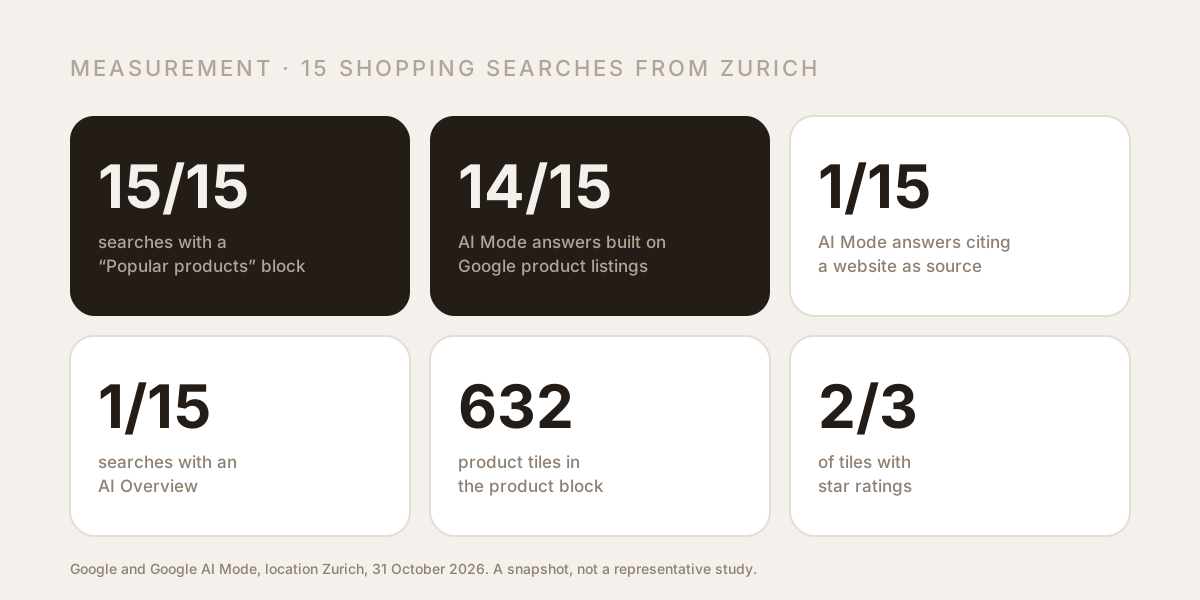
Anyone in Switzerland who googles «Velohelm kaufen» (buy a bike helmet) or «nachhaltige Bettwäsche» (sustainable bed linen) today sees products first: images, prices in francs, stars, retailers. Ask Google AI Mode the same question and you get advice with model recommendations, and the linked products almost always come from Google's product data, not from websites. We analysed 15 typical shopping searches from Zurich. This post shows what we found, why e-commerce SEO and GEO in 2026 are above all a question of product data, and what a Shopify store actually needs to be found in Google, Google AI Mode and ChatGPT.
Our measurement: 15 shopping searches from Zurich
On 31 October 2026 we sent 15 searches of the kind customers in Switzerland make to Google Search and Google AI Mode, with the location set to Zurich. The selection covers typical product ranges: bikes and e-bikes, bike helmets, bed linen, bean-to-cup coffee machines, running shoes, hiking boots, natural cosmetics, dog food, office chairs, wine as a gift, prams, mattresses, ski jackets, protein powder and watches.
| What we measured | Result |
|---|---|
| Searches with a «Popular products» block | 15 of 15 |
| Searches with an AI Overview | 1 of 15 |
| AI Mode answers based on Google product listings | 14 of 15 |
| AI Mode answers citing a website as a source | 1 of 15 |
| Product tiles in the product block in total | 632 |
| of which with a star rating | 418, so two thirds |
Three things stand out.
First: for shopping searches, products are the first answer. All 15 searches showed a product block with image, price, retailer and often stars. These tiles come from Google Merchant Center, not from the classic search results.
Second: Google's AI Overview hardly plays a role here. Only «Kinderwagen test schweiz» (pram test Switzerland) triggered an AI Overview. That fits our measurement of Google AI Overviews in Switzerland: AI Overviews appear mainly for questions and hardly ever for searches for a provider. Shopping searches behave like provider searches.
Third: Google AI Mode advises with product data. For «Wanderschuhe Damen wasserdicht Empfehlung» (women's waterproof hiking boots recommendation), AI Mode answered with a table of three models, their intended use, features such as a Gore-Tex membrane or Vibram sole, and a price range in francs. Each model was linked to its product listing on Google. In 14 of 15 answers AI Mode relied on product listings like these, and only a single answer cited a classic website as a source. For local service providers, AI Mode relies on Google Maps, as our analysis of 100 questions to Google AI Mode showed. For products it is the counterpart: Google's product data.
The big retailers dominate the product block. Decathlon appeared on 47 tiles across our 15 searches, Galaxus on 45. But specialist Swiss stores showed up too, such as Lehner, Zubi or Perroulaz Nutrition. The spots don't belong only to the big players. If you want to compete, you need an approved product feed.
How ChatGPT recommends products
ChatGPT works differently from Google. OpenAI does not disclose its weighting, but it is known that for products ChatGPT uses structured data from merchants and third parties, prices, descriptions and reviews, and that merchants can supply their own data through a product feed. Since March 2026 OpenAI has focused its shopping efforts on product discovery, with the purchase happening in the store. For Shopify merchants, data also arrives via the Shopify Catalog; more on that in Agentic Commerce: what Swiss online stores need to know now.
Two studies help put this in context:
- A BrightEdge analysis of the 2025 US holiday season found that for shopping questions, retailer websites made up around 36 percent of ChatGPT's sources but only around 4 percent of the sources in Google's AI Overviews. Google instead cited mainly YouTube, Reddit and forums.
- A September 2026 study of more than 2,500 commercial questions found that ChatGPT and Gemini cited on average only 5.4 percent of the same domains, and that recommendations changed for identical, repeated questions.
For your store this means: there is not one AI visibility but several. Google relies heavily on product data, while ChatGPT reads store pages and sources about your products more. If you only cover one side, you are missing from the other.
SEO for online stores: the three layers of SEO and GEO
The measurement and the platforms' requirements give three layers that have to work together.
1. Product data and feeds
This is the layer Google uses most for shopping searches.
- Google Merchant Center approved, with a complete feed: title, description, images, price, availability, GTIN, brand, category, shipping and returns.
- Product titles that carry search terms. Not «Montaro III», but «Giro Montaro MIPS III bike helmet, matte black, size M». Brand, model, product type, key feature, variant.
- The new attributes for AI conversations. Google Merchant Center offers optional attributes for product questions and answers, links to manuals and data sheets, matching accessories, variant names and popularity. They don't affect approval, but they give AI Mode exactly the material it needs to give advice.
- Reviews in the feed and on the page. Two thirds of the tiles in our measurement showed stars. A product without stars looks weaker next to them.
- The same data everywhere. Price, stock and shipping in the feed must match the product page exactly, otherwise Merchant Center rejects products.
How to build a catalogue in which these fields aren't maintained by hand is described in creating Shopify products automatically.
2. Shopify SEO: the technical foundations
Shopify takes a lot off your plate, but not everything.
- Duplicate product URLs. Many themes link products within a collection as
/collections/velohelme/products/giro-montaro. The canonical points to/products/giro-montaro, and internal links should do the same. Google recommends using the same URL form everywhere: in links, the sitemap and the canonical. - Controlling filter URLs. Filters quickly create thousands of URL variants. Google names robots.txt as the most effective tool when filtered pages shouldn't be indexed. In Shopify, robots.txt can be adjusted via the
robots.txt.liquidtemplate without losing the default rules. The exceptions are filter pages with real search demand, such as «Velohelm mit MIPS» (bike helmet with MIPS): these are better off as a collection of their own. - Pagination. Don't point page 2 of a collection to page 1 with a canonical. Google explicitly advises against it.
- Variants with their own URL. Google recommends that every variant be reachable at its own URL. Shopify does this with the
?variant=parameter, while the canonical stays with the product. - Completing structured data. Product with Offer, GTIN, brand, SKU, reviews and product group for variants. Google now recommends declaring shipping and return policies centrally at organisation level, with product-level details only as an exception. Many themes don't deliver this completely.
- Languages and markets. Shopify Markets generates hreflang tags automatically from your market and language settings. For Switzerland with German, French and Italian, every language version should be fully translated, including metafields, SEO titles and alt text.
- Don't lock out AI crawlers. Check whether your robots.txt or a bot protection setting at Cloudflare or another provider blocks the crawlers of OpenAI, Google and others. If you lock them out, your own pages can't appear in their answers.
3. Content and mentions outside the store
This layer matters most for ChatGPT and for every question that goes beyond «buy».
- Collection pages with advice. An intro text above the products and an advice section below them.
- Product pages that answer questions. Not just data, but who it's for, what it's for, how it fits, what's in the box.
- Guides for buying decisions. Pages that answer the questions customers put to an assistant.
- Mentions outside the store. Test reports, comparison articles, trade magazines, forums and review platforms. According to BrightEdge, Google cited mainly sources like these for shopping questions, and ChatGPT reads them too. How to get into these sources in a credible way is covered in Digital PR for AI visibility.
Concrete examples: what good Shopify pages look like
Taking a Swiss bike accessories store as an example:
Collection page «Bike helmets»
- Page title: «Buy a bike helmet: helmets for city, road and MTB | Store name»
- Two or three sentences above the products: which helmets are available here, who they're for, with shipping within Switzerland and returns within 30 days.
- Filters by use, size, MIPS, weight and price. Filtered URLs not indexed, unless there is real demand.
- An advice section below the products: How do I find the right size? What does MIPS do? Which helmet for e-bikes up to 45 km/h? How often should you replace a helmet?
- Links to sub-collections such as «E-bike helmets» and to the guide «Which bike helmet for commuting?».
Product page «Giro Montaro MIPS III»
- Title and H1 with brand, model and product type.
- Original copy instead of the manufacturer's description: which rides it's for, how it fits, how it wears compared with its predecessor.
- All data as attributes: weight, sizes with head circumference, vents, standards, what's in the box.
- A short questions-and-answers block, with the same questions in the Merchant Center feed.
- Reviews visible and structured.
Guide «Which bike helmet for commuting in Zurich?»
- Answers the question directly in the first paragraph.
- Compares three helmet types with pros and cons, and names specific models from the range with links.
- Covers Swiss specifics: rules for fast e-bikes, winter, lights on the helmet.
- This is exactly the kind of page AI assistants cite when someone asks for advice, and it leads straight to the collection.
How to measure your visibility
- Google Merchant Center: clicks and impressions from free product listings, rejected products, notices about missing attributes.
- Google Search Console: rankings and clicks for collections, products and guides.
- Analytics: visits and revenue from chatgpt.com, perplexity.ai, gemini.google.com and copilot.microsoft.com, tracked cleanly as a channel of their own. Shopify shows orders from the AI channels of Agentic Storefronts with their own attribution in the admin.
- Fixed questions to the AI assistants: ten to twenty questions your customers ask, put regularly and repeatedly to ChatGPT, Gemini, Perplexity and Google AI Mode. Is your store mentioned, which products, which sources? How we set this up is described in Measuring AI visibility.
How Hierarchy makes your Shopify store visible
At Hierarchy, Shopify development, SEO and GEO sit in the same team. That's why we don't bolt visibility onto a store afterwards, we build it in.
- New store or migration: As a Shopify agency in Zurich we build stores with complete product data, clean technology and a catalogue approved by Google Merchant Center. When moving from Magento, WooCommerce or Shopware, we bring your rankings along, as described in Switching to Shopify.
- Existing store: Our SEO agency works on the technology, collections, product pages and guides. As a GEO agency we make sure your products are mentioned in ChatGPT, Gemini and Perplexity, and measure it with fixed questions.
- Shopping ads and Performance Max are built on the same product data.
In short
For shopping searches in Switzerland, products are the first answer, and Google AI Mode advises with Google's product data. ChatGPT, by contrast, reads store pages and sources about your products more heavily. SEO and GEO for a Shopify store therefore means three things: complete, consistent product data in Merchant Center and the Shopify Catalog, a technically clean store structure, and content and mentions that offer real buying advice.
Want to know where your store stands in Google, AI Mode and ChatGPT today? Book a free intro call. We'll show you which questions your products are missing from and what can be changed fastest.

About the author