Contents
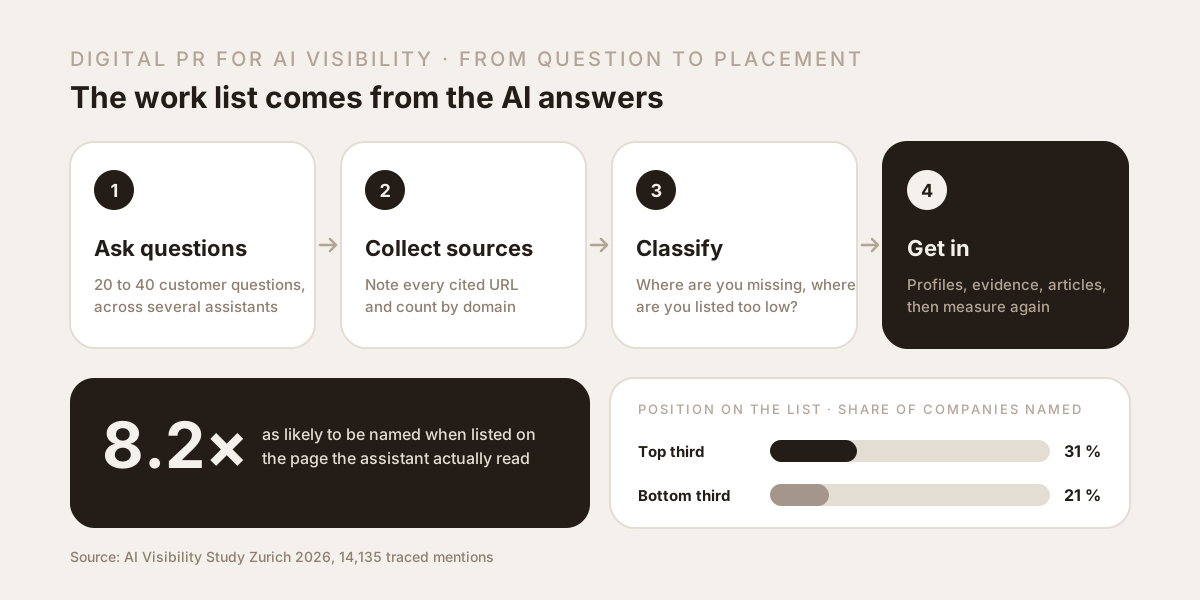
When asked for a provider, ChatGPT rarely reads only your website. It first looks for best-of lists, directories and comparison articles, then recommends the companies listed there. In our AI visibility study, companies on a page the assistant read were 8.2 times as likely to be named. Digital PR for AI visibility therefore means getting onto exactly these pages, systematically and legitimately. Not onto any pages, but onto the ones that are actually cited in your industry.
The starting point sounds similar in many companies. A consulting firm notices that it barely appears in the relevant rankings, even though those rankings keep showing up as sources for provider questions. A B2B company is missing from almost every best-of list and trade directory in its industry. A communications team wants its media work to deliver not just clippings but recommendations in ChatGPT and Google AI Mode.
This article shows how to find the sources that count in your category, which types of sources exist, how to get into them legitimately and how to measure the effect. Why AI assistants recommend certain companies in the first place is covered in detail in How do I get recommended by ChatGPT?. Here the focus is on the part that lies outside your own website.
Why third-party sources carry so much weight in provider questions
For a question like «Which consulting firms in Zurich specialise in succession planning?», ChatGPT with web search works in three steps: it searches for lists, directories and comparisons, opens the websites of the companies it finds there and writes its recommendation from them. If you are missing from the list, you do not appear in the second step at all.
Our own data shows how strong this effect is. For the AI visibility study we traced 14,135 mentions of 5,110 Zurich companies in twelve industries back to their source:
- Being on the page is worth 8.2 times as much. Companies on a page the assistant demonstrably read were 8.2 times as likely to be named as companies missing from it.
- Position on the list counts too. Companies in the top third of a list page were named in 31 percent of cases, companies in the bottom third in 21 percent.
- The direct share varies strongly by industry. Across all industries, 18 percent of mentions come directly from third-party pages, 9 percent for physiotherapy practices and 32 percent for moving companies.
- The model's memory carries the most. Around 40 percent of mentions arise without any page being opened, 57 percent for wealth managers. What has been written about your company in media, directories and expert articles over the years is part of the material models learn from. Digital PR therefore works twice: in the short term through web search, in the long term through memory.
Google AI Mode shows a similar picture. In our analysis of 100 answers, 25 percent of the 483 linked sources were portals, booking and comparison platforms, 10 percent associations and authorities and 4 percent media and city guides. For B2B questions, AI Mode relied on Google Maps cards much less often (for IT service providers in only 3 of 10 answers) and answered more often with lists, comparison portals and «best providers» articles.
Step 1: Build the source map for your category
The most common mistake in digital PR for AI visibility is to start with a media list. The right work list comes from the answers themselves:
- Collect customer questions. Write 20 to 40 questions the way your customers ask them: «Which providers for X in Switzerland can you recommend?», «Who specialises in Y?», «X or Y for an SME with 50 employees?». Mostly problem and category questions, hardly any questions about your name.
- Ask across several systems. ChatGPT with web search, Perplexity, Gemini and Google AI Mode cite different sources. Looking at only one system shows only part of the map.
- Note every cited URL and count by domain. After two or three rounds, a core of pages that keep coming back emerges. In many categories, that is a manageable number of domains.
- Classify every source. Are you listed there? If so, in which position and with which description? If not, who is listed, and by which criteria do you get in?
AI answers vary from round to round. A single query is therefore not a source map but a snapshot. How to build a repeatable measurement with a fixed prompt set is explained in Measuring AI visibility. Many monitoring tools now show the cited sources per answer directly, which speeds up the third step considerably.
Step 2: The source types and how to get in
The source map almost always contains a mix of the same types. Each has its own way in:
| Source type | Typical examples | How to get in |
|---|---|---|
| Best-of lists and «best providers» articles | Rankings on industry portals, comparison articles by media and industry blogs | Check the list's criteria, contact the editors or the author with evidence: specialisation, references, reviews, expert articles. Many lists are updated regularly |
| Industry, comparison and quote portals | In our AI Mode analysis, for example sortlist.ch, gryps.ch, ofri.ch, depending on the industry | Complete profile with the right categories, a clear description of services and reviews |
| Associations and chambers | Member directories of professional and industry associations, such as SIA or the bar association | Membership and a maintained directory profile, work in specialist groups, talks at association events |
| Trade media and local media | Trade journals and industry portals, business sections of regional media | Guest articles, expert quotes on current topics, your own data and studies that journalists can cite |
| Review platforms | Google Business Profile, for software platforms such as G2 or Capterra | Actively ask for reviews. In our study, the share of named companies rises clearly up to around 30 reviews, then hardly at all |
| Awards and rankings with a jury | Industry awards with published criteria | Only competitions with transparent criteria and an independent jury; winning gets mentioned in media and on partner sites |
| Entity sources | Commercial register and Zefix, LinkedIn, Wikidata, Wikipedia | Consistent data everywhere. Wikipedia only if the notability criteria are met and independent sources exist; paid edits must be disclosed there |
Two things stand out again and again in practice. First, the sources that count are very industry-specific. In our AI Mode analysis, quote portals showed up for tradespeople, the Zurich bar association for lawyers and the SIA Zurich section for architects, while a general business directory got two references. Mass listings in arbitrary directories therefore achieve little. Second, it matters not only whether you are on a page but how. A listing with a sentence like «specialised in succession planning for SMEs in the Zurich area» gives the assistant a reason it can adopt. A listing with a name and phone number gives it none.
Step 3: Digital PR that can be cited
Classic press work often measures success in reach. For AI visibility, something else counts: whether the mention sits on a page assistants read, and whether it says clearly who you are and what you stand for. That leads to a few formats that work particularly well:
- Your own data and studies. An analysis with real numbers from your field is what journalists and industry portals are most likely to cite, and it makes your company the source rather than the subject. A sound method that you disclose is essential.
- Expert quotes. Trade media look for voices from practice on current topics. Whoever answers quickly, precisely and with a clear view gets asked again. Every quote with name, role and company strengthens the entity.
- Guest articles in trade media. Especially for complex B2B topics, well-founded articles in your target group's media are worth more than a broad press release.
- Case studies with clients. A project report that the client or an industry medium also publishes creates a mention with concrete context: industry, problem, result.
- Appearances documented online. Talks at industry events, panel discussions and webinars appear on the organisers' programme pages, often with a short bio and a company description.
What rarely works in our experience: a press release that only sits on a distribution portal. It is hardly ever the page an assistant opens for a provider question. And what ties everything together: your company description should read the same in all sources, with the same name, the same specialisation and the same location. The more consistent the details, the more likely a model can identify you unambiguously.
What to avoid
- Bought list positions without a label. Sponsored articles and listings are legitimate as long as they are recognisable as such. A bought first place in an «independent» best-of list is not, and it is as much a reputational risk for your company as for the medium.
- Buying links as a shortcut. A package of fifty articles on blogs nobody reads and no assistant cites improves neither rankings nor AI answers. What Google says about it and what you actually get for your money is covered in Buying backlinks in Switzerland.
- Mass listings. A hundred directories with inconsistent data harm identification more than they help. Ten listings in the sources cited in your category, with a consistent description, are worth more.
- Bought or fake reviews. They break the rules of every major review platform and get noticed sooner or later.
Measuring the effect
Digital PR for AI visibility can be measured, but on three levels, not only in clippings:
- Placement: Are you on the pages of your source map, in which position and with which description? That is the direct working metric.
- Citation: Does the new source show up in the answers, and are you named where the source is cited?
- Mention rate: Does the share of answers from your prompt set that include your company rise across all systems?
On top of that come visits that reach your website through the new sources and through AI assistants. How to capture this traffic cleanly in GA4 and which metrics belong in the quarterly report is described in Measuring AI visibility. The realistic expectation: movement in the mention rate is measurable after one quarter, a stable channel develops over two to three quarters.
SEO, online PR and editorial: who does what
Anyone looking for a partner for this work is really looking for three skills at once: source analysis from SEO and GEO, editorial ability for expert articles and profiles, and relationships with editors. Rarely does all of it sit in one place, and it does not have to. What matters is that the source map sets the priorities, not the media list.
These questions help with the choice, whether you ask an SEO agency, a PR agency or an internal team:
- Will you first show us which pages the AI assistants cite in our category, before approaching media?
- How do you separate editorial from paid placements, and how do you label paid ones?
- Who writes the expert articles, and does that person understand our subject well enough for trade media?
- Do you also work in the other national languages if our customers ask in French or Italian?
- How do you measure success: in clippings, or in placements, citations and mentions in AI answers?
For complex B2B products, the third point is decisive. A trade medium will not take an article that stays on the surface, and an assistant will not cite a mention that does not say what you can actually do.
How Hierarchy approaches this
Hierarchy is a full-funnel marketing and AI agency in Zurich, in business for more than ten years and specialised in SEO, GEO and paid ads. Source work is a fixed part of our GEO work: we build the source map for your category across several AI assistants, prioritise the pages with the biggest leverage, prepare profiles, evidence and expert articles and measure whether the placements show up in the answers. Classic media relations can stay with your communications team or your PR agency; they get the source map and the priorities from us. Services and packages are on the generative engine optimization page.
Conclusion
Digital PR pays into AI visibility when it starts where the assistants get their answers. Those are different best-of lists, portals, associations and trade media in every industry, which is exactly why the starting point is not a media list but a source map. Companies on the cited pages, as high up as possible and with a clear description, get recommended much more often. The way there is solid work with evidence, expert articles and maintained profiles, not a bought shortcut.
The free AI visibility check shows where your company stands today: it checks whether ChatGPT, Gemini and Claude name you and which competitors appear instead.
Sources
- Hierarchy: AI Visibility Study Zurich (2026): 1,515 AI answers, 14,135 traced mentions, 5,110 companies measured in 12 Zurich industries; 40 % memory, 39 % own website, 18 % third-party pages; being on the page that was read 8.2×; top third of a list 31 %, bottom third 21 %.
- Hierarchy: One year of Google AI Mode in Switzerland (2026): 100 answers, 483 linked sources; 25 % portals, 10 % associations and authorities, 4 % media.
- Swiss Press Council: declaration of the duties and rights of journalists, guideline 10.1 on separating editorial content and advertising.
- Google Search Central: spam policies: link spam and labelling of paid links.

About the author