Contents
There is no single best GEO agency, but there is a right one for you. Three questions decide whether an agency fits: Does it work at every point where an AI recommendation originates? Does its size fit your mandate? And does it measure in a way that lets you tell chance from impact? This article compares large agencies, boutiques and freelancers, shows nine warning signs that a provider is not a fit, and walks you through five steps to choose.
Whether you need a pure SEO agency, a GEO specialist or an integrated agency is covered in SEO agency or GEO agency?. Named agencies in Zurich are in our comparison of SEO, GEO and AEO agencies. This article is about the question before and after: what kind of agency fits your company, and how do you tell that a provider will not deliver what it promises?
What a GEO agency has to deliver
GEO stands for Generative Engine Optimization: making sure ChatGPT, Gemini, Claude and Google name your company when customers ask for a provider. In our AI visibility study of 1,515 AI answers, 39 percent of mentions came from the company's own website, 40 percent from the model's memory and 18 percent from third-party sites such as directories, best-of lists and media. A GEO agency therefore has to work in three places:
- Your website: service pages an assistant can copy a recommendation from, with specialisation, location, prices and case examples.
- Third-party sources: the lists, directories and trade media the assistants demonstrably read in your industry. How that works is in Digital PR for AI visibility.
- Measurement: a fixed set of realistic customer questions, repeated in several assistants, so you can see whether the mention rate moves. Details in Measuring AI visibility.
For local businesses there is a fourth place: the Google Business Profile. In our measurement of Google AI Mode, three out of four answers relied on Google Maps data. Anyone who does not cover these three or four places is doing part of the job, however large the agency.
Large agency, boutique or freelancer?
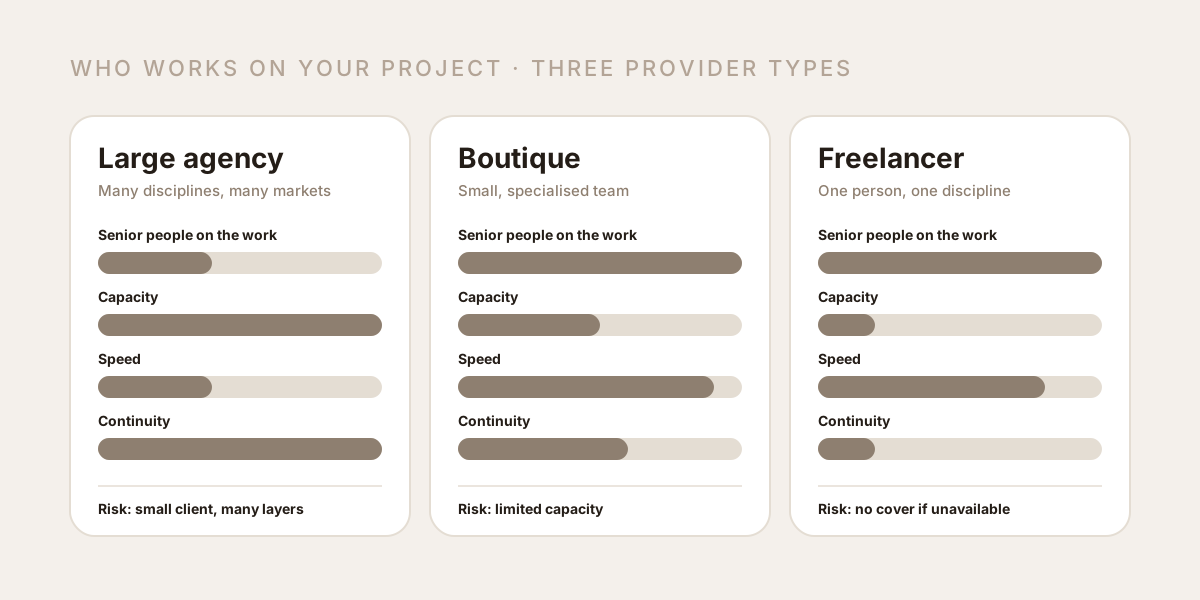
Size says less about quality than about who works on your project, how fast things move and what happens when someone is away.
| Large agency | Boutique | Freelancer | |
|---|---|---|---|
| Who works on the project | Teams, often with an account manager as the interface, mix of junior and senior | Small team, the senior people do the work themselves | One person |
| Breadth | Many disciplines under one roof, from campaigns to tech | Few disciplines, often deep | One discipline |
| Speed | Processes and approvals often take time | Short paths, quick adjustments | Fast, as long as the person has time |
| Capacity | High, also for many markets and languages | Limited, check utilisation | Very limited |
| Continuity | High, cover is organised | Medium, clarify cover within the team | Low |
| Typical pricing | Higher hourly rates, larger minimum volumes | Monthly packages or projects | Hourly or day rate |
| Fits when | Group, many countries, campaigns and SEO from one source | SME or mid-sized company, one or two markets, seniority matters | Clearly scoped task or sparring for an in-house team |
Large agency. Its strength is capacity. If you want to be visible in ten countries at once, need campaigns, paid media and SEO from one source and your procurement team values framework agreements, a large agency is often the only realistic choice. Check who actually works on your mandate, not just who gives the pitch. With a smaller budget, clarify which team looks after you and what response times apply.
Boutique. At small, specialised agencies the experienced people usually work on the project themselves. The person who develops the strategy often also writes the content or implements the technical work. That is fast and good value relative to experience. The limit is capacity: ask how many mandates the team handles in parallel and who takes over during absences.
Freelancer. For an initial assessment, a technical audit or as a sparring partner for your own marketing team, an experienced freelancer is often the most efficient solution. For an ongoing mandate covering website, content, third-party sources and measurement at once, one person quickly hits limits. Agree cover and ownership of accounts and data in writing.
A fourth option is your own team with outside support: your marketing team implements, an agency provides strategy, measurement and reviews. Providers who work this way are listed in Managing AI visibility in-house: 8 providers.
9 warning signs that an agency is not a fit
The following nine patterns are warning signs, whether they come from a large agency, a boutique or a freelancer. Each comes with a question that exposes it in the first meeting.
1. Success is proven with a screenshot
How you notice it: The pitch shows an image of ChatGPT recommending one of the agency's clients. Why that is not enough: AI answers fluctuate. In our measurement of Google AI Overviews we ran the same 84 searches twice on the same day. The cited sources overlapped by only 61 percent on average, and for the question about the best IT service provider for SMEs in Zurich, Google named different companies the second time and relied on entirely different sources. A single screenshot proves that something happened once, not that it is repeatable. Question to ask: «How often is your client named across a fixed question set, and how has that rate changed since the baseline?»
2. GEO is SEO with a new label
How you notice it: The GEO service list is the same as the SEO one: keywords, meta data, backlinks, with the words ChatGPT and AI added. Why that is not enough: In our study, around three quarters of the companies the assistants recommended were not in Google's top 10, even for the searches the assistants ran themselves. A good ranking is a prerequisite, not the selection. Question to ask: «What do you do for AI visibility that you would not do for pure SEO?»
3. The main deliverable is a file
How you notice it: The GEO package essentially consists of an llms.txt file, schema markup and an FAQ page. Why that is not enough: Clean structured data and a clear FAQ make sense, they are basics. They replace neither content an assistant can copy a recommendation from nor work on the third-party sources that almost one in five mentions comes from. Question to ask: «What will have happened after three months, apart from technical changes?»
4. Content at volume
How you notice it: The agency promises 30 or 50 AI-generated articles a month. Why it rarely works: Assistants cite pages that answer a question specifically and with evidence: prices, processes, figures and examples from your company. Interchangeable texts on generic terms create volume but rarely citations, and Google's spam policies treat mass-produced content without added value as a problem. Question to ask: «What information from our company do you need for an article, and who checks the facts?»
5. Mentions are bought or self-built
How you notice it: The agency offers to place you on seemingly independent «best-of lists» that it actually owns or that are paid for without saying so, or to seed mentions in forums and on Reddit. Why that is a risk: Third-party sources are powerful. In our study, a company listed on a page the assistant had read was 8.2 times as likely to be named as one that was missing. That is exactly why such sources get manipulated. A comparison on a provider's own website is legitimate as long as it is clear who wrote it and by which criteria. Unlabelled paid placements and lists that only pretend to be independent are a reputational risk for your company. Question to ask: «Which sites do you want to place us on, who owns them, and are the listings labelled as paid?»
6. There is a guarantee
How you notice it: «Number 1 in ChatGPT in 30 days» or «money back if ChatGPT does not recommend you». Why that is not serious: Nobody controls what a language model answers. Answers depend on wording, assistant, model and timing. A serious agency promises work and a measurement method, not a position. Question to ask: «What can you not influence?»
7. Only ChatGPT is measured
How you notice it: The report covers ChatGPT only. Why that is not enough: The assistants select very differently. For Zurich architecture firms in our study data, 88 percent of Gemini's mentions came from the model's memory without any source, 28 percent for Claude and 11 percent for ChatGPT. More on the industry in Architecture firm marketing in Zurich. Measuring one assistant means optimising for a slice. Question to ask: «Which assistants do you measure, and why those?»
8. The Google profile is missing
How you notice it: The plan for a local business has no Google Business Profile, reviews or directory listings. Why that is a big mistake: For searches like «dentist Zurich» or «removal company Zurich», Google showed the map with businesses in 22 of 24 cases in our measurement and almost never an AI Overview. And in AI Mode, three out of four answers relied on Google Maps data. For local businesses the profile is one of the most important levers. Question to ask: «What will you do with our Google Business Profile?»
9. Switzerland is treated like Germany
How you notice it: Examples, tools and sources come from Germany, Swiss directories, associations and media do not appear. Why that matters: In our measurement, 34 of 58 Google AI Overviews cited at least one German source, even for Swiss questions on tenancy law or architect fees. That is a gap Swiss companies can fill with Swiss content, and an agency that knows the Swiss source landscape helps. Question to ask: «Which Swiss sources do the assistants cite in our industry?»
Why a good agency can still be the wrong one
Turning an agency down is not always a verdict on its quality. Common reasons a good agency is still the wrong one:
- The size does not fit. An SME with one market does not need a structure for twenty countries, a group does not need a lone operator.
- The industry is new to it. Regulated industries have their own rules, for instance on advertising medicines, legal services or financial services. An agency without that experience can easily write too cautiously or too boldly.
- Nobody implements. A strategy without access to the website and CMS stays a document. Clarify whether the agency implements itself or whether your team or web agency does.
- The working model does not fit. Some companies want everything done for them, others want to learn. Both are legitimate, but not every agency can do both.
- Accounts and data belong to the agency. Google profile, Analytics, Search Console and content should be in your name. Otherwise switching becomes expensive.
- The language is missing. If you have customers in French-speaking Switzerland or abroad, you need content and measurement in several languages.
How to find the right GEO agency: 5 steps
- Measure where you stand. First check whether and how often ChatGPT, Gemini and Claude name your company today, for example with our free AI visibility check. Without a baseline you cannot prove success later.
- Assess your situation. Do you mainly need work on the website, third-party sources, the Google profile or measurement? And who implements on your side? That tells you whether a specialist, an integrated agency or a freelancer fits, and what size makes sense.
- Shortlist three providers. Not ten. Ask for case examples from comparable industries and company sizes.
- Test in the first meeting. Ask the questions for the nine warning signs above and ask to see a sample report. General questions for any agency are in Finding an SEO agency: 7 criteria.
- Agree a 90-day goal. For example: mention rate across 30 fixed customer questions in three assistants from X to Y, plus a list of third-party sources you should be listed on afterwards. With an exit option if the goal is clearly missed.
Where Hierarchy fits and where it does not
Hierarchy is a full-funnel agency in Zurich specialising in SEO, GEO and paid ads, with a team of four people, so a boutique. The same people develop the strategy, write the content, implement the technical work and measure the impact across ChatGPT, Gemini, Claude and Google. Our work is based on our own AI visibility study of 5,110 Zurich companies.
We are a good fit for SMEs and mid-sized B2B companies in Switzerland and the German-speaking market that want SEO and AI visibility from one source, either implemented by us (done for you) or with their own team (done with you). We are less of a fit if you need a rollout across many countries and languages at once, classic advertising campaigns with TV and print, or a pure technical audit at the lowest price. Packages from CHF 900 per month are on our GEO agency page.
Conclusion
The best GEO agency for you is the one that works at every point where an AI recommendation originates, whose size fits your mandate and that proves its success with repeated measurements rather than screenshots. Large agencies play to their strengths across many markets, boutiques on seniority and speed, freelancers on clearly scoped tasks. The nine warning signs help you spot quickly in the first meeting who is not a fit. The free AI visibility check gives you the baseline.

About the author