Contents
When a buyer or engineer looks for a solution today, they increasingly ask ChatGPT, Gemini or Google's AI Mode first. They don't ask for your name; they ask about their problem. Complex B2B products often drop out of these answers, even when the website ranks well on Google: the pages that answer exactly these questions are missing, and so are the third-party sources the assistant can rely on. You can find out with a baseline audit built on realistic buyer questions, a prompt mapping.
The trigger is the same in many companies. At a machine builder, leadership wants to know whether the company shows up when prospects ask ChatGPT for solutions like theirs, and nobody internally has experience with it. A manufacturer of complex products ranks well on Google but is invisible in ChatGPT and AI Overviews. A B2B software provider notices that its audience increasingly researches in ChatGPT instead of Google.
This article shows how B2B buyers use AI assistants, why complex products in particular get dropped, how a baseline audit works step by step, which content works and how to judge an agency for the job.
How B2B buyers use AI assistants
In B2B purchasing, research with an AI assistant looks different from a consumer question. Three patterns shape it:
- Problem, not brand: People ask "How can we reduce downtime when packaging powders?" or "Which process is best for deburring aluminium die castings?", not for a company name. The brand only appears when the assistant names it as part of the solution.
- Several stages: First comes understanding the problem, then approaches, then suppliers and finally specifications, standards and comparisons. If you only show up in the last stage, you have often already dropped off the shortlist.
- Several people: Engineering, purchasing, production and leadership are all involved in a B2B decision, and each of them asks differently. The engineer asks about tolerances, the buyer about suppliers in Switzerland, the CFO about operating costs.
On top of that, AI assistants like to give short lists. If you are not on the list, you often never appear in the rest of the evaluation, even if your product would be a technical fit.
Why complex products get dropped
A good Google ranking and a mention in ChatGPT are two different things. The results page ranks pages for a search term. An AI assistant answers a question and uses whatever content answers it most directly. For B2B manufacturers, this usually breaks down in four places:
- No clear application pages. The website is organised by product line, but the buyer asks about an application. If nowhere says "for filling abrasive powders in the food industry", the assistant cannot make the connection.
- Technical data locked in PDFs. Performance data, materials, standards and dimensions sit in downloadable data sheets. People are used to that; for an assistant that reads a page in seconds, it is an obstacle.
- No comparisons. Many questions read "Process A or B?" or "When does design X make sense?". Without your own factual comparison content, the assistant answers these questions with other people's content.
- Missing third-party sources. AI assistants rely on trade media, associations, directories and trade fair pages. A manufacturer that is missing there, or only has an outdated entry, is missing as a confirmed option for the assistant.
Our own study shows how strongly the source factor works. We analysed 1,515 AI answers about Zurich companies across twelve industries and traced 14,135 mentions: around 40 percent came from the model's memory, 39 percent from the company's own website and 18 percent from third-party sites. When a company was on a page the assistant read, it was 8.2 times as likely to be named. The study covers local service businesses, not industry. The mechanism is the same, though: the companies that get named are the ones on the pages being read and whose own website answers the question clearly. How assistants choose sources is covered in detail in How do I get recommended by ChatGPT?.
The baseline audit: prompt mapping in five steps
Answering leadership's question "Do we show up?" needs no tool subscription and no prior knowledge, just a clean baseline audit. It works in five steps:
- Collect questions. Sales, application engineering and customer service know best what prospects ask. From those conversations, email enquiries and Search Console comes a list of typically 30 to 60 questions in the customers' own words.
- Map them to buying stages. Each question is assigned to a stage: problem, approach, supplier, specification. That later shows where you are missing, not just how often.
- Query repeatedly. Each question is asked several times across several systems, such as ChatGPT, Gemini, Perplexity and Google AI Mode, in German and, depending on the market, in French or English. AI answers fluctuate, so a single query is not a measurement.
- Analyse. For each answer you record: is your company named, in which position, which competitors appear alongside it, which sources does the assistant cite? The sources are the most important part, because they show where work pays off.
- Translate gaps into work. For every stage where you are missing, you note which page on your website or which third-party source would close the gap. The result is a prioritised plan, not just a report.
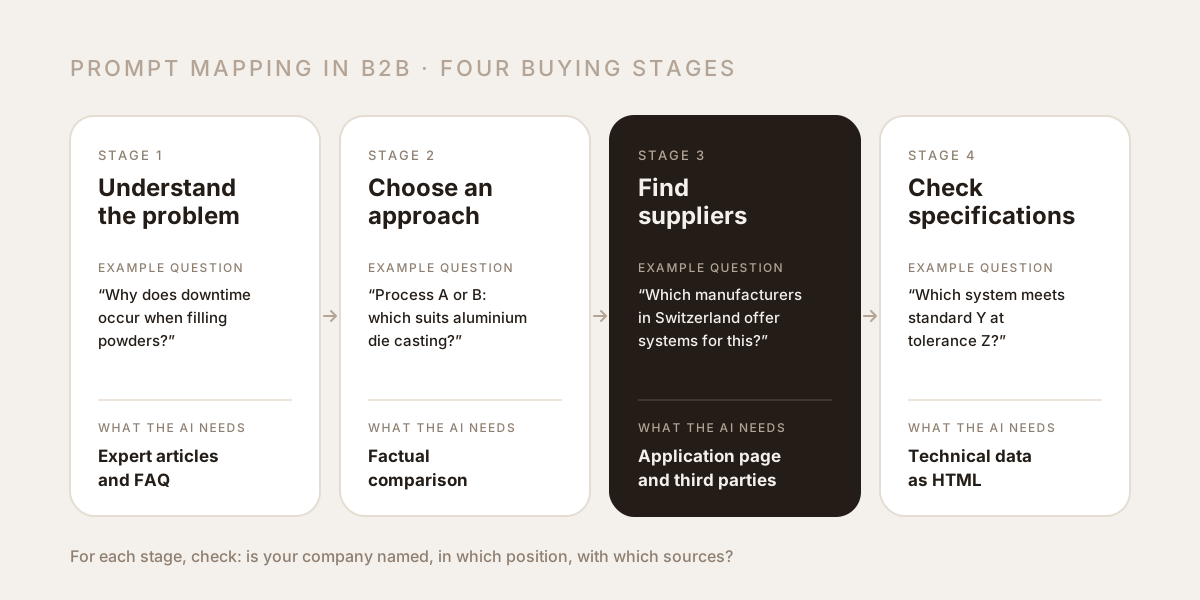
How a one-off baseline becomes ongoing measurement, with KPIs and reporting, is covered in Measuring AI visibility. For a first impression, try the free AI visibility check.
Which content works in B2B
The gaps from prompt mapping almost always lead to the same content types. What matters is that each one answers a concrete question.
| Content | Answers questions like | What matters |
|---|---|---|
| Application page per use case and industry | "Which solution suits X in industry Y?" | One page per application, with problem, solution, limits and a reference example |
| Technical data as HTML | "Which system handles X units per hour at tolerance Y?" | Key figures, materials, standards as text and tables; the PDF stays as a supplement |
| Factual comparison | "Process A or B?", "When does design X make sense?" | Clear criteria, including where your own product is not the right fit |
| FAQ from sales | "How long does commissioning take?", "Do you offer service in western Switzerland?" | Real questions from enquiries and conversations, answered briefly and concretely |
| Expert article on the problem | "Why does downtime occur in X?" | Expertise without a sales tone, with author and date |
The FAQ is particularly worth the effort: in our study, pages with an FAQ section were cited 1.6 times as often as pages without one. And the best FAQ questions are usually already sitting in the sales team's inbox.
Third-party sources: trade media, associations, trade fairs, directories
In B2B, the sources an assistant reads are rarely the big review portals. They are trade media, industry associations, trade fair listings, manufacturer directories and customer application stories. That leads to concrete tasks:
- Trade media: Expert articles and application stories in your industry's media, clearly tied to an application and a problem. That is online PR, just with technical content.
- Associations: Complete, current entries in your industry associations' member directories, with a description of activities, applications and location.
- Trade fairs: Exhibitor profiles often stay online for years. An up-to-date profile listing applications rather than just product names is quick to do.
- Directories and platforms: Industry and supplier directories where buyers search. Consistent company data across all entries helps the assistant identify the company correctly.
- References: Application stories, with the customer's consent, on your own website and in trade media. For assistants and buyers alike, they are proof.
Which third-party sources are actually read in your category is shown by the source analysis in the prompt mapping. Without that data, online PR quickly turns into scattershot work.
German, French, English
Swiss B2B companies rarely sell in only one language. For AI visibility, that means an assistant answers in the language of the question and prefers content in that language. If you sell in French-speaking Switzerland, you need French application pages, not just a translated homepage. If you export or work with international groups, you need English content, because many buyers and engineers ask their questions in English and many trade media are English-language. The prompt set should therefore cover every sales language, otherwise part of the market goes unobserved.
B2B software: what counts on top
For B2B software providers the same basics apply, with their own emphasis: comparison and alternatives pages, profiles on software review platforms, publicly readable documentation, one page per important integration and English content. Because software keeps evolving, the work here is more of an ongoing task than a one-off project. Whether a monitoring tool is enough or an agency makes more sense is covered in depth in AI Visibility for SaaS: Buy a Monitoring Tool or Hire an Agency?.
How to report it to leadership
Leadership doesn't need prompt lists; it needs three answers: where do we stand, where do competitors stand, and what do we do next? A one-page report has proven itself:
- Mention rate: For how many buyer questions the company is named, broken down by buying stage.
- Competitors: Who gets named for the same questions, and how often.
- Sources: Which pages and third-party sources the assistant uses for your category, and which ones you are missing from.
- Next three actions: With reasoning and a timeframe.
Repeated each quarter, this becomes a trend the work can be measured against. More on KPIs and tracking AI traffic in GA4 is in Measuring AI visibility. How visitors then become qualified meetings is described in Automated lead generation for B2B SMEs.
How to recognise the right agency
Anyone looking for a partner on this topic usually has clear requirements: an understanding of complex products, classic SEO combined with online PR, strong in-house editorial skills and a location in Switzerland. These questions help you check that in a meeting:
- Onboarding: How do you get to grips with our products? Do you talk to sales and application engineering, or only to marketing?
- Data, not gut feeling: How is the prompt set built, how often do you measure, and do we see the cited sources per answer?
- Editorial: Who writes the application pages and expert articles, and who checks technical accuracy?
- Online PR: How do you get us into the trade media and directories that are read in our category?
- Evidence: Is there a case study with traceable numbers on rankings and AI mentions?
- Ownership: Do the prompt set, reporting and content belong to us at the end?
An agency that only talks about technology in answer to question 1 will hit its limits with complex products. On this topic, editorial work is the biggest part of the job.
How Hierarchy works
Hierarchy is a full-funnel marketing and AI agency in Zurich, specialised in SEO, GEO and paid ads, with marketing and engineering in one team. We start with a baseline audit built on your buyer questions and then implement (done for you), enable your team (done with you) or train it in workshops.
What weekly steering looks like is shown in our case study for a solar provider, also a consultation-heavy category with a long decision cycle: within six months, the 30 focus keywords moved from positions 10 to 12 to positions 2 to 4, and the brand was named in 63 instead of 19 out of 100 AI answers. Services and packages are on the generative engine optimization page.
Conclusion
Complex B2B products rarely disappear from AI answers because of poor technology. They disappear because the content that directly answers a buyer's question is missing, and because third-party sources don't confirm the company. The first step is a baseline audit built on your customers' real questions: it shows in which buying stage you are missing and which page or source would change that.
Where your company stands today is shown by the free AI visibility check: it checks whether ChatGPT, Gemini and Claude name your company and which competitors appear instead.

About the author