Contents
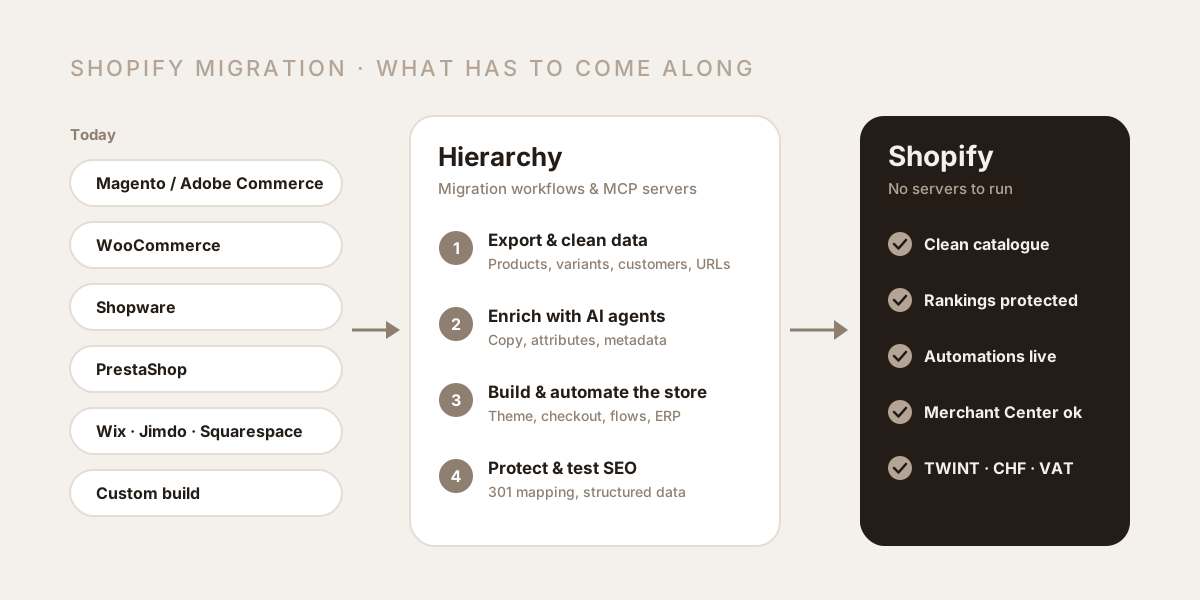
Many Swiss online stores still run on systems that cost their team more time than they bring in: Magento installs on a version that no longer gets security updates, WooCommerce stores with so many plugins they get in each other's way, or site-builder stores that haven't grown with the range. This post shows why switching to Shopify makes sense for many merchants, when it doesn't, how a migration works without losing Google rankings, and how Hierarchy builds your store with its own migration workflows, MCP servers and automations.
For the technical details of such a migration, see our case study: Magento 2 to Shopify with a central product database. This post covers the questions before that: is the switch worth it, from which system, and what has to come along?
Why Swiss merchants switch to Shopify
Most merchants don't switch because Shopify is new, but because running the old store eats too much time. The reasons repeat:
No more running it yourself. With Magento, WooCommerce, Shopware or PrestaShop, hosting, servers, security updates, version upgrades and extensions are your job or your agency's. Shopify is a SaaS platform: hosting, updates and security run in the background. Your team looks after products, marketing and customers instead of servers.
Outdated versions without updates. Magento 1 hasn't received updates since June 2020. Every Magento 2 version also has a fixed end of support, so if you don't move to the next version regularly, sooner or later you are running a store without security patches. Shopware stopped developing Shopware 5 at the end of July 2024. On these systems, upgrading to the next version is often a project of its own, hardly smaller than a migration.
Plugin load. WooCommerce and many other systems grow through extensions. Each one is its own source of errors, its own update and its own security risk. On Shopify, apps run separately from the platform core: a platform update doesn't break an app, and securing the core isn't your job. Too many apps slow down a Shopify store as well, so we use them sparingly.
Swiss requirements are covered. Shopify supports CHF as the store currency, Swiss VAT, multiple languages for German, French, Italian and English, and Shopify Payments for Switzerland. Depending on the setup, TWINT can be connected through Shopify Payments or through payment providers such as Datatrans. With Shopify Markets you can also sell into the EU with your own prices and currencies.
A checkout that sells. The Shopify checkout is optimised for smartphones, keeps improving and supports express payments. That is work someone would have to pay for on a self-hosted system.
Automations built in. With Shopify Flow and the GraphQL Admin API, recurring tasks can be automated: inventory, tags, order review, notifications, customer segments. More on that below.
Ready for Google Shopping and AI assistants. Shopify connects product data directly with Google and other channels. With Agentic Storefronts, announced in December 2025, Shopify also brings products directly into AI assistants such as ChatGPT, Google AI Mode and Microsoft Copilot. As of October 2026, buying inside the assistant is limited to customers in the US, while product discovery already works in Switzerland. What that means for Swiss stores is covered in Agentic commerce: what Swiss online stores need to know now. What is clear: if your product data is clean and structured, you are visible where customers increasingly shop.
When Shopify is not the right choice
Switching isn't worth it for every store. We say so openly in the intro call when that's the case.
- Heavily custom logic: Complex B2B pricing, elaborate product configurators or deeply integrated special processes need apps or custom development on Shopify. That often works, but not always sensibly.
- Fixed URL structure: Shopify sets prefixes such as
/products/and/collections/. If you need a fully custom structure, you have to go headless. For most stores a clean redirect mapping is enough. - Variants and options: Shopify allows up to 2048 variants per product, but the number of options is limited. We check whether your catalogue fits at the start, not the end.
- Payment providers: If you use an external payment provider instead of Shopify Payments, Shopify charges an additional transaction fee depending on the plan. That belongs in the calculation.
- Data location: Shopify does not host in Switzerland. For most merchants an updated privacy policy and a clean tracking setup are enough. If you must keep customer data in Switzerland, you need a different solution.
From which system? The most common starting points
| Starting system | Typical trigger for switching | What we watch for in the migration |
|---|---|---|
| Magento 1 / Magento 2 / Adobe Commerce | End of support, hosting and update effort, expensive development | Attribute sets, configurable products, store views, URL rewrites ending in .html |
| WooCommerce | Plugin conflicts, speed, security updates | Replacing plugin features, variants, bringing WordPress content and blog along |
| Shopware 5 / Shopware 6 | End of Shopware 5, effort of upgrading to version 6 | Properties and variants, shopping worlds, plugins |
| PrestaShop | Module dependencies, updates, operations | Combinations to variants, replacing modules, multilingual URLs |
| Wix, Jimdo, Squarespace | Range is growing, limits on filters, automations and channels | Product export often incomplete, images and copy, page structure |
| Custom build | Dependence on individual developers, no further development | Understanding the data model, complete export, reconnecting integrations |
The same idea applies in every case, the one we lay out in the case study: a store migration is really a data migration. If you only switch the system, you take every data problem with you. If you sort the data during the move, you end up with a better store than before.
What has to come along in a migration
A migration is only finished when nothing that brings revenue or visibility has been lost:
- Products: titles, descriptions, variants, images with alt text, attributes as metafields, prices, inventory, GTIN and brand.
- Categories: as collections, including the category copy that ranks today.
- Customers and order history: customer data can be transferred, passwords can't. With Shopify's new customer accounts, customers sign in with a one-time code; with classic accounts, they reactivate their account. Both need a clear announcement.
- Discount codes, gift cards, reviews: often forgotten and then missing on day one.
- All old URLs: from a crawl, Search Console, analytics, backlinks and the old system's redirects, each with a matching target via a 301 redirect.
- SEO content: titles, meta descriptions, structured data and internal links.
- Integrations: ERP, inventory management, accounting, shipping, marketplaces and newsletter.
- Tracking: analytics, Google Ads, Meta and Merchant Center, clean and with consent.
Google Merchant Center: approved from day one
Products only appear in Google Shopping, in free product listings and in Shopping ads once Google Merchant Center approves them. Among other things, it checks:
- Consistency: price, availability and shipping costs in the feed must match the product page.
- Required information: shipping and return policies and contact details must be easy to find.
- Product data: unique identifiers such as GTIN, brand, correct categories and images without promotional overlays.
- Checkout: secure and without surprises in prices or fees.
Rejected products or a suspended account cost revenue directly, especially when Shopping ads are an important channel. That's why we build every store to these requirements: every store we set up is approved by Google Merchant Center. The same clean product data also feeds the structured data on the website that Google and AI assistants read for product answers.
How Hierarchy builds your Shopify store
As a Shopify agency in Zurich, Hierarchy combines marketing and engineering in one team. For Shopify that means: we don't just migrate, we build the whole store, including the systems that run it afterwards.
Our own migration workflows. For Magento, WooCommerce, Shopware, PrestaShop and site-builder stores we have our own workflows that export products, variants, attributes, categories, customers and URLs, map them to the Shopify model and check them. What costs weeks of manual spreadsheet work in a traditional migration largely runs automatically with us.
Our own MCP servers. Through the Model Context Protocol, our AI agents work directly with the old store, the product database and the Shopify Admin API. They clean attributes, fill in missing copy and metadata from verified sources, find duplicates and contradictions, and create products in a structured way. They only take technical values from manufacturer data or from you, never from imagination. Approval rules decide what goes into the store.
The complete store. Theme and design, navigation and filters, product and collection pages, checkout, payment methods including TWINT, shipping, VAT, languages, legal pages, tracking and Merchant Center. You get a finished store, not a data package.
Automations and workflows. We automate what your team does by hand today: inventory sync with ERP or suppliers, enrichment of new products, tagging and customer segments, order review and fraud filters, low-stock alerts, feeds for Google and marketplaces, replies to recurring customer questions. How we set up such processes is described in process automation for Swiss SMEs. It saves your team hours every day.
SEO, GEO and paid ads from the start. Redirect mapping, content parity and structured data are part of the migration for us, not a later project. After that we keep building visibility: in Google, in Google's AI answers and in assistants such as ChatGPT. That is the work of our SEO and GEO agency. We set up Shopping ads and Performance Max on the same product data.
At a fraction of the cost. Because our workflows and agents handle most of the routine work, a store with us costs a fraction of what traditional web development charges for the same scope. You pay for concept, quality and judgement, not for hours in spreadsheets.
You decide how to work with us: done for you, we build and run it, or done with you, we build the systems and train your team to run the store themselves.
In practice: Magento 2 to Shopify with a product database
An established retailer wanted to move from Magento 2 to Shopify without losing a catalogue built up over years or its Google visibility. Instead of just copying the data, we built a universal product database as the single source of truth, synced it bidirectionally with Shopify and put AI agents on top for enrichment, analysis and SEO.
The result:
- Product maintenance in a fraction of the time: agents write copy, attributes and metadata, the team reviews and approves.
- A consistent catalogue: the same attributes, the same units, complete copy.
- A faster store with less maintenance, now that no server has to be run in-house.
- Ready for new channels: marketplaces and feeds pull their data from the same database.
The architecture, the decisions behind it and the lessons learned are in the full case study: migrating Magento 2 to Shopify.
How a migration with us works
- Intro call and assessment: catalogue, languages, integrations, payment methods, URLs, traffic and rankings. Afterwards you know whether the switch is worth it and what it involves.
- Data model and mapping: what products, variants, attributes and categories look like in Shopify, and which system leads for which field from now on.
- Store build: theme, design, payment methods, shipping, taxes, languages, legal pages.
- Data migration and enrichment: through our workflows and MCP servers, approved by your team.
- Automations and integrations: ERP, accounting, shipping, feeds, Shopify Flow.
- Protecting SEO: redirect mapping, content parity, structured data, testing every redirect before go-live.
- Merchant Center and tracking: feed, approval, analytics, Google Ads and Meta.
- Go-live and monitoring: content freeze in the old store, switchover, sitemap in Search Console, close watch on 404 errors and rankings in the first weeks.
Checklist: 10 questions before switching to Shopify
- What problem should the switch solve: operations, speed, cost, growth or new channels?
- Does every product fit Shopify's variant and option logic?
- Which features of the old store do you still need, and are there apps or clean custom solutions for them?
- Which systems need connecting: ERP, inventory, accounting, shipping, marketplaces?
- Which payment methods do your customers expect, including TWINT, and through which provider?
- In which languages and markets do you sell, today and in two years?
- Do you have a complete list of all old URLs with traffic, rankings and backlinks?
- Who tells your customers about the new login?
- Which tasks in the store does your team do by hand today that could be automated?
- Is Google Shopping a channel, and does your store meet Merchant Center requirements?
What drives the effort
Concrete prices can't be given seriously without looking at the catalogue. But the drivers are clear:
- Catalogue: number of products, variants and attributes, and how clean the data is today.
- Languages and markets: every language brings its own copy and URLs.
- Integrations: every connected system brings its own interfaces.
- Special features: whatever the old system did in a custom way has to be solved anew in Shopify.
- URLs: many old URLs and redirect chains lengthen the mapping.
- Design: customised standard theme or custom design.
- Automations: how many processes should run without manual work afterwards.
In short
Switching to Shopify pays off when your team spends more time running the store than selling. What matters is that nothing gets lost in the move: no product data, no URLs, no rankings. With our own migration workflows, MCP servers and automations, we build you a store that is approved by Google Merchant Center, becomes visible in Google and AI assistants and saves your team hours every day, at a fraction of the cost of traditional web development.
Everything we do for your store is on the page of our Shopify agency, the systems behind it on systems & AI automation.
Thinking about switching to Shopify, or want a new online store built? Book a free intro call. We'll look at your current store and tell you honestly whether the switch is worth it.

About the author