Contents
As of November 2026. Measurement: search results of 25 October, pages retrieved on 10 November 2026.
E-E-A-T stands for Experience, Expertise, Authoritativeness and Trust. Google uses it to describe what good content looks like. It is not a single ranking factor. And the most popular measure taken in its name, the author box, separates nothing in our measurement: of 196 pages Google cited in Swiss AI Overviews, 18 percent named a person as author. Of 543 pages that ranked for the same searches and were passed over, 19 percent did.
E-E-A-T still matters. It is just usually tackled from the wrong end, with a photo and three lines of biography under the text. Our data shows where the difference really lies. Institutions have about twice the chance of a citation. Among guides, recent and well-sourced pages are ahead. And "admin" as an author is not a good sign.
This article explains what is behind the four letters, what Google itself says about them and what to do, in which order.
What is E-E-A-T?
E-E-A-T comes from Google's guidelines for quality raters, a 182-page document last updated in September 2025. People around the world who assess search results use it to ask four questions about a page and its publisher:
| Letter | What is assessed | How a Swiss SME website shows it |
|---|---|---|
| Experience | Has the person lived through or done this themselves? | Your own project photos, real cases, cost examples from practice |
| Expertise | Do they have the necessary knowledge and skill? | Specialist medical title, federal diploma, bar registration, career history |
| Authoritativeness | Is the person or website known as a go-to source? | Association membership, articles in trade media, mentions by third parties |
| Trust | Is the page accurate, honest, safe and reliable? | Clear legal notice, sourced claims, transparent terms, current information |
The four are not equal. Google calls trust the most important member of the family, because an unreliable page has little value however experienced and expert it seems. The example in the guidelines sticks: a scammer may be a true expert in scams, but that does not make them trustworthy.
Authority is also relative to the topic. For a passport application, the authority is the official source. For what a shop has on offer right now, Google says it can be the shop's social media profile. That is good news for SMEs: within your own field and location, you can become the go-to source.
Is E-E-A-T a ranking factor?
No. In its guide to helpful content, Google writes that E-E-A-T itself is not a specific ranking factor. There is no E-E-A-T value a tool could read. Anyone selling you an "E-E-A-T score" made it up themselves.
Quality raters do not change rankings either. Google states that their ratings do not directly influence ranking. They are used to check whether the systems deliver good results. The systems themselves use a mix of factors meant to identify content with good experience, expertise, authoritativeness and trustworthiness.
In practice, E-E-A-T is the standard Google aligns its systems with. That makes it worth knowing. It will never be a checklist you tick off once.
For your own content, Google asks three simple questions: who created it, how was it created and why does this page exist? Google considers the third the most important. If the honest answer is "for Google", no author photo will help.
Where E-E-A-T matters most: YMYL
YMYL stands for "Your Money or Your Life". It refers to topics that could significantly affect people's health, financial stability or safety, or the welfare of society. Google applies its highest standards to these topics.
In Switzerland, this includes many SMEs that rarely see themselves as part of the debate: practices and clinics, law firms, fiduciaries, wealth managers, often real estate too, and anything to do with safety in the home. Google's own example of expertise is whom you would trust for home electrical rewiring: a skilled electrician or an antique homes enthusiast.
Personal experience counts there as well, within limits. Someone writing about living with an illness can show high experience, as long as the text is consistent with expert consensus. Treatment advice belongs with professionals.
What AI answers take from this: our measurement
For AI Overviews and AI Mode, Google writes that there are no additional requirements or special optimisations, and points to helpful, reliable content. That says little about which pages actually end up cited. So we looked.
The basis is the 84 searches from 12 Swiss industries we ran twice from Zurich on 25 October 2026. In at least one run, 63 of them showed an AI Overview. For those searches, we retrieved all cited pages and all organic top-10 results Google did not cite. 760 of 886 pages could be analysed. We excluded forum posts, because every author there is a username. That left 196 cited and 543 passed-over pages from 59 searches in which both groups appeared.
The comparison is deliberately strict: it sets cited and passed-over pages against each other within the same search. That way, a topic that naturally attracts many guides or government pages does not distort the result.
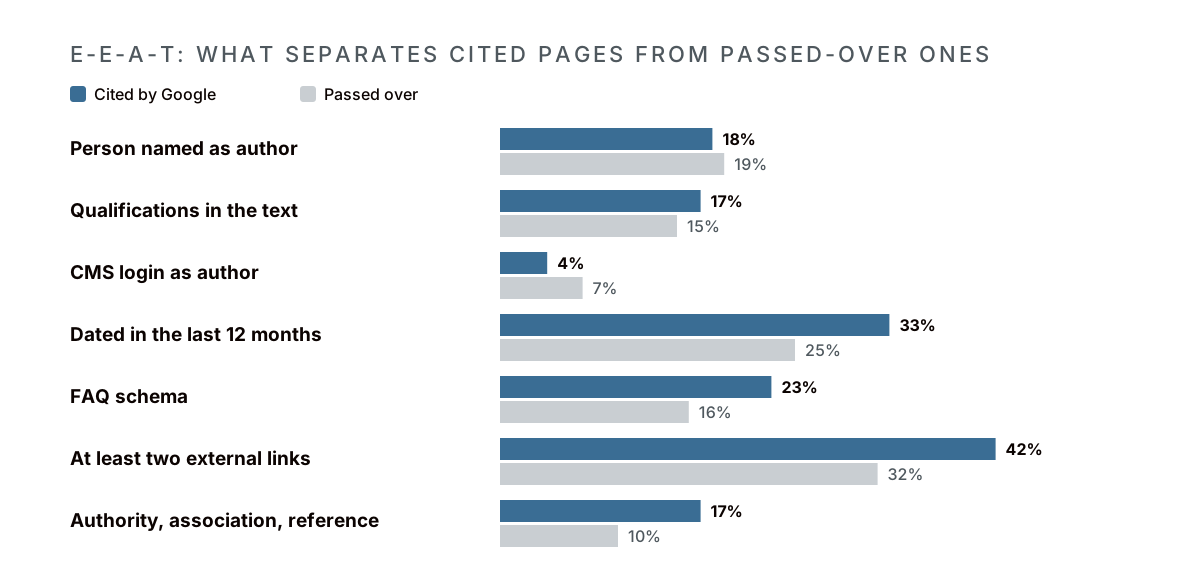
| Signal on the page | Cited | Passed over | Within the same search |
|---|---|---|---|
| Person named as author | 18% | 19% | no difference |
| Qualifications in the text | 17% | 15% | no difference |
| Structured data present | 79% | 78% | no difference |
| Legal notice linked | 81% | 83% | no difference |
| Company as author | 22% | 16% | trend: more often |
| CMS login as author | 4% | 7% | trend: less often |
| Dated in the last 12 months | 33% | 25% | trend: more often |
| FAQ schema | 23% | 16% | trend: more often |
| At least two external links | 42% | 32% | narrowly confirmed |
| Authority, association, reference | 17% | 10% | clear: about twice the chance |
The author box separates nothing
Four out of five cited pages name no person as author. That is only partly because many of them are service pages: even among blog articles and guides, only a third carried a name, equally often among cited and passed-over pages (33 percent).
A much larger study paints a similarly sobering picture. TJ Digital analysed 193,507 AI answers from AI Mode, AI Overviews and ChatGPT and found that pages with a byline even had 28 percent lower odds of being cited. The report does not know why and explicitly advises against removing names on that basis. So do we.
There is one trace of a pattern. On high-stakes topics, meaning health, law, money and real estate, 23 percent of cited pages carried a name, compared with 19 percent of passed-over pages. For moving, bathrooms, building services, IT and architecture it was the reverse, 12 versus 19 percent. That is too little for a firm statement. The direction does fit Google's logic, though: the name counts where readers need to know who is speaking.
"admin" as an author is not a good sign
46 pages in our sample named a technical username as author: "admin", a company account ending in "_admin", an SEO agency's shorthand or an email address. Such pages made up 7 percent of passed-over pages and only 4 percent of cited ones. There are too few pages to confirm the difference, but the direction is plausible.
Nobody is likely being penalised for this directly. A login in the author data is more a sign of a website nobody looks after. It is, however, the cheapest fix in this entire article, and it answers exactly the question Google asks: who created this? A company as author even does slightly better, at 22 versus 16 percent. Better an honest company name than a login.
The sender counts more than the packaging
The clearest result concerns the A. Authorities, associations and reference works made up 17 percent of cited pages but only 10 percent of passed-over pages. Within the same search, that means about twice the chance of a citation. Associations alone reached 6 versus 1.5 percent, though on only 12 and 8 pages.
This fits the well-known Ahrefs analysis of 75,000 brands: the strongest correlation with mentions in AI Overviews was with mentions of the brand on the web (0.664), while backlinks were far lower (0.218). Authority evidently arises where others talk about you.
You will not become a government office. But you can appear where such publishers write, and within your narrow specialty you can be the source everybody else links to.
Maintained pages and sourced claims
Across all pages, three further signals are ahead: a machine-readable date from the last twelve months (33 versus 25 percent), at least two links to other websites (42 versus 32 percent) and FAQ schema (23 versus 16 percent). Only the links are narrowly statistically confirmed.
It shows most clearly where it matters most, on guides and blog articles. Of those cited, 48 percent were dated within the last year, versus 37 percent of those passed over. Two or more external links: 43 versus 32 percent. FAQ schema: 30 versus 17 percent. All three differences hold within the same search. On provider websites, recent pages also had an advantage (40 versus 28 percent). TJ Digital also found a clear link for recency, and FAQs fit our Zurich AI visibility study.
Caution is warranted with FAQ schema: Google explicitly does not require any special markup for this. More plausibly, pages with real questions and clear answers are easier to cite. The schema is then more a side effect than a cause.
What separates nothing
Structured data as such (79 and 78 percent), a legal notice (81 and 83 percent), qualifications in the text (17 and 15 percent): no measurable difference here. That only means these things do not decide who stands out from the field. A legal notice wins no citations. If it is missing, though, visitors rightly wonder who is behind the site.
How to implement E-E-A-T, in this order
Sorted by impact per effort, from a ten-minute fix to work over months.
- Replace logins shown as authors. Check your posts and schema for "admin", shorthand and agency accounts. Use a real person or the company name.
- Genuinely update important pages. Prices, deadlines, laws, examples. Change the date when the content has changed. A new date above an old text is exactly the kind of deception Trust is about.
- Back up claims. Link to the law, federal office, association or study at the point where you rely on it. That helps readers, and assistants find the evidence along with it.
- Answer questions people actually ask. Collect them from sales and advisory conversations and write clear answers right below the question.
- Show experience nobody can copy. Your own cases with figures, photos of real projects, what went wrong and what it cost. No script reliably detects this, our measurement included. But it is the only item on this list your competitors cannot simply rebuild.
- Say who is behind it. Team with education, career and focus areas, complete company details, the same address everywhere. On guides and wherever readers expect it, a real author with their own profile page. Google explicitly encourages this and warns against deceptive authorship.
- Appear where your industry looks things up. Association directory, article in trade media, talk at a university, data that others want to quote. What that looks like in practice is covered in our article on digital PR for AI visibility.
- Measure. Rankings alone do not show whether you are being named. How to set this up properly is covered in measuring AI visibility.
The role these signals play alongside lists, reviews and model memory when it comes to a specific recommendation is described in How do I get recommended by ChatGPT?
The Swiss special case: when professional rules have a say
Much E-E-A-T advice comes from the US and revolves around patient testimonials and star ratings. That is a poor fit for doctors in Switzerland. Annex 2 of the FMH code of conduct excludes patient testimonials on a practice's own website, and patients must not be influenced to obtain reviews.
What is permitted are exactly the things that demonstrate expertise: professional qualifications, career history, languages, consultation hours, services and professional articles. Dentists follow the SSO code of conduct. In regulated professions, check first what your professional rules allow before adopting a checklist from the internet.
E-E-A-T and AI-written text
Google has taken a clear position: quality is what counts, regardless of how a text was created. Its guidance on generative AI calls for manually checking AI content for accuracy and trustworthiness before publication. Anyone generating many pages without added value risks violating the spam policies, which also explicitly cover manipulating generative AI responses in Google Search. Disclosing AI use makes sense where readers would wonder how the content was created.
The first E remains the limit. A language model can imitate expertise well, and authority can at least be claimed. It has no experience. If your text could have been written without your company, that is the letter that is missing. How we build experience into the production process is described in the SEO content engine.
Checklist: 12 points for E-E-A-T
Sorted by impact per effort, derived from Google's guidelines and our measurement.
How we implement it
As an SEO agency in Switzerland and GEO agency from Zurich, we help companies appear as a reliable source in Google and in AI answers. We check author information, schema, recency and evidence, write the missing content together with your specialists and build your presence with third parties. Your webmaster does not have to do anything. We implement it ourselves, and quickly.
Conclusion
E-E-A-T is not a plugin. The author box belongs on a guide because readers want to know who is writing. It does not win citations on its own. In our data, other things stand out: who is speaking, whether someone looks after the page, whether claims are sourced. Start with the login today. The work will end where it always has: with a company other people choose to talk about.
Not sure where your website stands today? The AI visibility check is free. Or let's talk.
Sources
- Our own Hierarchy measurement: 84 searches, 12 industries, location City of Zurich, desktop, two runs on 25 October 2026; 760 pages retrieved, 739 analysed excluding forums, retrieved on 10 November 2026.
- Google: Search Quality Evaluator Guidelines, September 2025 edition.
- Google: Creating helpful, reliable, people-first content
- Google: AI features and your website
- Google: Using generative AI content
- Google: Spam policies
- TJ Digital: 2026 AI Citation Study: 193,507 AI answers, August to October 2026. The firm itself sells SEO and GEO services, as we do.
- Ahrefs: An Analysis of AI Overview Brand Visibility Factors: 75,000 brands, Spearman correlation.
- Hierarchy: AI Visibility Study Zurich 2026

About the author