Contents
A new medical practice fills up when it appears where people search today: in Google Maps, in Google Search, in the answers of ChatGPT and Gemini, on booking portals and with the colleagues who refer. A complete Google Business Profile works fastest. In the long run, the practice is carried by SEO, a website that ranks on Google for specialty and location, and by GEO, clear information that AI assistants quote. This article answers the questions doctors ask us most often after opening or taking over a practice, shows which decisions matter first, and explains why you do not need to hire anyone for it.
Anyone opening or taking over a practice has plenty to do: the cantonal licence to practise, the ZSR number, the lease, practice software, staff, financing. Marketing usually comes last on that list. Understandable, but expensive: every week the practice cannot be found online, appointment slots stay empty while rent and salaries still have to be paid.
The essentials: five decisions that matter
- Start early. Eight to twelve weeks before opening, not on the first day.
- Google Maps first. The Google Business Profile brings the fastest calls and is a main source for Google AI Mode.
- The website as the foundation. One page per treatment, in full sentences, with specialty and location. SEO and GEO build on it.
- Ads as a bridge. Google Ads bring patients from day one until organic visibility takes over.
- Have it done instead of hiring. A specialised agency does more than a single marketing person and costs a fraction.
Everything is measured by two numbers: new patients per month and what a new patient costs. Not clicks, likes or visitors.
How do new patients find my medical practice?
Through five channels, and a new practice should serve all five from the start:
- Google Maps. For searches like "GP near me", the map view with three practices often appears above all other results. It is based on the Google Business Profile.
- Google Search. "Hausarzt Zürich" (GP Zurich) is searched around 1,300 times a month, "Dermatologe Zürich" around 3,600 times, "Frauenarzt Zürich" (gynaecologist) around 1,600 times. On top of that come searches for symptoms, treatments and neighbourhoods.
- AI assistants. More and more people ask ChatGPT, Gemini or Google's AI Mode directly: "Which GP in Oerlikon is still accepting new patients?" The answer contains only a few names.
- Booking portals and directories. OneDoc, the FMH doctor directory, local.ch, search.ch and your specialist society. In our measurement for ophthalmologists, OneDoc appeared in 10 of 32 AI answers.
- Referrals. Often the most important channel for specialists. GP practices in the area need to know that you exist, what you treat and how quickly you give appointments.
The first four channels depend on the same information: specialty, specialist title, location, consultation hours, languages and whether you accept new patients. If it is identical everywhere and written as full sentences online, Google, Maps and the assistants will find your practice.
What do I need to do before opening my medical practice so patients can find me?
New practices lose the most when they wait until opening day to start marketing. A Google profile has to be verified, a website takes a few weeks, and Google needs time to index new pages. This sequence has proven itself:
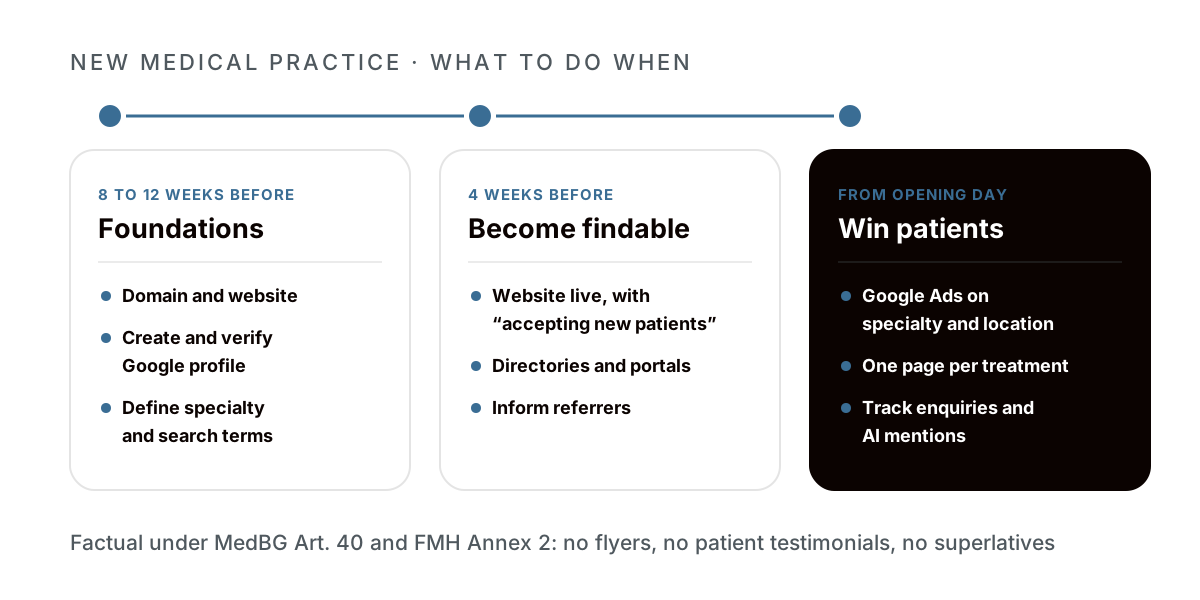
| When | What | Why |
|---|---|---|
| 8 to 12 weeks before | Secure the domain, commission the website, create and verify the Google Business Profile | Verification and indexing by Google take time |
| 8 to 12 weeks before | Define specialty, focus areas and search terms | Page structure, Maps category and ads depend on them |
| 4 weeks before | Website live, with opening date and a note that new patients are accepted | First enquiries and bookings before the start |
| 4 weeks before | Listings on OneDoc, the FMH directory, local.ch, search.ch and your specialist society, written the same way everywhere | Consistent details are the basis for Maps and AI |
| 4 weeks before | Inform referring practices in the region, with focus areas and appointment availability | Referrals are the fastest channel for specialist practices |
| From opening day | Google Ads on specialty plus location | Immediate visibility until organic rankings take over |
| First 3 months | One page per treatment or condition, tracking of calls and appointments | Long-term visibility on Google and in AI answers |
How do I optimise my medical practice for Google Maps?
For a new practice, the Google Business Profile is the single most important lever. It appears in Maps and in the map view of Search, and it is a main source for Google's AI answers, especially in Google AI Mode. In our measurement on aesthetic medicine, Google AI Mode relied on Google Maps data for 7 of 8 questions. The clinics it suggested had a median of 4.9 stars and 103 reviews.
Google ranks local results by three criteria: relevance (does the profile match the search?), distance (how close is the practice?) and prominence (how well known is it online and offline?). You cannot change distance, but you can change the other two:
- The right primary category. The most precise category for your specialty, such as "General practitioner", "Dermatologist" or "Pediatrician", plus suitable secondary categories. The primary category is the strongest relevance signal.
- Complete information. Consultation hours including public holidays and vacations, services, languages, accessibility, parking, website and a booking link, for example to your OneDoc calendar.
- The real practice name. No search terms in the name such as "GP Zurich Practice Muster". That violates Google's guidelines and can get the profile suspended.
- Photos. Entrance, reception, waiting room, team. Patients want to see where they are going.
- Identical details everywhere. Name, address and phone number exactly the same on your website, Google, OneDoc, local.ch, search.ch and the FMH directory. Inconsistencies weaken prominence.
- Keep it current. Add new doctors, changed hours or holiday cover immediately. A profile with wrong hours costs trust and calls.
What does my medical practice's website need to rank on Google?
A portal profile is a good additional listing, but it does not belong to you, it shows other practices next to yours, and it answers only a few questions. Your own website is the foundation for SEO and GEO. In our measurement for ophthalmologists, 63 percent of the sources AI assistants cited were websites of practices and clinics, seven in ten of them subpages on individual topics.
What matters for SEO for a practice:
- One page per treatment or condition. Not all services as a keyword list on one page, but one page each with symptoms, assessment, procedure, risks, aftercare and insurance coverage. Such pages rank for the specific questions patients ask.
- Specialty and location in titles and text. "GP practice in Zurich Oerlikon" instead of "Welcome". Add neighbourhood, nearest stop and accessibility as text.
- Patient questions on the home page. Are you accepting new patients? How soon is an appointment available? Is a referral needed? Which insurance models, such as GP or telemedicine models? What to do in an emergency? Which languages?
- Structured data. A Physician or MedicalClinic schema and FAQ markup, so Google and AI can attribute the information reliably.
- Technology. Fast, flawless on mobile, phone number and booking immediately reachable, clean internal linking.
- Tracking without health data. Google Analytics 4, Search Console and Tag Manager, without capturing form contents.
The medical sign-off of every page stays with you. SEO takes a few months, but then works permanently and without click costs.
How do I get ChatGPT, Gemini and Google AI Mode to recommend my medical practice?
That is the job of GEO, Generative Engine Optimization. AI assistants name practices about which they find clear and consistent information from several sources. In our measurement for ophthalmologists, 7 of 24 mentions for the short-notice appointment question went to single-handed practices, and the most common reason given was that the practice accepts new patients. For a new practice, that is an opportunity: many established practices are full, and a practice that clearly states it is accepting new patients answers exactly the question being asked.
What GEO means for a practice:
- Quotable sentences. "The Muster GP practice in Oerlikon is accepting new patients, with appointments usually available within a week." An assistant can take over a sentence like that, but not an icon.
- The same facts everywhere. Website, Google profile, OneDoc, directories and specialist society must say the same thing. Contradictions make the assistants cautious.
- Third-party sources. Portal and directory listings, a profile with your specialist society, a factual report in the local press about the opening. Assistants do not rely on your own website alone.
- Measure regularly. Ask ChatGPT, Gemini and Google AI Mode the same patient questions every month and record whether and why your practice is named. How to set that up is covered in Measuring AI visibility.
How we measure and implement this for doctors is described on the page SEO for medical practices.
I have taken over a medical practice: what happens to the Google profile, website and phone number?
The key principle for a takeover: take over, do not start from scratch. The existing practice has built up visibility, and it should not be lost.
- Google Business Profile. Have yourself added as the owner instead of creating a second profile. Reviews, photos and the position in Maps belong to the existing listing. Two profiles for the same address harm both.
- Phone number. Keep it if possible. It is on prescriptions, referrals, in directories and in patients' memories.
- Domain and website. Take over the domain contractually. If the website is rebuilt, redirect every old address to the matching new page, or existing rankings are lost.
- Practice name. If it changes, update it everywhere at once: website, Google profile, portals, directories. Different names confuse Google and the assistants.
- Communicate the succession. State factually on the home page who has been running the practice since when, what stays the same, such as team, address and consultation hours, and that new patients are welcome.
- Existing patients. Patient records are subject to professional secrecy. How they are handed over and how existing patients learn about the succession is governed by the takeover contract. Clarify this with your cantonal medical association or a legal professional before patient data is used for a letter. A later newsletter to your own patients requires their consent under FMH rules.
- Referring practices. Under FMH rules, a circular to colleagues may contain more than information for patients, such as focus areas, equipment and appointment availability. Use that.
Am I allowed to advertise my medical practice?
Yes, if it is factual. Art. 40(d) of the Medical Professions Act requires advertising to be objective, meet a public need and be neither misleading nor intrusive. For FMH members, Annex 2 of the Code of Professional Conduct sets out what that means.
| Allowed and useful | Not allowed |
|---|---|
| Professional qualifications, specialist title, career | Patient testimonials on your own website |
| Languages, consultation hours, home visits | Influencing patients to get reviews |
| Accepting new patients | Self-promotion, such as "the best GP in Zurich" |
| Group practice, cooperation, insurance models | Comparisons with colleagues |
| Services such as X-ray, lab or physiotherapy | Statements that raise unjustified expectations |
| Website, directories, search engines, social networks | Flyers, unaddressed mailings and mass emails |
Two points surprise many doctors: the classic flyer in the neighbourhood letterboxes is not permitted for FMH members. And circulars or newsletters to your own patients are only allowed with their consent. Cantonal medical associations can issue additional rules.
The useful part: exactly the permitted information is what Google and AI assistants quote. For a medical practice, factual information is not a compromise but the best marketing.
Are Google Ads worth it for a new medical practice?
For the start, usually yes. A new website does not rank for "GP" plus your town from day one. Ads bridge that period and bring calls and bookings from the first day. They are not cheap: Google estimates a click on "Augenarzt Zürich" (ophthalmologist Zurich) at around USD 16 and on "Dermatologe Zürich" at around USD 10. That is why ads always need a page that matches the search term and tracking of which clicks turn into appointments. The same professional rules apply to ad copy as to the website: specialty, location, consultation hours and accepting new patients, no superlatives. Once SEO and Maps carry the practice, the budget can be reduced.
What should my medical practice focus on first?
Not every practice needs everything at once. The right order depends on how strong demand is and how much competition there is:
| Your situation | First | Then | Less important |
|---|---|---|---|
| GP practice in a region with few doctors | Google Maps, website saying "accepting new patients" | Directories, GEO | Ads, the demand is already there |
| Specialist practice in a city with lots of competition | Website with one page per treatment (SEO), Google Ads | Maps, GEO, referrers | General image campaigns |
| Takeover of an established practice | Take over profile, number and domain, communicate the succession | Expand SEO, GEO | A new practice name without need |
| Practice with self-pay services, such as aesthetics | SEO per treatment, Google Ads | Maps, GEO | Discount campaigns that quickly look pushy |
Three questions help with every decision:
- Does it measurably bring new patients? If that cannot be shown after three months, stop or rebuild it.
- Do I own the result? Website, domain, Google profile, content and ad accounts must be in the practice's name, not a service provider's.
- Is it compatible with professional rules? If in doubt, do not do it, or ask your cantonal medical association.
How long until my new medical practice is full?
That depends on specialty, region and competition, and anyone who promises you a fixed number is guessing. What can be said: the Google profile and ads work from day one. Organic rankings and AI mentions build up over several months. And in specialties and regions where patients wait a long time for an appointment, a practice that is easy to find fills up much faster.
Should I hire a marketing person for my medical practice?
We hear this question almost every time, and for a single-handed or group practice the answer is usually no. Not because marketing is unimportant, but because a hire is the most expensive and at the same time the weakest solution.
What a marketing position costs. According to Lohncheck, a marketing manager in Switzerland earns a median of around CHF 84,000 gross a year. Add employer contributions to AHV, IV, EO, unemployment insurance, pension fund, accident insurance and family allowance fund, as a rule of thumb 15 to 20 percent. Then a workplace, software for SEO, ads, design and tracking, training and recruitment. Together that quickly comes to around CHF 100,000 a year, before a single franc has gone into ads.
What one person cannot do alone. Winning patients takes web development, copywriting, SEO, GEO, Google Maps, Google Ads and clean tracking. One person is strong in two of these areas and a beginner in the others. Add holidays, illness and resignations, and the knowledge leaves with the person.
And the medical practice assistant who does it on the side? The MPA has enough to do at reception, in the lab and on the phone. Marketing on the side means, in practice, that it happens when there is time, which is rarely. And the expertise to run ads or SEO profitably is missing.
| Specialised agency like Hierarchy | Marketing hire | |
|---|---|---|
| Cost per year | a fraction of a hire | around CHF 100,000 with contributions and tools |
| Expertise | specialists for website, SEO, GEO, Maps, ads and tracking | one person, one or two strengths |
| Holidays or resignation | keeps running | standstill, knowledge is lost |
| Tools and software | included | paid on top |
| Management and control | monthly report with enquiries and appointments | by you, without marketing expertise |
| Notice | no minimum term, cancel any time | notice periods under employment law |
A specialised agency brings together the specialists for each of these areas at a fraction of the cost of a hire. And it has a clear incentive: it only remains your partner as long as it brings you new patients. Which models exist in general and what stays in-house is covered in Marketing without an in-house team.
What should I look for in an agency for my medical practice?
Ask these questions in the first meeting:
- Do you know the professional rules? Anyone who suggests a review campaign, patient testimonials on the website or flyers does not know the FMH rules.
- Do you implement yourselves? Website, copy, Google profile, directories and ads, without your team or webmaster having to do anything.
- Do you measure AI visibility? Anyone who reports only Google rankings cannot see whether ChatGPT, Gemini and Google AI Mode name your practice.
- What do you report? New patients and appointments, not impressions and clicks.
- Who owns the accounts and content? The answer must be: you.
- How long am I tied in? Long minimum terms are a warning sign. A partner who delivers results does not need them.
How much of my own time does it take as a doctor?
Less than many fear. In the first month, one in-depth conversation about specialty, focus areas, patients and goals, plus access and the medical sign-off of the first texts. After that, usually one to two hours a month: approvals, a short look at the monthly report and the occasional specialist question. The medical responsibility for content stays with you, the implementation does not.
Checklist: 12 points for launching your medical practice
From the Google profile through the website to the monthly AI check, as a list to tick off.
How we support new medical practices
Hierarchy is a full-funnel agency in Zurich, as an SEO and GEO agency specialised in SEO, GEO and paid ads. For new and acquired medical practices we take care of everything that brings new patients: website and pages per treatment, Google Business Profile and Maps, directories, Google Ads and the monthly tracking of appointments and AI mentions. You approve, we implement, your webmaster does not have to do anything. There is no minimum term, and accounts, data and content belong to you. Yan Yu, a physician, advises us on medical and practice-related questions.
Services and approach are described on the page SEO and GEO for medical practices. Whether ChatGPT, Gemini and Google AI Mode name your practice today is shown by the free AI visibility check.
Conclusion
A new medical practice fills up when it can be found from day one where patients search, and when it clearly says everywhere that it is accepting new patients. Start eight to twelve weeks before opening, make the Google profile your first priority, build the website as the foundation for SEO and GEO, and bridge the first months with ads. You do not need your own marketing position for this. A specialised partner does more, costs less and has an interest in filling your schedule.
Sources
- Medical Professions Act (MedBG), Art. 40(d): fedlex.admin.ch
- FMH, Annex 2 to the Code of Professional Conduct, guidelines "Information and Advertising", revision June 2023 (German): fmh.ch
- Google, tips to improve your local ranking: support.google.com
- Lohncheck, marketing manager salary Switzerland 2026: lohncheck.ch
- Search volumes and click prices: Google Ads Keyword Planner, Switzerland, 9 November 2026
- AI measurements: our own analyses of ophthalmologists and aesthetic medicine in Zurich, November 2026

About the author