Contents
An SME without a marketing team does not need a marketing plan with twenty channels. It needs a partner who reliably handles the few things that work: a website that clearly says what you do and for whom, a well-kept Google Business Profile, visibility on Google and in AI answers, and measurement that counts enquiries rather than likes. Almost all of it can be outsourced. What has to stay in-house are decisions, approvals and your expertise, and that usually takes one to two hours a month.
Many owners and managing directors know the situation: business comes through referrals, the website is a few years old, someone set up the Google profile once, and marketing happens when there is time. Which is rarely. At the same time, more and more customers first ask ChatGPT, Gemini or Google's AI Mode for a provider and get a short list of names. If you are not on it, you never get the enquiry.
This article covers what an SME without its own marketing really needs, what can be outsourced, which models exist and how to steer a partner with little time. How to then choose a specific agency is covered in Choosing a marketing agency.
What an SME without a marketing team really needs
For most small businesses, new enquiries are decided in a few places. This order usually pays off:
- A website that answers in its first paragraphs: Who are you, what do you offer, for whom, where and roughly at what price? Customers read exactly these sentences first, and AI assistants build their description of your company from exactly such sentences.
- A well-kept Google Business Profile: correct categories, opening hours, photos, services and a steady flow of new reviews. For local providers, this is often the very first contact.
- SEO for your core services: one page per service that Google finds for the terms your customers search for.
- AI visibility: In our study of 1,515 analysed AI answers, 58 percent of mentions did not come from the named company's own website but from third-party sources or from the models' memory. Entries in directories, best-of lists and industry portals are therefore part of the job. How assistants choose companies is covered in How do I get recommended by ChatGPT?.
- Ads where demand already exists: for example Google Ads on search terms where customers are already looking for a provider. Useful if you need enquiries quickly or organic visibility is still missing.
- A simple channel to existing customers: a newsletter or a regular mailing, so existing customers come back and recommend you.
- Measuring enquiries: counting forms, calls and emails and knowing where they come from. Without that number, nothing can be steered.
Not everything has to happen at once. A good partner tells you which two or three points will work first for you, instead of selling all seven at the same time.
What you can outsource and what stays in-house
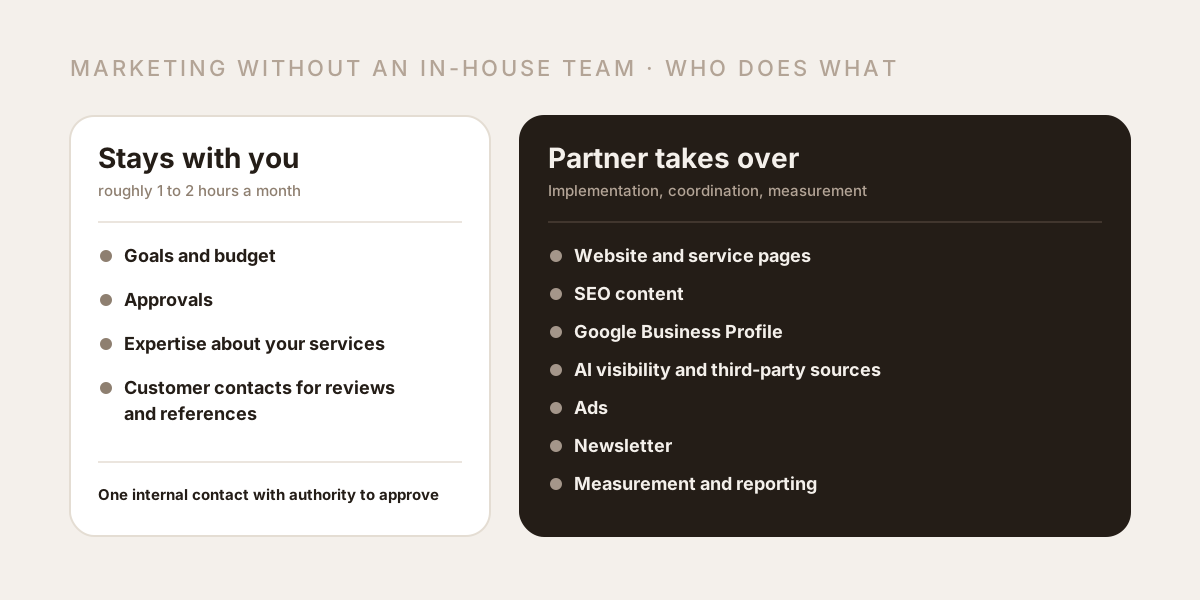
| Task | Outsource? | What you contribute |
|---|---|---|
| Website and service pages | yes | Facts about services and prices, approval |
| SEO content | yes | Expertise in a short conversation, approval |
| Google Business Profile | yes | Photos, input on sensitive reviews |
| Collecting reviews | partly | Asking customers, the partner provides templates and links |
| AI visibility and third-party sources | yes | Approving entries and profiles |
| Ads | yes | Budget, offer, feedback on the quality of enquiries |
| Newsletter | yes | Topic ideas, customer list, approval |
| Customer stories and references | partly | Contacts and customer consent |
| Goals, budget, priorities | no | Decisions |
What matters most is a fixed internal contact. This does not have to be a marketing specialist; often it is the managing director or someone from administration. They need roughly one to two hours a month and the authority to approve texts. Without this person, every approval waits for weeks and the partner works in a vacuum.
Four models compared
Anyone who wants to outsource marketing usually ends up with one of four models:
| Freelancer | Agency on retainer or flat rate | Done-for-you package | Part-time marketing lead | |
|---|---|---|---|---|
| What you get | One person for one or a few channels | A team for an agreed scope, billed monthly | A package with a fixed scope, implementation entirely with the partner | An experienced person who takes on marketing leadership a few days a month |
| Strengths | Direct contact, flexible, often affordable | Several disciplines, cover during absences | Clear scope, little coordination for you | Strategy and steering in-house, coordinates other providers |
| Limits | Rarely covers all channels, absence risk, coordination stays with you | Scope must be clearly defined, otherwise every extra is billed | Only fits if the package matches your goals | Usually does not implement, needs implementers on top |
| Fits when | One channel is the priority and you keep the overview | Several channels need ongoing care | You want as little effort as possible and priorities are clear | A larger budget spans several providers |
The lines between the models are blurred. Many agencies offer packages, some freelancers work in networks. The deciding question is not the label but: who carries overall responsibility, and who coordinates when several channels work together? Without your own team, the answer should not be "you".
Marketing flat rate: what to check
"Marketing flat rate" sounds like all-inclusive at a fixed price. It usually means a fixed monthly price for a defined scope. That can work well if these points are agreed in writing:
- Scope: How many content pieces, which channels, how many hours or meetings per month? What counts as extra work?
- Minimum term and notice period: How long are you committed, and what happens to ongoing work if you cancel?
- Ad budget: Is the budget for Google Ads or Meta included in the price or on top? Is it paid directly to the platform?
- Accounts: Google Ads, Google Analytics, Google Business Profile, domain, website and newsletter tool should be in your company's name. The partner gets access, not ownership.
- Content and data: Do texts, images, campaigns and reports belong to you, including after the contract ends?
- Reporting: Which figures come every month, and does the report cover enquiries or only reach?
- Handover: What do you get when the collaboration ends? Access, files, documentation?
These points are not a matter of distrust but of hygiene. A reputable partner answers them in the first meeting without hesitation.
How to steer a partner with little time
Without a marketing team, there is also no time for long reports. These five rules keep the effort small:
- One goal, few figures: number of enquiries, cost per enquiry, visibility on Google and in AI answers. Likes, impressions and followers are side metrics, not goals.
- A one-page report and one short meeting a month: What was done, what did it bring, what comes next? Nothing more is needed.
- Clear approval rules: What may the partner change without asking (typos, photos, opening hours, for example), and what needs your approval (new pages, prices, campaigns)?
- Ask where customers come from: a field in the contact form or a question on the phone: "How did you hear about us?" Add "ChatGPT or another AI assistant" as an option. Many of these contacts otherwise show up in no statistics at all.
- Priorities per quarter: Once a quarter you decide together where the next three months go. In between, the partner works.
How to measure AI visibility in practice and what a management report looks like is covered in Measuring AI visibility.
The first 90 days
A realistic start looks roughly like this:
- Month 1, audit and foundations: review the website, Google profile, directories and AI visibility. Move accounts into your company's name, set up tracking for enquiries. One in-depth conversation in which the partner gets to know your services, customers and goals. Then a set of questions against which AI visibility will be measured from now on.
- Month 2, the most effective pages: rewrite the homepage and service pages, complete the Google Business Profile, add the key directory entries, publish the first content. If needed, a first campaign on search terms with clear purchase intent.
- Month 3, first measurement and plan: What has moved in enquiries, on Google and in AI answers? That becomes the plan for the next quarter.
On expectations: AI assistants with web search re-read a revised page the next time they retrieve it, so changes in their answers often show within weeks. On Google, competitive terms usually take months. Mentions from the models' memory take longest.
Done for you or do it with me?
For companies without a marketing team, done for you is the right model: the partner implements, you approve. The counterpart is do it with me, where an agency provides strategy, training and reviews and the in-house marketing team implements. That only pays off once two to five people internally already publish content themselves. Which providers work this way and how the division of work looks is covered in Managing AI visibility in-house.
The two models are not mutually exclusive. If you hire a marketing person later, you can switch from done for you to do it with me, and the work of the first months remains the foundation.
How Hierarchy does it
Hierarchy is a full-funnel marketing and AI agency in Zurich, specialised in SEO, GEO and paid ads. We have been around for more than ten years, and we are a team of four in which marketing and engineering sit together. For companies without their own marketing, we work on a done-for-you basis:
- Base, from CHF 900 a month: 1 to 2 SEO content pieces a month, technical optimisation, AI visibility monitoring with a compact prompt set, monthly reporting with clear priorities and two meetings a month.
- Growth, from CHF 1,500 a month: additionally more content, an extended prompt set, a competitor benchmark and GEO work in third-party sources.
- Worry-free, on request: completely done for you. We take care of everything and keep optimising, you only approve.
All prices exclude VAT and external media or placement costs. Details are on the SEO agency page. Ads on Google, Meta, TikTok and in ChatGPT are handled through Paid ads & growth marketing, and how all channels work together is described on the Marketing agency Zurich page. An overview of other agencies in Zurich is in The 5 best marketing agencies in Zurich.
Conclusion
Marketing without an in-house team works when three things are in place: a partner who implements and carries overall responsibility, an internal contact with one to two hours a month and a few figures that count enquiries. Before you start, clarify what exactly is included in the price and who owns accounts, data and content. Then your effort stays small and the work still gets done.
Where your company stands today is shown by the free AI visibility check: it checks whether ChatGPT, Gemini and Claude name your company and which competitors show up instead.

About the author