AI Course, AI Workshop or Certificate Programme: Which Format for Which Team?
Open course, in-house workshop or CAS: the three formats of AI training solve three different problems. How to tell which one is yours, what each actually delivers – and why the wrong format stays ineffective even when it is run well.
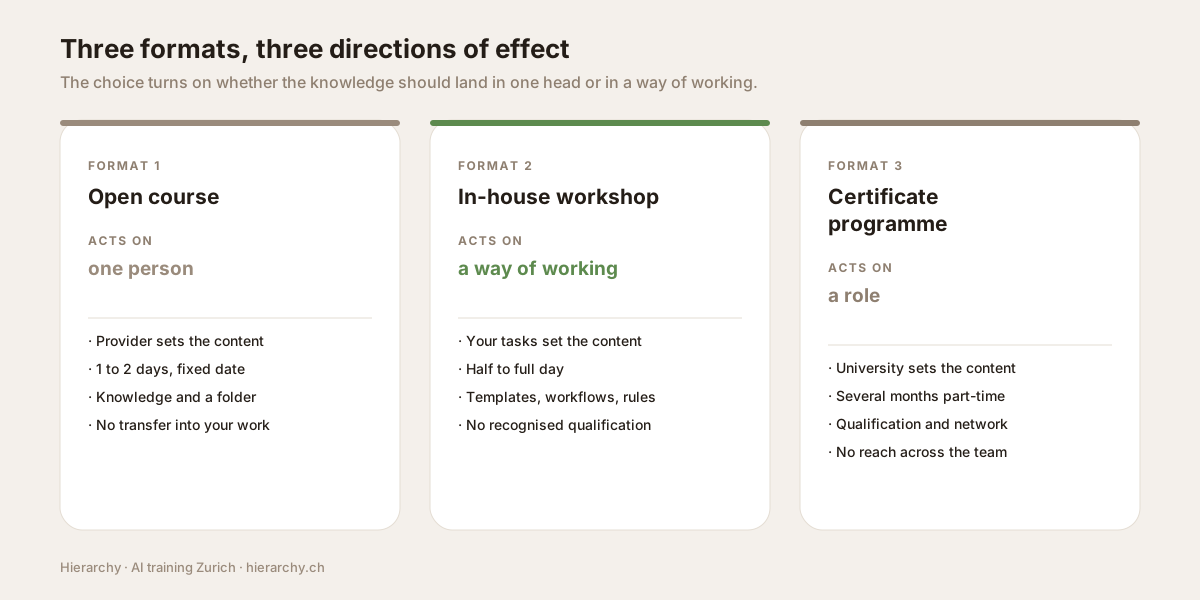
The three formats of AI training solve three different problems, and the most demanding one is rarely the most effective. An open course brings one person up to date. An in-house workshop changes how a team works. A certificate programme builds one person into a role. Book the wrong format and you get a well-run event with no effect — not because of the delivery, but because of the construction.
The most frequent enquiry that reaches us runs roughly: "we need something on AI for our team." Almost always the first useful answer is not a recommendation but a question back. Because three things sit side by side in this market, differing sharply in effort, duration and promise, and all going by the same words in search queries: course, training, workshop, continuing education, programme. The words have become interchangeable; the products behind them have not.
Three formats, three different purchases
| Open course | In-house workshop | Certificate programme | |
|---|---|---|---|
| Who books | one person, often themselves | the company | the person or the employer |
| Who sets the content | the provider | your tasks | the university |
| Who is in the room | strangers from many companies | your team | strangers with the same career goal |
| Typical duration | 1 to 2 days | half to full day, often as a series | several months alongside work |
| What exists at the end | knowledge and a course folder | templates, workflows, a data rule | a qualification and a network |
| What it does not deliver | transfer into your business | a recognised qualification | reach across the team |
The last row is the important one. Every format has a built-in weakness, and it cannot be trained away by better delivery — it follows from the construction. An open course can be excellent: it does not know your documents. An in-house workshop can land precisely: it does not issue a qualification that counts in an application. A programme can be demanding: it changes exactly one person.
Accept that and the choice is almost made. Refuse it and you buy one format while expecting the effect of another — the most common reason a well-run piece of training is remembered as a disappointment.
What "certificate" actually means in Switzerland
Before the choice itself, the vocabulary is worth a look, because three very different things carry the same word in this market.
The university levels are defined. CAS, DAS and MAS are not marketing terms but a graded system with a minimum size in ECTS credits. A CAS carries at least 10 credits, commonly 10 to 15. A DAS starts at 30, which at most institutions amounts to three combined CAS. A MAS starts at 60 and closes with a master's thesis. ECTS credits measure not classroom time but total workload including private study and assessment — roughly 25 to 30 hours per credit. A CAS is therefore not a long training course but around 280 to 300 hours of work across one semester.
The usual shape is alongside a job: about one study day per week over a semester, supplemented by one or more block weeks. At many institutions individual CAS certificates can be stacked into a DAS or MAS within three to five years — which takes the pressure off the decision, since nobody has to commit to two years on day one. Admission normally requires a university degree or equivalent plus professional experience; admission "sur dossier" without a formal degree is widespread.
The SVEB certificate is something other than many assume. It evidences adult-education methodology — planning, running and evaluating learning events — and explicitly not subject expertise. Someone who holds it can teach; whether they understand AI, it does not say. That is not a criticism of the certificate but a warning about a common misreading: in provider profiles it often sits right next to the AI topics and reads there like a subject qualification.
And everything else is unregulated. Outside the university levels, "certificate" is an unprotected term. A confirmation of attendance, a vendor certificate and a home-made diploma look identical in a screenshot. "AI trainer" is not a protected title either. For you this means a certificate is only a selection criterion when you know who issued it and for what — otherwise it is decoration, and you are better off judging the references and the preparation.
The open course: one person, one topic, a fixed date
An open course is a product. It has a curriculum that has to work for many people, a date already set, and participants from companies that do not know each other. That is exactly where its strength lies: it is available immediately, it is predictable, and nobody has to prepare it.
It fits when a single person needs a bounded topic — prompting, a specific tool, a cloud service, a vendor certification. It also fits when somebody wants a quick overview before an internal decision. And it fits as a run-up: one person attends, comes back with an assessment, and management then decides whether an in-house day makes sense. That sequence is underrated, because it makes the more expensive decision better informed.
It does not fit when the goal is "afterwards the team should work differently." That is not about the quality of the course. It is that the course has to work on examples everyone in the room can follow — which means other people's. Transferring that to your quotes, your briefings, your code stays homework, and nobody does homework after a full day of training.
Two things are worth asking when buying. First, the group size, and whether people work on their own machines or watch. Second, how old the material is — in this subject area, screenshots and menu paths go stale within months, and a course folder showing interfaces from the year before last is a reliable signal.
The in-house workshop: one team, its own tasks
The in-house workshop reverses the order. First you look at what eats the most time in the business, then the day is built around that. The examples are yours, the exercises run in your accounts, and what emerges stays: prompts, templates, two to four workflows that actually get used afterwards.
The real advantage, though, is social. When a team learns together, a shared vocabulary emerges and — more importantly — shared permission. The most common blocker in Swiss SMEs is not lack of skill but uncertainty about whether this is allowed: may I upload this document? what do I tell the client? That question cannot be answered in an open course, because the answer depends on your data and your rules. In an in-house workshop it is part of the programme.
On group size there is an honest answer and a comfortable one. The comfortable one would be a number with a research veneer. The honest one: for hands-on workshops, 6 to 14 people is a good range in practice, but robust research on an optimal group size in workplace training does not exist. What can be observed reliably is the tipping point: as soon as not everyone can be seen while practising, the room shifts from working to watching, and that happens closer to fifteen than to twelve.
Its price is preparation, on both sides. From us it demands a pre-call, sight of real documents and an alignment with IT about accounts and access. From you it demands that somebody names three workflows that should change. A workshop that was not prepared is an open course with your logo on it — and then you should have booked the open course.
The certificate programme: one person, one new role
A CAS is not a training course but an education. Months long, with assessments, ECTS credits and fellow students pursuing the same goal. What comes out of it is depth no single day can produce, and a network that often outlasts the material.
The question is who benefits. A programme is an investment in a person. If that person then takes on a defined role — internal point of contact, ownership of the AI policy, selection of tools — it adds up. If they return to the same seat as before, you have one very well-informed individual and an unchanged team.
A frequent budgeting error: the programme for one person is approved because it fits on one invoice and looks like continuing education, while a workshop for twelve people is filed as an "event". The effort is similar. The reach is not.
Two things should be settled before enrolment, and both are regularly forgotten. First, the absence: one study day per week across a semester is a real gap in the team, and it usually hits exactly the person who is needed anyway. Second, the role afterwards: if it is not clear before the start what this person will own in the building, there is no place for the learning to land. The programme is still good — it just works on the job market rather than at your company.
Count in hours, not only in invoices
The offers look differently expensive, and that impression almost always misleads, because the larger item never appears on the invoice: working time.
An open one-day course costs one person one to two working days plus travel. An in-house day costs your team half a day to a day — multiplied by the number of heads in the room, plus a few hours of preparation on your side. A CAS costs one person around 280 to 300 hours across a semester, spread over contact days, private study and assessments, and part of that inevitably falls into working time.
Lay the three side by side and it is immediately clear that the programme is not the big measure and the workshop the small one. The workshop ties up more people for a short time; the programme ties up one person for a long time. Those are two entirely different interventions in a business, and which one is bearable has little to do with the invoice total.
On funding, since it is regularly hoped for: education vouchers for individuals are governed at cantonal level in Switzerland and exist in only some cantons. Zurich is not among them. The federal continuing-education act is a framework law that funds basic skills and umbrella associations, not company training. For a business the ordinary route therefore remains: training paid for by the company is a business expense and is treated like any other — no special programme, but no obstacle either. Self-funded, job-related continuing education by a private individual is deductible against federal income tax up to a statutory maximum; ask your tax office for the current figure rather than taking it from an article.
Why the gap matters more than the length
Few findings in learning research have been replicated as often as this one: distributed practice beats massed practice. Several shorter units with gaps between them produce markedly better long-term retention than the same time in one block. This is not a marginal observation but one of the most stable effects in cognitive psychology.
For format selection that has an inconvenient consequence. The full day is popular because it is organisationally simple — one date, one room, one catering order. And that construction works against retention. Two half days three weeks apart are organisationally more annoying and more effective, and the reason is not only the gap: real questions arise in between. At the second session they come out of people's own work rather than out of the programme, and that is the point where a workshop stops being a demonstration.
The related classic, the forgetting curve, is often shown in training material with precise percentages. The basic shape holds — the steepest drop comes early, then it flattens — but the exact figures should not be carried over: they come from an 1885 experiment with a single subject and nonsense syllables. That meaningful material is forgotten along the same curve does not follow from it. What does follow is the practical rule: repetition in the first days after training is worth more than any extension of the training day.
The four levels you could measure on
The most common framework for the effect of training has four levels: reaction — how did participants find it? learning — was the intended material actually learned? behaviour — is it applied at work? results — does anything change in the business as a consequence?
Nearly all training is evaluated at level one, because that is where the feedback form sits. After a well-run day it is almost always good, and it says precisely nothing about levels three and four. A provider who only shows satisfaction scores is showing you what is easiest to measure.
The gap between level two and level three has its own name in organisational psychology — the transfer problem — and has been the core topic of research into workplace training for decades. What comes out of it reliably: whether learning gets applied depends at least as much on the work environment after the training as on the training itself. Opportunity to apply it, support from managers, and somewhere to direct questions matter more than the quality of the training day.
One number that circulates constantly in this context should be struck out: that only around ten per cent of what is learned reaches the workplace. It can be traced back to an opinion piece from 1982, where it appeared as a rhetorical question, with no data and no methodology. That transfer losses are substantial is uncontested; the specific percentage was invented and has been travelling through sales decks ever since.
In practice: fix two or three workflows before the training as the things you will check at level three, and put the review date in the calendar straight away. Without that, even the best training gets judged at level one.
The one question that decides the format
It is not "how much budget do we have?" but: is our bottleneck knowledge or way of working?
If nobody in the business knows what a language model can do at all, the bottleneck is knowledge. Then a course or a short foundations block is enough to start with, and it is quick to arrange.
If everyone roughly knows, some use it privately, and yet no workflow in the business runs differently than it did two years ago — then the bottleneck is the way of working. That is the more common case, and it cannot be fixed by transferring knowledge. More courses do not make the problem smaller; they make it better informed.
A second test, quick to run: can one person implement the outcome alone? If yes, send that person. If no — because a new workflow passes through three pairs of hands, because a rule has to apply to everyone, because somebody has to approve — then the group that carries the workflow has to be in the room.
A third, quicker still: who is asking? If the wish comes from an individual who wants to get ahead, it is a course or a programme. If it comes from management because "we have to do something about this", it is almost always an in-house workshop — and the real work starts one level earlier, with the question of which work gets changed first.
What the EU AI Act requires — and what it does not
Because the question comes up in every second pre-call: Article 4 of the EU AI Act has required, since February 2025, that providers and deployers of AI systems ensure a sufficient level of AI literacy among the people operating those systems on their behalf. "Deployer" here includes an ordinary company using AI tools in its operations, not just the makers.
Three things matter about it. First, it is a best-efforts obligation: you are to take appropriate measures, not guarantee a particular level of competence. Second, it prescribes no format and no certificate — an in-house workshop satisfies it as well as an open course, as long as the content matches actual use. Third, it requires no documentation of its own.
Which is exactly why the attendance list is still worth keeping. It costs nothing and is the only evidence you have should the question ever be asked. For Swiss businesses the obvious qualifier applies: reach depends on EU nexus. A company with none stands on firm ground; a company serving EU clients should not assume it is automatically out of scope. The detail is in the EU AI Act for SMEs.
What none of the three formats delivers
No format replaces the decision about which work gets changed first. That is not a training question but a leadership question, and it cannot be delegated — not to us either.
No format replaces the rules for handling data. Training can explain what may go into which tool, but the decision belongs in the building and on paper; what a one-page internal AI policy looks like is covered in its own article.
No format replaces a tool that is set up. If participants still have no business account on the training day, they practise in an account they are not allowed to use afterwards — the most reliable way to make a good day pointless.
And no format works without a follow-up. The difference between a workshop everyone remembers fondly and one after which something is different lies almost entirely in the four weeks afterwards: a point of contact, and a date on which somebody checks what stuck. Why training otherwise evaporates we have described at length elsewhere.
The combination that most often works
In practice the most effective answer is rarely one of the three formats alone but an unspectacular sequence.
First one person goes to an open course, or gets up to speed some other way, so that somebody in the building knows the vocabulary and can assess offers. Then an in-house day for the group that actually carries the workflow, with three tasks named in advance and their own accounts. Three to four weeks later a second half day, where the questions come out of real work and the data rule gets written onto one page. And only once it becomes clear that one person should answer the internal questions permanently does the programme pay off for exactly that person — now with a role to return to.
That sequence costs no more than the reverse. It only makes sure the longest investment comes last, once you know what it is for.
Conclusion
Choose the format by direction of effect, not by price tag. One person who needs a topic: open course. A team whose work should change: in-house workshop. A person who should take on a new role: programme. The formats do not exclude one another, and the most effective combination is often the least spectacular — an in-house day for everyone, a programme for the one person who answers the questions afterwards.
How we build workshops and what goes home with people is on our AI training page. If the question is rather which work can be automated at all, the entry point is AI automation.
Frequently asked questions
- What is the difference between an AI course and an AI workshop?
- A course is openly bookable, has a fixed date and a fixed curriculum, and the participants come from different companies. A workshop is built for one specific team and works on that team's own tasks. The difference is not the duration but who sets the curriculum: in a course the provider, in a workshop your work. Everything else follows from that — the examples, the exercises, and the question of what stays in the building by the evening.
- Is a CAS in AI worth it?
- For a person who takes on a new role afterwards, yes. In Switzerland a CAS carries at least 10 ECTS credits, commonly 10 to 15 — roughly 280 to 300 hours of work across one semester, usually alongside a job with about one study day per week plus block weeks. That is an investment in a person, not in a team. It pays off when that person then owns AI internally. It does not pay off as a way to build a team's capability: the material does not walk back into the department by itself.
- What do ECTS credits mean for a CAS, DAS or MAS?
- ECTS credits measure workload, not classroom time — one credit corresponds to roughly 25 to 30 hours of work including private study and assessments. That produces the Swiss ladder: CAS from 10 ECTS, DAS from 30, MAS from 60 with a master's thesis at a total of around 1,800 hours. At most institutions individual CAS certificates can be stacked into a DAS or MAS within a window of three to five years.
- Is an SVEB certificate a qualification for AI training?
- No, and this gets confused regularly. The SVEB certificate evidences adult-education methodology: the ability to plan, run and evaluate learning events. It says nothing about subject expertise in any particular field and is not an AI qualification. It can make sense for someone without teaching background — as evidence that somebody understands AI, it is not useful.
- How many people should attend an AI workshop?
- For a workshop where people genuinely work at their own screens, 6 to 14 people works well. That is practical experience, not a proven optimum — there is no robust research establishing an ideal group size for workplace training. Below that the preparation effort rarely pays; above it, practising turns into watching. For larger workforces the answer is not a bigger workshop but a series.
- Open course or in-house workshop — which one adds up?
- An open course is billed per person, an in-house workshop per group. On arithmetic alone it tips at around three to five people depending on the provider. But the arithmetic misleads, because the formats deliver different things: a course for five people produces five informed people; a workshop for five people produces one changed workflow. Count in hours and in effect, not only in invoice totals.
- Does an AI workshop need a certificate?
- Only if somebody genuinely needs one. A certificate is evidence towards a third party — a future employer, an admissions office, a tender. For the internal record that training happened, a confirmation of attendance with date, content and participant list is enough. Anyone reading a certificate as a quality seal should know that outside the university qualifications, nobody defines what has to be on it.
- Can AI training be done online?
- For knowledge transfer yes, for ways of working only partly. Online works well when content is explained and demonstrated, and surprisingly well for distributed teams, because everyone sits at their own machine with their own data. It works poorly for the part that makes the difference: the conversations between exercises where somebody admits they have been doing something differently in secret for months.
- How long should a useful AI training session be?
- Half a day is enough for one topic and one role. A full day is enough for foundations plus two or three workflows that genuinely hold afterwards. Anything beyond that does not belong in a longer day but in a series with a gap in between: two half days three weeks apart achieve more than one full day, because people practise in between and the second session's questions come out of their own work.
- Which format satisfies the EU AI Act training obligation?
- Article 4 has required a sufficient level of AI literacy among staff since February 2025, but prescribes no format — not a course, not a workshop, not a programme, and no certificate. It is a best-efforts obligation with no mandated documentation. That is precisely why the attendance list is worth keeping: it is the cheapest evidence that something was done. What matters is that the content matches actual use in the business.
- Are there education vouchers in the canton of Zurich?
- No. Education vouchers for individuals are governed at cantonal level and exist in only some cantons — Zurich is not among them. The federal continuing-education act is a framework law that funds basic skills and umbrella associations, not company training. For a business the relevant fact is therefore ordinary deductibility as a business expense, not a funding programme.
- How do we know whether the training achieved anything?
- Not from the feedback form. That measures reaction, and after a well-run day it is almost always good. The informative levels are two steps up: behaviour — is a workflow genuinely running differently four weeks later? — and results — does it measurably save time or errors? Fix two or three concrete workflows before the training as the things you will check, otherwise nobody checks afterwards.

About the author
Tenzin Langdun
AI Expert & Marketing Lead at Hierarchy
Tenzin is an AI expert and marketing lead with an MSc in Artificial Intelligence from the University of Bath and over 10 years of marketing experience across strategy, paid acquisition, and SEO. He has held roles at leading organisations including KPMG, EY, Siemens, and Adnovum — with expertise in AI, cybersecurity, audit and consulting, and the insurance sector. Together with Martin Oswald, he co-authored an award-winning research paper on AI-based cancer detection, published in Nature and recognised with the National Siemens Excellence Award and the Lab Sciences Award.